Breckenridge in Wilkin County, Minnesota — The American Midwest (Upper Plains)
Breckenridge
⎯⎯⎯
Steamboats

October 25, 2024
1. Breckenridge / Steamboats Marker
Breckenridge Headwaters of the Red River of the North
Breckenridge, founded in 1857, has a current population of 3559 (2000 census). A progressive city, located at the juncture of three rivers, it is the gateway to the Red River Valley. The city boasts numerous residential subdivisions, many parks and playgrounds and a vibrant business district. The county seat of Wilkin County, its courthouse is on the National Register of Historic Places. Breckenridge is home to the Wilkin County Historical Museum filled with antiques and memorabilia tracing the communities past. It is also home to one-half of the unique Bois de Sioux golf course which is located in two states and joined by a bridge spanning the Red River. It has nine holes in Minnesota and nine holes in North Dakota. Recalling the cities past as a railroad village, the Great Northern Railroad Park has a restored caboose as well as a streetcar railway display. Summer outdoor activities include canoeing, camping and fishing. Winter activities include snowmobiling and ice fishing. The city hosts two exciting annual festivals; Breckenridge Headwaters Days and the Wilkin
this page online
Breckenridge, first a river town, then a railroad village and now an agricultural city, has a spirit all its own. Because of the resilient spirit of its people, even though burned, abandoned and flooded, Breckenridge always rises again, stronger than ever.
Steamboats And Oxcart Trails along the Red River
One of the more colorful eras in the history of the Red River Valley was provided by the steam powered paddle wheelers chuffing and churning the muddy waters of the Red. The arcane jargon of the steamboat captains, low water difficulties, bells and whistles all provided excitement to this early transportation system. As much as local investors and residents wanted to believe differently, the boats were never to be more than a temporary link in a changing

October 25, 2024
2. Breckenridge / Steamboats Marker (right)
In the 1850s, St. Paul and Fort Gary were the two largest settlements in the area. Minnesota merchants used horse or ox drawn Red River carts to ship goods for sale to their northern neighbors. The carts were cheap but slow as the 500 mile, one way, trip took a month. A steamboat on the Red could cut that time in half.
In 1859, Anson Northup dragged a steamboat's engine and boiler from the Mississippi River through a nasty Minnesota winter to the Red near Kragnes, Minnesota. He built a new steamboat and named it after himself. It wasn't much of a boat. One pilot called it a "lumbering old pine basket that had to be handled as gingerly as a hamper of eggs". The Hudson's Bay Fur Trading Company at Fort Garry built a steamboat terminal at Georgetown, Minnesota, to transfer furs and trade goods between ox carts and the boat, Soon trains of hundreds of carts were squeaking their way from St. Paul to meet the Anson Northup and the International, a second steamboat built at Georgetown in 1862.
In 1871, the Northern Pacific Railroad reached the Red River at Moorhead and steamboating expanded. Trade with Winnipeg

October 25, 2024
3. Breckenridge / Steamboats Marker
The steamboat era started its decline in the southern valley when the railroad reached Fisher's Landing on the Red Lake River, east of Grand Forks in 1876. Flatboats became the preferred method of river transportation. Built locally, they were piled high with goods, and slowly floated to Winnipeg. The goods were sold and the flatboats dismantled and sold for the lumber. By 1878, Winnipeg had its own rail connection and steam boating was soon abandoned for the faster and cheaper rail system.
While steamboats could not compete with the railroad there were new farmers along the Red with wheat that needed to be transported to the railhead. Steamboaters turned to short-hauling grain, lumber and other wares. In 1878, the huge Grandin bonanza wheat farm near Halstad, Minnesota, built the J.L. Grandin. It hauled wheat to their elevator in Fargo. Within a few years the railroad built branch lines up and down the banks of the Red and steamboating once again could not compete. Steamboats operated near Grand Forks until about 1910 but the
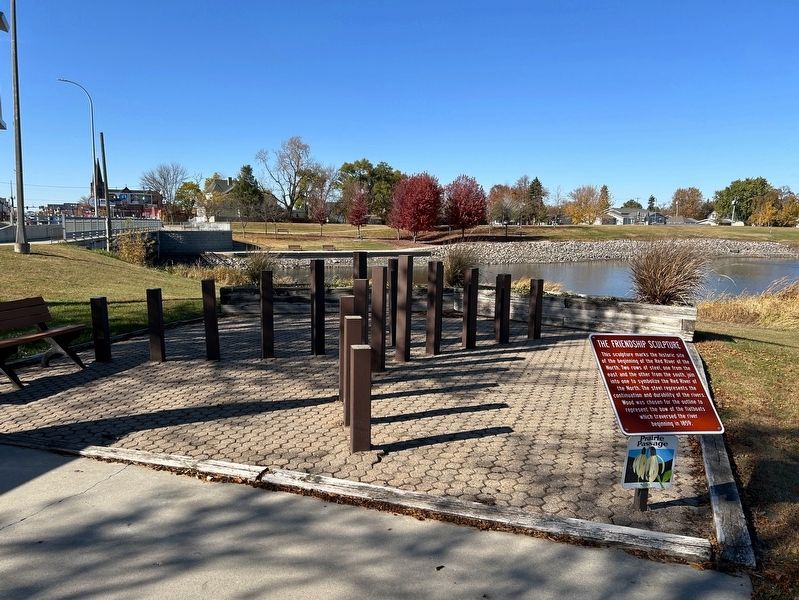
October 25, 2024
4. The Friendship Sculpture, nearby
"This sculpture marks the historic site of the beginning of the Red River of the North. Two rows of steel, one from the east and the other from the south, join into one to symbolize the Red River of the North. The steel represents the continuation and durability of the rivers. Wood was chosen for the outline to represent the bow of the flatboats which traversed the river beginning in 1859."
(Mark Peihl, Clay County Historical Society)
Captions:
Left to Right: Wildflowers on the banks of the Red. Camping and fishing. Kayaking on the Red. Turtles sunning. (Kelly Krabbenhoft, River Keepers, Kelly Krabbenhoft, Kelly Krabbenhoft)
Great Northern Railway caboose in Railroad Park, Breckenridge. Neoma Laken
Wilkin County Courthouse, built in 1928, is on the National Register of Historic Places. Neoma Laken
The steamboat International on the Red River. Clay County Historical Society
The J. L. Grandin taking on wheat in the southern valley. Clay County Historical Society
The J. L. Grandin tied up by the Grandin Lines elevator. Clay County Historical Society
The Unser Fritz, U.S. Government owned dredge. Clay County Historical Society
Basic Canoe Strokes
Some of the most important strokes in paddling are illustrated below.
Forward Stroke
To move the canoe forward.
Pry Stroke
To forcefully move the canoe sideways away from the paddling side.
Back Stroke
To stop the forward motion of the canoe or to move it backward.
Drawback
To move the canoe sideways toward the paddle.
Forward Sweep
To spin or pivot the canoe to the off-side of the paddler.
Reverse Sweep
To spin or pivot the canoe to the on-side of the paddler.
Courtesy of American Canoe Association
Personal Flotation Devices
(PFDs or Life Jackets) are required equipment. There are five types of PFDs approved for use on recreational boats:
Type I – Off-Shore Life Jacket
This is a vest or yoke type device generally found on commercial craft. It is designed to turn most unconscious persons from a face downward to a face up position in the water.
Type II – Near-Shore Buoyant Vest
The buoyant vest usually looks like a horse collar and is worn like a bib. It has an unconscious turning ability similar to the Type I, but it will not turn as many persons under the same conditions.
Type III – Flotation Aid
These devices are usually foam-filled and come in several colors and styles, including full-sleeved jackets. Type III are not designed to turn an unconscious victim, but they do provide protection from immersion hypothermia (exposure to cold water).
Type IV – Throwable Devices
(Buoyant Cusion, Ring Buoy or Horshoe Buoy): These devices are designed to be thrown to a victim in the water, rather than worn. Cushions especially should be checked often to see if they are in serviceable condition.
Courtesy of Minnesota Department of Natural Resources
Topics. This historical marker is listed in these topic lists: Industry & Commerce • Settlements & Settlers • Waterways & Vessels. A significant historical year for this entry is 1857.
Location. 46° 15.828′ N, 96° 35.9′ W. Marker is in Breckenridge, Minnesota, in Wilkin County. It is on Minnesota Avenue west of Pope Street, on the right when traveling west. Located in Headwaters Park. Touch for map. Marker is at or near this postal address: 46 Minnesota Ave, Breckenridge MN 56520, United States of America. Touch for directions.

Regionally, this marker is in the American Midwest, in the Corn Belt, on the prairies, on the Great Plains, and specifically on the Northern Plains. Globally, it is in North America, the Western Hemisphere, the Western World, and the Anglosphere. Historically, it finds itself in what was once Rupert’s Land, the territory of the Mississippian Culture, and the Louisiana Purchase.
Other nearby markers. At least 8 other markers are within walking distance of this marker: Red River of the North (here, next to this marker); Historic Breckenridge (within shouting distance of this marker); First Expedition in Breckenridge Cabin Site (approx. 0.2 miles away); By the Waters of Three Rivers (approx. 0.2 miles away); Richland County World War I Memorial (approx. 0.4 miles away in North Dakota); Richland County Courthouse Veterans Memorial (approx. 0.4 miles away in North Dakota); Union Veterans Memorial (approx. 0.4 miles away in North Dakota); "Boomer" (approx. 0.4 miles away). Touch for a list and map of all markers in Breckenridge.
Related marker. Click here for another marker that is related to this marker.
Also see . . .
1. Breckenridge, Minnesota - Wikipedia. (Submitted on November 26, 2024.)
2. Red River Steamboats | MNopedia. (Submitted on November 26, 2024.)
Credits. This page was last revised on November 26, 2024. It was originally submitted on November 26, 2024. This page has been viewed 199 times since then and 23 times this year. Photos: 1, 2, 3, 4. submitted on November 26, 2024.
