Melrose-Mercy in St. Petersburg in Pinellas County, Florida — The American South (South Atlantic)
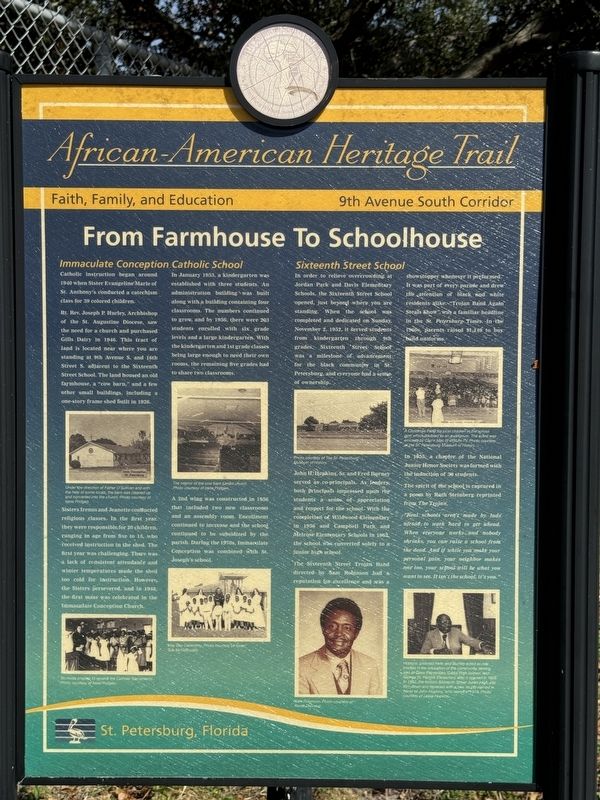
From Farmhouse To Schoolhouse
Faith, Family, and Education • 9th Avenue South Corridor
| — | St. Petersburg African-American Heritage Trail | — |
Photographed by Brandon D Cross
1. From Farmhouse To Schoolhouse Marker
Immaculate Conception Catholic School
Catholic instruction began around 1940 when Sister Evangeline Marie of St. Anthony's conducted a catechism class for 39 colored children.
Rt. Rev. Joseph P. Hurley, Archbishop of the St. Augustine Diocese, saw the need for a church and purchased Gills Dairy in 1946. This tract of land is located near where you are standing at 9th Avenue S. and 16th Street S. adjacent to the Sixteenth Street School. The land housed an old farmhouse, a "cow barn," and a few other small buildings, including a one-story frame shed built in 1926.
Sisters Irenus and Jeanette conducted religious classes. In the first year, they were responsible, for 20 children, ranging in age from five to 15, who received instruction in the shed. The first year was challenging. There was a lack of consistent attendance and winter temperatures made the shed too cold for instruction. However, the Sisters persevered, and in 1948, the first mass was celebrated in the Immaculate Conception Church.
In January 1953, a kindergarten was established with three students. An administration building was built along with a
this page online
A 2nd wing was constructed in 1956 that included two new classrooms and an assembly room. Enrollment continued to increase and the school continued to be subsidized by the parish. During the 1970s, Immaculate Conception was combined with St. Joseph’s school.
Sixteenth Street School
In order to relieve overcrowding at Jordan Park and Davis Elementary Schools, the Sixteenth Street School opened, just beyond where you are standing. When the school was completed and dedicated on Sunday, November 2, 1952, it served students from kindergarten through 9th grades. Sixteenth Street School was a milestone of advancement for the black Community in St. Petersburg, and everyone had a sense of ownership.
John H. Hopkins, Sr. and Fred Barney served as co-principals. As leaders both principals impressed upon the students a sense of appreciation
Photographed by Brandon D Cross
2. From Farmhouse To Schoolhouse Marker
The Sixteenth Street Trojan Band directed by Sam Robinson had a reputation for excellence and was a showstopper whenever it performed. It was part of every-parade and drew the attention of black and white residents alike. "Trojan Band Again Steals Show” with a familiar headline in the St. Petersburg Times. In the 1960s, parents raised $1,119 to buy band uniforms.
In 1955, a chapter of the National Junior Honor Society was formed with the induction of 30 students.
The spirit of the school is captured in a poem by Ruth Steinberg reprinted from The Trojan.
“Real schools aren't made by lads afraid to work hard to get ahead. When everyone works and nobody shrinks, you can raise a school from the dead. And if while you make your personal gain, your neighbor makes one too, your school will be what you want to see. It isn't the school, it's you."
(captions)
Under the direction of Father O'Sullivan and with the help of some locals, the barn was cleaned up and converted into the church. Photo courtesy Irene Pridgen.
Students prepare to receive the Catholic Sacraments. Photo courtesy of Irene Pridgen.
The interior of the cow barn turned church. Photo courtesy of Irene Pridgen.
May Day Ceremony. Photo courtesy of Sister Sue McGillicudy.
Photo courtesy of The St. Petersburg Museum of History.
Sam Robinson. Photo courtesy of Randy Dennard.
A Christmas Party for local children in the school gym which doubled as an auditorium. The event was emceed by Cap’n Mac of WSUN-TV. Photo courtesy of the St. Petersburg Museum of History.
Hopkins, pictured here, and Burhey acted as role models in the education of the community, serving also at Davis Elementary, Gibbs High School and George W. Paderis Elementary after it opened in 1958. In 1992, Historic Sixteenth Street Junior High was torn down and replaced with a new facility named in courtesy of Leslie Hopkins.
Erected by National Park Service, Florida Department of State, the City of St. Petersburg and the Dr. Carter G. Woodson African American History Museum.
Topics. This historical marker is listed in these topic lists: African Americans • Civil Rights • Education • Religion & Religious Structures. A significant historical year for this entry is 1940.
Location. 27° 45.671′ N, 82° 39.417′ W. Marker is in St. Petersburg, Florida, in Pinellas County. It is in Melrose-Mercy. It is at the intersection of 9th Avenue South and Queen Street S, on the right when traveling west on 9th Avenue South. Touch for map. Marker is at or near this postal address: 701 16th Street S, Saint Petersburg FL 33712, United States of America. Touch for directions.

Regionally, this marker is on Florida’s Gulf Coast and on Tampa Bay. It is also in the American South and on the Gulf Coast. Globally, it is in the North Atlantic Region, North America, a Gulf of Mexico state, the Western Hemisphere, the Western World, and the Anglosphere. Historically, it finds itself in what was once New Spain, the territory of the Mississippian Culture, one of the Confederate States of America, and the Antebellum South.
Other nearby markers. At least 8 other markers are within walking distance of this marker: Early Housing (within shouting distance of this marker); 9th Avenue South Corridor (within shouting distance of this marker); Happy Workers - Trinity Presbyterian (about 600 feet away, measured in a direct line); a different marker also named 9th Avenue South Corridor (about 600 feet away); Avenue of Faith (approx. 0.2 miles away); a different marker also named 9th Avenue South Corridor (approx. 0.2 miles away); Women United (approx. ¼ mile away); Civic Associations (approx. 0.3 miles away). Touch for a list and map of all markers in St. Petersburg.
Also see . . .
1. St. Pete’s Hidden History: The men behind the schools. (Submitted on November 27, 2024, by Brandon D Cross of Flagler Beach, Florida.)
2. The Heritage Trail. (Submitted on November 27, 2024, by Brandon D Cross of Flagler Beach, Florida.)
3. The Deuces Live. (Submitted on November 27, 2024, by Brandon D Cross of Flagler Beach, Florida.)
Credits. This page was last revised on December 5, 2024. It was originally submitted on November 27, 2024, by Brandon D Cross of Flagler Beach, Florida. This page has been viewed 258 times since then and 60 times this year. Photos: 1, 2. submitted on November 27, 2024, by Brandon D Cross of Flagler Beach, Florida. • Bernard Fisher was the editor who published this page.
