
Jordan Park in St. Petersburg in Pinellas County, Florida — The American South (South Atlantic)
The Beginning
9th Avenue South Corridor • 22nd Street South Corridor
| — | St. Petersburg African-American Heritage Trail | — |
Photographed by Brandon D Cross
1. The Beginning Marker
Dirt Trails to Main Street
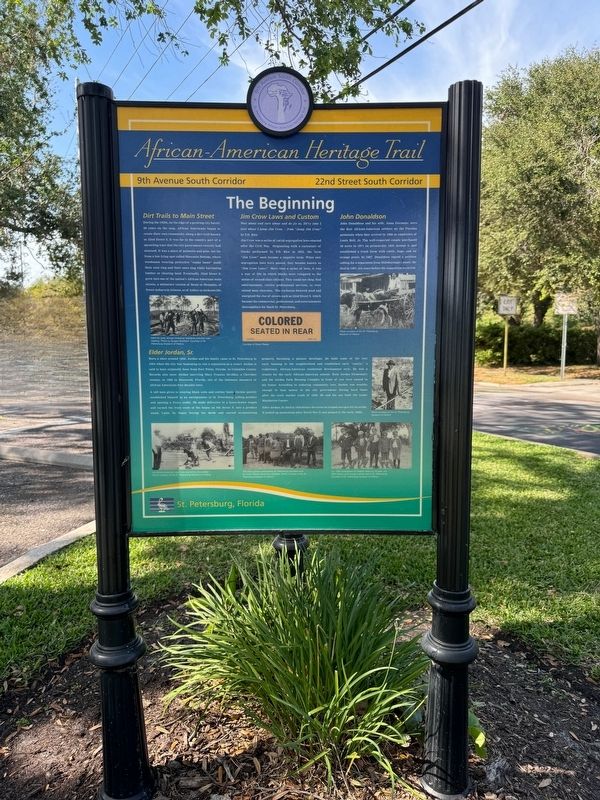
During the 1920s, on the edge of a growing city barely 30 years on the map. African Americans began to create their own community along a dirt trail known as 22nd Street S. It was far in the county, part of a sprawling tract that the city government recently had annexed. It was a place of palmetto and pine, not far from a low-lying spot called Moccasin Bottom, where woodsmen wearing protective “snake boots” made their axes ring and their saws sing while harvesting lumber or clearing land. Eventually, 22nd Street S. grew into one of the nation’s African-American main streets, a miniature version of Beale in Memphis, of Sweet Auburn in Atlanta, or of Ashley in Jacksonville.
Jim Crow Laws and Custom
Weel about and turn about and do jis so, Eb'ry time I weel about I jump Jim Crow.- from “Jump Jim Crow” by T.D. Rice.
Jim Crow was a series of racial segregation laws enacted after the Civil War. Originating with a caricature of blacks performed by T.D. Rice in 1832, the term "Jim Crow" soon became a negative term. When new segregation laws were passed, they became known as “Jim Crow Laws.”
this page online
John Donaldson
John Donalison and his wile, Anna Germain, were the first African-American settlers on the Pinellas peninsula when they arrived in 1888 as employees of Louis Bell, Jr. The well-respected couple purchased 40 acres in 1871 on present-day 18th Avenue S. and established a truck farm with cattle, hogs, and an orange grove. In 1887, Donaldson signed a petition calling for a separation from Hillsborough County. He died in 1901, ten years before the separation occurred.
Elder Jordan, Sr.
Born a slave around 1850, Jordan and his family came to St. Petersburg in 1904 when the city was beginning to win a reputation as a resort. Jordan is said to have originally been from Fort White, Florida, In Columbia County. Records

Photographed by Brandon D Cross
2. The Beginning Marker
A tall man given to wearing black suits and cowboy boots, Jordan quickly established himself as an entrepreneur in St. Petersburg, selling produce and opening a livery stable. He made deliveries in a horse-drawn wagon and turned the front room of his house on 9th S. into a produce stand. Later, he began buying tax deeds and started accumulating property, becoming a pioneer developer. He built some Of the very early housing in the neighborhood and established early "courts,” a traditional, African-American residential development style. He was a trustee for the early African-American schools. Both Jordan Elementary and the Jordan Park Housing Complex in front of you were named in his honor. According to enduring community lore, Jordan was wealthy enough to loan money to the city government during hard times after the stock market crash of 1929. He and his son built the iconic Manhattan Casino.
Elder Jordan, Sr. died in 1936 before the street he helped energize hit
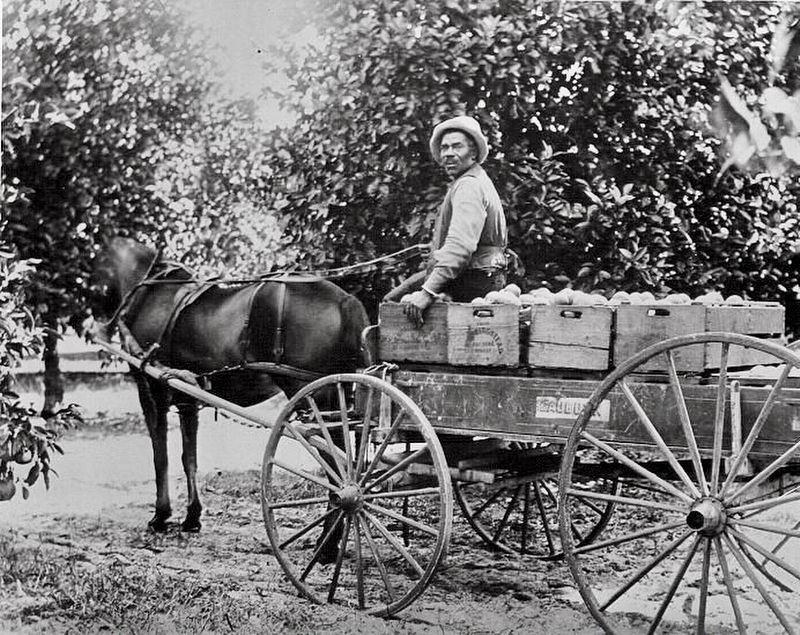
Photo courtesy St. Petersburg Museum of History
3. John Donaldson
(captions)
Work for early African-American residents included road Clearing. Photo by Burgert Brothers. Courtesy of St. Petersburg Museum of History.
Colored Seated in Rear courtesy of Gwen Reese
Photo courtesy of the St. Petersburg Museum of History.
An African-American road crew lays bricks for a street. Photo courtesy of the St. Petersburg Museum of History.
The citrus groves surrounding St. Petersburg provided work for many African-American residents. Photo courtesy of the St. Petersburg Museum of History.
Ca. 900 photograph of children taken by 10-year-old Ruth Myers Lane during a winter visit to St. Petersburg Courtesy of St. Petersburg Museum of History.
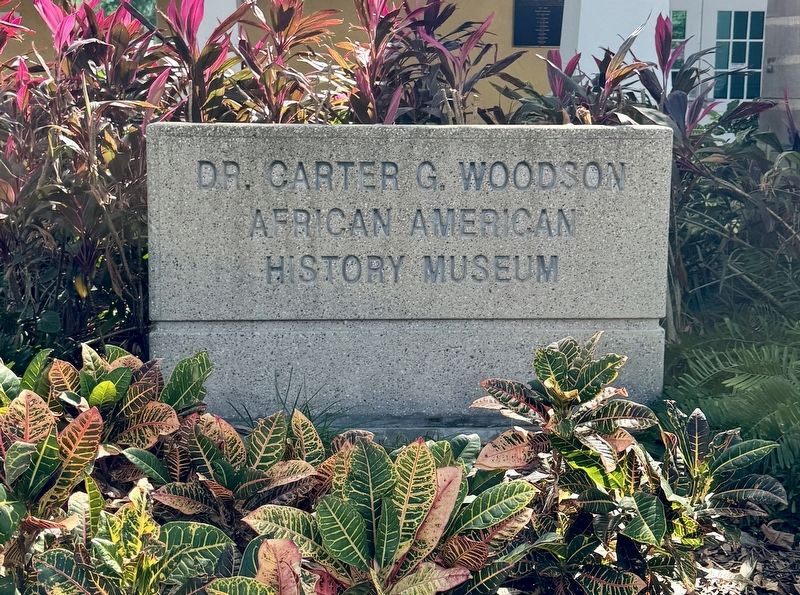
Erected by National Park Service, Florida Department of State, the City of St. Petersburg and the Dr. Carter G. Woodson African American History Museum.
Topics. This historical marker is listed in these topic lists: African Americans • Civil Rights • Industry & Commerce • Notable Places. A significant historical year for this entry is 1920.
Location. 27° 45.662′ N, 82° 39.825′ W.
Photographed by Brandon D Cross
4. Dr. Carter G. Woodson African American History Museum

Regionally, this marker is on Florida’s Gulf Coast and on Tampa Bay. It is also in the American South and on the Gulf Coast. Globally, it is in the North Atlantic Region, North America, a Gulf of Mexico state, the Western Hemisphere, the Western World, and the Anglosphere. Historically, it finds itself in what was once New Spain, the territory of the Mississippian Culture, one of the Confederate States of America, and the Antebellum South.
Other nearby markers. At least 8 other markers are within walking distance of this marker: 9th Avenue South Corridor (here, next to this marker); End of an Era (here, next to this marker); Building 22nd Street S. (about 400 feet away, measured in a direct line); 22nd Street South Corridor (about 400 feet away); a different marker also named 9th Avenue South Corridor (about 500 feet away); Pioneer Schools (about 500 feet away); Civic Associations (about 500 feet away); In the Name of “Progress” (about 600 feet away). Touch for a list and map of all markers in St. Petersburg.
Also see . . .
1. Recovering and Discovering Our Past: The African-American Experience in St. Petersburg. (Submitted on November 27, 2024, by Brandon D Cross of Flagler Beach, Florida.)
2. Elder Jordan Sr. Honored as Pillar of Community. (Submitted on November 27, 2024, by Brandon D Cross of Flagler Beach, Florida.)
Credits. This page was last revised on December 5, 2024. It was originally submitted on November 27, 2024, by Brandon D Cross of Flagler Beach, Florida. This page has been viewed 157 times since then and 19 times this year. Photos: 1, 2, 3, 4. submitted on November 27, 2024, by Brandon D Cross of Flagler Beach, Florida. • Bernard Fisher was the editor who published this page.
