Jordan Park in St. Petersburg in Pinellas County, Florida — The American South (South Atlantic)
Pioneer Schools
Faith, Family, and Education • 9th Avenue South Corridor
| — | St. Petersburg African-American Heritage Trail | — |
Photographed by Brandon D Cross
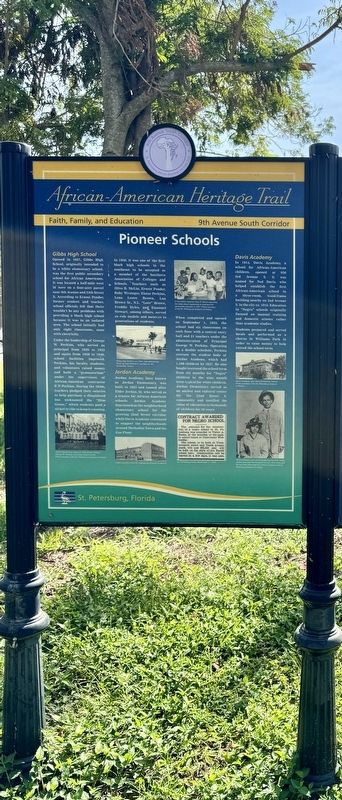
1. Pioneer Schools Marker
Gibbs High School
Opened in 1927, Gibbs High School, originally intended to be a white elementary school, was the first public secondary school for African Americans. It was located a half-mile west of here on a four-acre parcel near 9th Avenue and 34th Street S. According to Ernest Ponder, former student and teacher, school officials felt that there wouldn't be any problems with providing a black high school because it was in an isolated area. The school initially had only eight classrooms, none with electricity.
Under the leadership of George W. Perkins, who served as principal from 1929 to 1932 and again from 1938 10 1946, school facilities improved. Perkins, his faculty, students. and volunteers raised money and built a "gymnatorium" under the supervision of African-American contractor P. P. Perkins. During the 1930s, teachers pledged their salaries to help purchase a dilapidated bus nicknamed the “Blue Goose." which students paid a nickel to ride to keep it running.
In 1950, it was one of the first black high schools in the southeast to be accepted as a member of the Southern Association of Colleges and Schools. Teachers such as Olive B. McLin, Ernest Ponder, Ruby Wysinger, Eloise Perkins, Lena Lester Brown. Lou Brown Sr., N.L. "Love" Brown, Freddie Dyles, and Emanuel Stewart, among others, served as role models and mentors to generations of students.
Jordan Academy
Jordan Academy, later known as Jordan Elementary, was built in 1925 and named after Elder Jordan, Sr. who served as a trustee for African-American schools. Jordan Academy functioned as the neighborhood elementary school for the growing 22nd Street corridor while Davis Academy continued to support the neighborhoods around Methodist Town and the Gas Plant.
When completed and opened on September 1, 1925, the school had six classrooms
this page online
Davis Academy
In 1914, Davis Academy, a school for African-American children, opened at 950 3rd Avenue S. It was named for Ned Davis, who helped establish the first African-American school in a three-room, wood-frame building nearby on 2nd Avenue S. in the city ca. 1910. Education in "Negro" schools originally focused on manual training and domestic science rather than academic studies.
Students prepared and served meals and performed as a chorus in Williams Park in order to raise money to help extend the school term.
(captions)
Gibbs High School, Class of 1945, Ernest Ponder, George W. Perkins and Eloise Perkins at left. Photo courtesy of the St. Petersburg Museum of History.
Gibbs High School, ca. 1964, now demolished. Photo by Bob Morstand, courtesy of the Tampa Bay Times.
Photo courtesy of the St. Petersburg Museum of History.
In this photo, teacher Mary R. Brown educates her class about registering to vote and the democratic process in 1951. Photo courtesy of the St. Petersburg Museum of History.
St. Petersburg Times, September 11, 1924.
Davis Academy, later Davis Elementary School. Photo courtesy of the St. Petersburg Museum of History.
Black teachers such as 3rd grade teacher Mary Fields shown here with her husband ca 1914 were paid far less than white teachers. Photo courtesy St. Petersburg Museum of History.
Erected by National
Photographed by Brandon D Cross
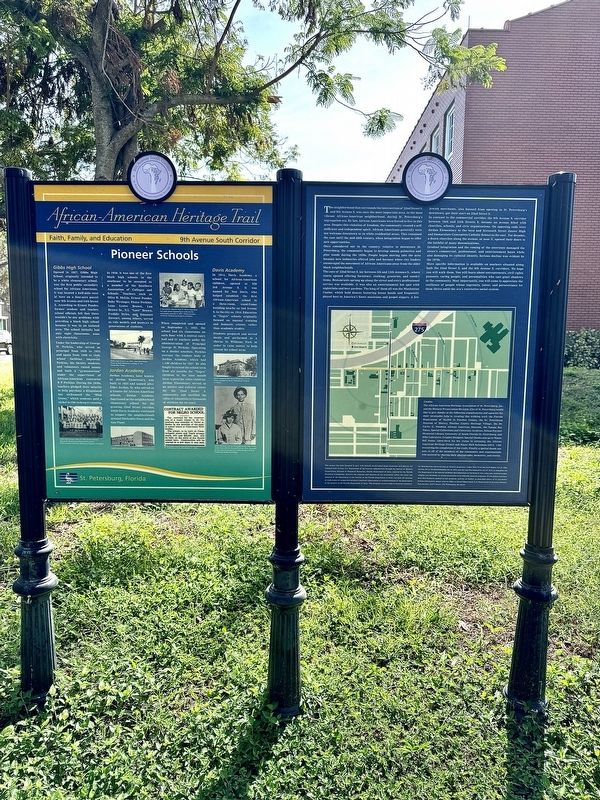
2. Pioneer Schools Marker (left)
Topics. This historical marker is listed in these topic lists: African Americans • Civil Rights • Education. A significant historical year for this entry is 1927.
Location. 27° 45.662′ N, 82° 39.914′ W. Marker is in St. Petersburg, Florida, in Pinellas County. It is in Jordan Park. It is at the intersection of 9th Avenue South and Jordan Park Street S, on the left when traveling west on 9th Avenue South. The marker is located in front of the Pinellas County Head Start Building, originally the Historic Jordan Elementary School. Touch for map. Marker is at or near this postal address: 2390 9th Avenue S, Saint Petersburg FL 33712, United States of America. Touch for directions.

Regionally, this marker is on Florida’s Gulf Coast and on Tampa Bay. It is also in the American South and on the Gulf Coast. Globally, it is in the North Atlantic Region, North America, a Gulf of Mexico state, the Western Hemisphere, the Western World, and the Anglosphere. Historically, it finds itself in

Photographed by Brandon D Cross
3. Historic Jordan Elementary School
Other nearby markers. At least 8 other markers are within walking distance of this marker: 9th Avenue South Corridor (here, next to this marker); End of an Era (about 500 feet away, measured in a direct line); a different marker also named 9th Avenue South Corridor (about 500 feet away); The Beginning (about 500 feet away); Building 22nd Street S. (approx. 0.2 miles away); 22nd Street South Corridor (approx. 0.2 miles away); In the Name of “Progress” (approx. 0.2 miles away); Royal Theater (approx. 0.2 miles away). Touch for a list and map of all markers in St. Petersburg.
Also see . . .
1. ‘We lived it.’ Alumni from St. Petersburg’s first Black high school reflect on desegregation. WUSF website entry (Submitted on December 1, 2024, by Brandon D Cross of Flagler Beach, Florida.)
2. A History of Civil Rights and Social Change in Pinellas County. Healthy St. Pete website entry (Submitted on December 1, 2024, by Brandon D Cross of Flagler Beach, Florida.)
3. The Heritage Trail.

Photographed by Brandon D Cross
4. Historic Jordan Elementary School Sign
Credits. This page was last revised on May 19, 2026. It was originally submitted on December 1, 2024, by Brandon D Cross of Flagler Beach, Florida. This page has been viewed 336 times since then and 46 times this year. Photos: 1, 2, 3, 4. submitted on December 1, 2024, by Brandon D Cross of Flagler Beach, Florida. • Bernard Fisher was the editor who published this page.
