Centerville in Montgomery County, Ohio — The American Midwest (Great Lakes)
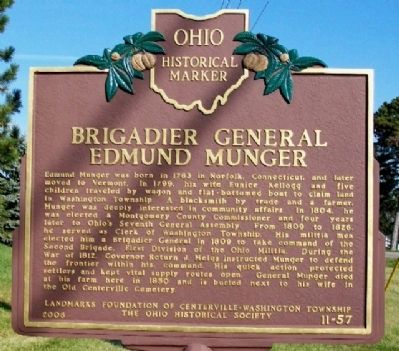
Brigadier General Edmund Munger
Photographed by William Fischer, Jr., December 6, 2009
1. Brigadier General Edmund Munger Marker
Edmund Munger was born in 1763 in Norfolk, Connecticut, and later moved to Vermont. In 1799, his wife Eunice Kellogg and five children traveled by wagon and flat-bottomed boat to claim land in Washington Township. A blacksmith by trade and a farmer, Munger was deeply interested in community affairs. In 1804, he was elected a Montgomery County Commissioner and four years later to Ohio's Seventh General Assembly. From 1809 to 1826, he served as Clerk of Washington Township. His militia men elected him a Brigadier General in 1809 to take command of the Second Brigade, First Division of the Ohio Militia. During the War of 1812, Governor Return J. Meigs instructed Munger to defend the frontier within his command. His quick action protected settlers and kept vital supply routes open. General Munger died at his farm here in 1850 and is buried next to his wife in the Old Centerville Cemetery.
Erected 2006 by Landmarks Foundation of Centerville-Washington Township, Ohio Historical Society. (Marker Number 11-57.)
Topics and series. This historical marker is listed in these topic lists: Agriculture • Government & Politics
this page online
Location. 39° 36.083′ N, 84° 12.001′ W. Marker is in Centerville, Ohio, in Montgomery County. It is on Yankee Street, on the left when traveling north. Marker is about one quarter mile north of the entrance to Yankee Trace Golf Club. Touch for map. Marker is at or near this postal address: 9955 Yankee Street, Dayton OH 45458, United States of America. Touch for directions.

Regionally, this marker is in the Dayton Metro and in the Miami Valley. It is also in the American Midwest and in the Corn Belt. Globally, it is in North America, the Western Hemisphere, the Western World, and the Anglosphere. Historically, it finds itself in what was once the Haudenosaunee (Iroquois) Confederacy, the territory of the Mississippian Culture, and the Northwest Territory.
Other nearby markers. At least 8 other markers are within 4 miles of this marker, measured as the crow flies: Centerville Veterans Memorial (approx. 1.9 miles away); Mad River Road / Road From Cunningham's to Mad River
Photographed by William Fischer, Jr., December 6, 2009
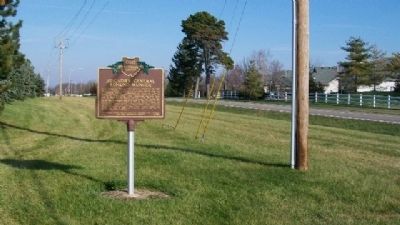
2. Brigadier General Edmund Munger Marker
Looking north along Yankee Street.
Another marker is no longer nearby. Washington Presbyterian Church Cemetery (was approx. 2.2 miles away but has been confirmed missing).
Also see . . .
1. General Edmund Munger. Centerville-Washington History website entry (Submitted on July 12, 2022, by Larry Gertner of New York, New York.)
2. General Edmund Munger. Find A Grave website entry (Submitted on July 12, 2022, by Larry Gertner of New York, New York.)
Photographed by William Fischer, Jr., December 6, 2009
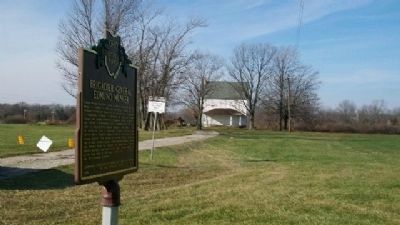
3. Brigadier General Edmund Munger Marker
Farm in background, looking west.
Photographed by Craig Doda, October 4, 2025
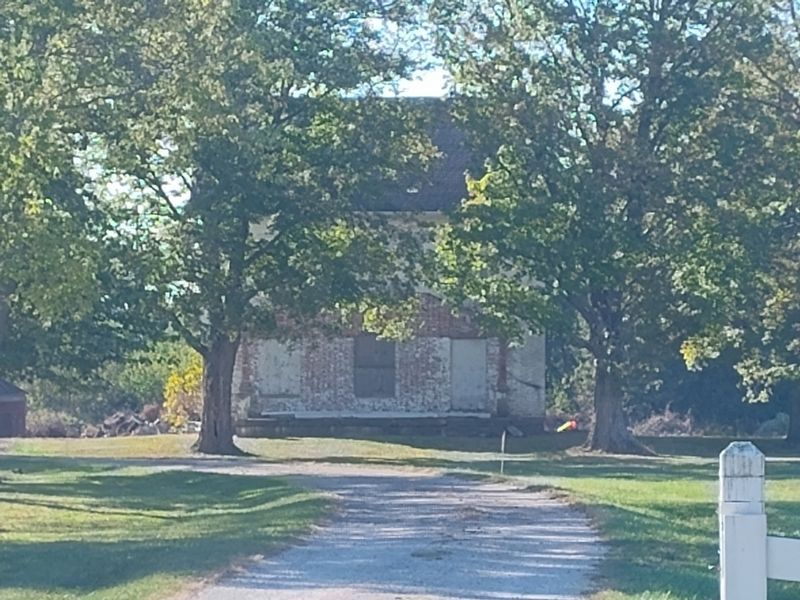
4. Brigadier General Edmund Munger Marker
Credits. This page was last revised on October 10, 2025. It was originally submitted on January 5, 2010, by William Fischer, Jr. of Reynoldsburg, Ohio. This page has been viewed 2,873 times since then and 128 times this year. Photos: 1, 2, 3. submitted on January 5, 2010, by William Fischer, Jr. of Reynoldsburg, Ohio. 4. submitted on October 8, 2025, by Craig Doda of Napoleon, Ohio.
