Fort Frances in Rainy River District, Ontario — Central Canada (North America)
La Verendrye Parkway
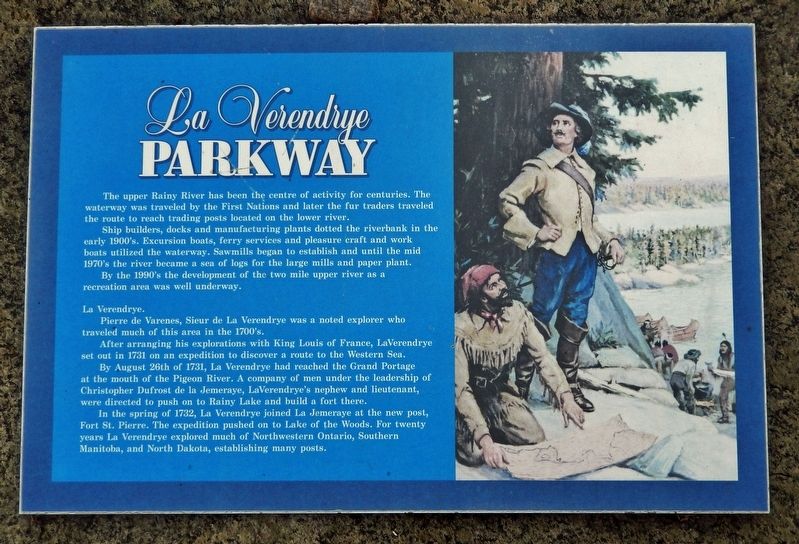
Photographed by Cosmos Mariner, June 16, 2024
1. La Verendrye Parkway Marker
The upper Rainy River has been the centre of activity for centuries. The waterway was traveled by the First Nations and later the fur traders traveled the route to reach trading posts located on the lower river.
Ship builders, docks and manufacturing plants dotted the riverbank in the early 1900's. Excursion boats, ferry services and pleasure craft and work boats utilized the waterway. Sawmills began to establish and until the mid 1970's the river became a sea of logs for the large mills and paper plant.
By the 1990's the development of the two mile upper river as a recreation area was well underway.
La Verendrye.
Pierre de Varenes, Sieur de La Verendrye was a noted explorer who traveled much of this area in the 1700's.
After arranging his explorations with King Louis of France, LaVerendrye set out in 1731 on an expedition to discover a route to the Western Sea.
By August 26th of 1731, La Verendrye had reached the Grand Portage at the mouth of the Pigeon River. A company of men under the leadership of Christopher Dufrost de la Jemeraye, LaVerendrye's nephew and lieutenant, were directed to push on to Rainy Lake and build
this page online
In the spring of 1732, La Verendrye joined La Jemeraye at the new post, Fort St. Pierre. The expedition pushed on to Lake of the Woods. For twenty years La Verendrye explored much of Northwestern Ontario, Southern Manitoba, and North Dakota, establishing many posts.
Topics. This historical marker is listed in these topic lists: Exploration • Forts and Castles • Industry & Commerce • Waterways & Vessels. A significant historical date for this entry is August 26, 1731.
Location. 48° 36.431′ N, 93° 22.778′ W. Marker is in Fort Frances, Ontario, in Rainy River District. It is on Front Street 0.1 kilometers east of Butler Avenue, on the right when traveling east. The marker is located along the La Verendrye Parkway, on the west side of the Sorting Gap Marina. Touch for map. Marker is at or near this postal address: 101 Front Street, Fort Frances ON P9A 1A3, Canada. Touch for directions.

Regionally, this marker is in Northern Ontario and specifically in Northwest Ontario. It is also in Central Canada. Globally, it is in North America, the Great North Woods, the Western Hemisphere, the Western World, and the Anglosphere.

Photographed by Cosmos Mariner, June 16, 2024
2. La Verendrye Parkway Marker
Looking southwest along the Rainy River; the marker is mounted atop a waist-high boulder. International Falls, Minnesota, USA is visible across the river.
Other nearby markers. At least 8 other markers are within walking distance of this marker: The Sorting Gap (about 150 meters away, measured in a direct line); The North West Mounted Police on the Dawson Route (approx. 0.3 kilometers away); The Shevlin Wood Yard (approx. 0.3 kilometers away); Forest to Wood Yard (approx. 0.3 kilometers away); History of the Lookout Tower (approx. 0.3 kilometers away); Recreation and Fun (approx. half a kilometer away); Explore Fort Frances West (approx. 0.6 kilometers away); The Fur Trade Competition (approx. 0.6 kilometers away). Touch for a list and map of all markers in Fort Frances.
Also see . . . Pierre Gaultier de Varennes, sieur de La Vérendrye (Wikipedia).
Excerpt: A French Canadian military officer, fur trader, and explorer. In the 1730s, he and his four sons explored the area west of Lake Superior and established trading posts there. They were part of a process that added Western Canada to the original New France territory(Submitted on December 5, 2024, by Cosmos Mariner of Cape Canaveral, Florida.)that was centered along the Saint Lawrence basin.Photographed by Cosmos Mariner, June 16, 20243. La Verendrye Parkway Sign(located 1 km west of this historical marker)
La Verendrye Parkway
officially opened July 1, 2003
Fort Frances Centennial 1903-2003In 1731 La Vérendrye, three of his sons and 50 engagés left Montreal. That autumn his son Jean-Baptiste built Fort St. Pierre on Rainy Lake. Next year they built Fort St. Charles on Lake of the Woods, which became his headquarters for the next several years.
He was the first known European to reach present-day North Dakota and the upper Missouri River in the United States. In the 1740s, two of his sons crossed the prairie as far as present-day Wyoming, United States, and were the first Europeans to see the Rocky Mountains north of New Mexico.
His four sons:
• Jean Baptiste de La Vérendrye (b. 1713), killed by the Sioux
• Pierre Gaultier de La Vérendrye (b. 1714)
• François de La Vérendrye (b. 1715)
• Louis-Joseph Gaultier de La Vérendrye (b. 1717), reached the Rocky Mountains

Credits. This page was last revised on December 5, 2024. It was originally submitted on December 5, 2024, by Cosmos Mariner of Cape Canaveral, Florida. This page has been viewed 193 times since then and 24 times this year. Photos: 1, 2, 3. submitted on December 5, 2024, by Cosmos Mariner of Cape Canaveral, Florida.
