Marbach am Neckar in Ludwigsburg, Baden-Württemberg, Germany — Central Europe
Tobias Mayer
Photographed by Andrew Ruppenstein, September 14, 2024
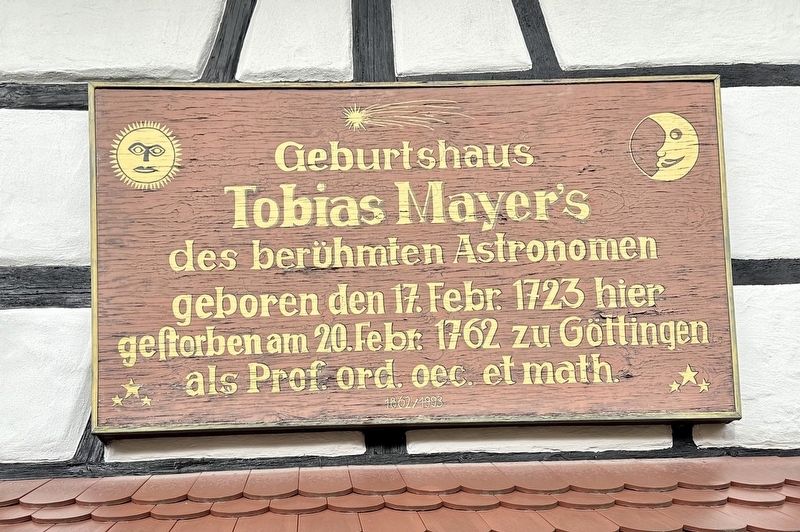
1. Tobias Mayer Marker

Tobias Mayer's
des berühmten Astronomen
geboren den 17. Febr. 1723 hier
gestorben am 20.febr. 1762 zu Göttingen als Prof. ord. oec. et math
Erected 1993.
Topics. This historical marker is listed in this topic list: Science & Medicine. A significant historical date for this entry is February 17, 1723.
Location. 48° 56.433′ N, 9° 15.538′ E. Marker is in Marbach am Neckar, Baden-Württemberg, in Ludwigsburg. It is at the intersection of Torgasse and Göckelhof, on the left when traveling north on Torgasse. Touch for map. Marker is at or near this postal address: Torgasse 13, Marbach am Neckar BW 71672, Germany. Touch for directions.

Regionally, this marker is in German Swabia. Globally, it is in Europe, the European Union, Atlantic Europe, Central Europe, the Schengen Area, Western Europe, and the Western World. Historically, it finds itself in what was once the Roman Empire, the Holy Roman Empire, and the former West Germany.
Other nearby markers. At
this page online
Also see . . . Scientist of the Day - Tobias Mayer (Linda Hall Library). Excerpt:
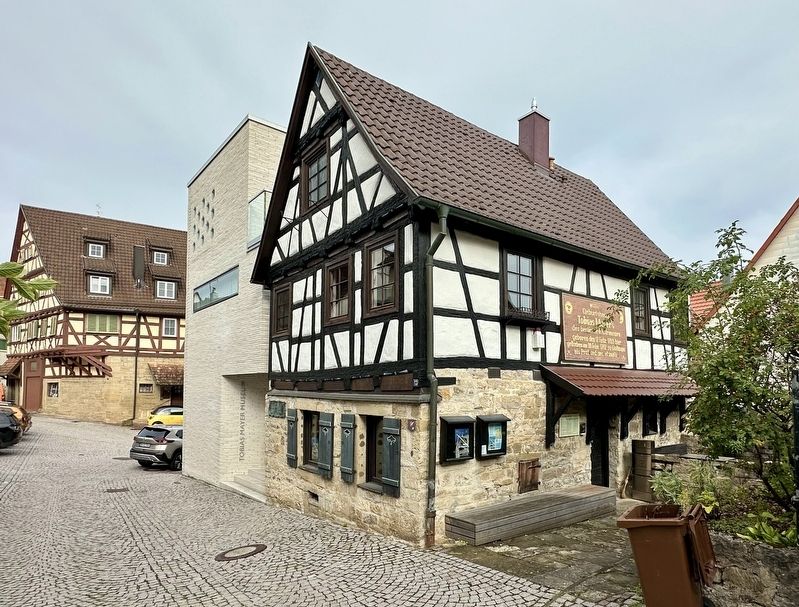
Tobias Mayer, a German mathematician and astronomer, was born Feb. 17, 1723, in Marburg, in southern Germany. His father was a wagon builder and well-digger, and his mother a nurse. The family moved to Esslingen, not far from Marburg, when Tobias was young, and where his father died, and then his mother, so Mayer grew up in the town orphanage. Somehow, he managed to get rudimentary schooling(Submitted on December 6, 2024.)and demonstrate uncommon ability in mathematics. He made a map for the town of Esslingen when he was 16, which was engraved and sold, an impressive achievement for someone of his background, and he must have demonstrated even more ability somewhere, for in 1744, when he was 21, he was hired by the Augsburg publisher, Andreas Pfeffel. …by 1748, Mayer was a recognized astronomer, working on a lunar map and globe based on measurements with a micrometer. By 1752, he had produced a set of lunar tables so accurate that they were used by English astronomers as the basis for determining longitude at sea using the lunar-distance method. By 1754, still without any university schooling, he became director of the astronomical observatory at Göttingen. He died suddenly, only 39 years old, in 1762. Most of his important work, such as his lunar maps, was published posthumously.Photographed by Andrew Ruppenstein, September 14, 20242. Tobias Mayer Marker - wide viewThe marker is visible here directly above the entrance to his house of birth.
Additional keywords. astronomy
Credits. This page was last revised on December 6, 2024. It was originally submitted on December 6, 2024, by Andrew Ruppenstein of Lamorinda, California. This page has been viewed 146 times since then and 35 times this year. Photos: 1, 2. submitted on December 6, 2024, by Andrew Ruppenstein of Lamorinda, California.
