Marmora Ironworks & Forges
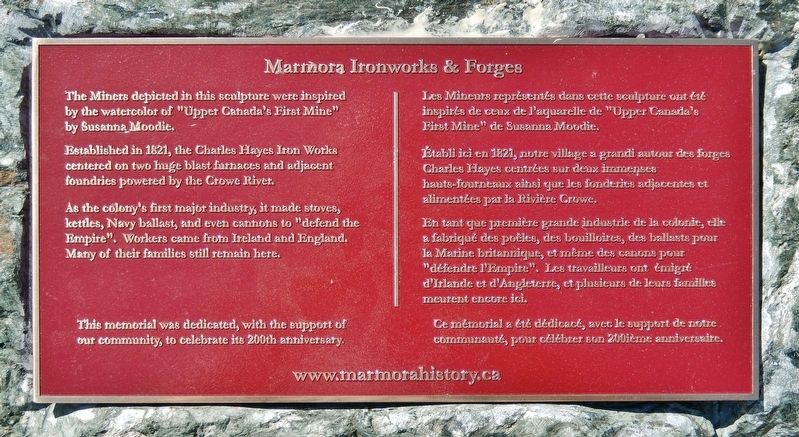

Established in 1821, the Charles Hayes Iron Works centered on two huge blast furnaces and adjacent foundries powered by the Crowe River.
As the colony’s first major industry, it made stoves, kettles, Navy ballast, and even cannons to “defend the Empire”. Workers came from Ireland and England. Many of their families still remain here.
This memorial was dedicated, with the support of our community, to celebrate its 200th anniversary.
Établi ici en 1821, notre village a grandi autour des forges Charles Hayes centrées sur deux immenses hauts-fourneaux ainsi que les fonderies adjacentes et alimentées par la Rivière Crowe.
En tant que première grande industrie de la colonie, elle a fabriqué des poêles, des bouilloires, des ballasts pour la Marine britannique, et même des canons pour « défendre l’Empire ». Les travailleurs ont émigré d’Irlande
this page online
Ce mémorial a été dédicacé, avec le support de notre communauté, pour célébrer son 200ième anniversaire.
Erected 2021.
Topics. This historical marker is listed in these topic lists: Arts, Letters, Music • Immigration • Industry & Commerce • Settlements & Settlers. A significant historical year for this entry is 1821.
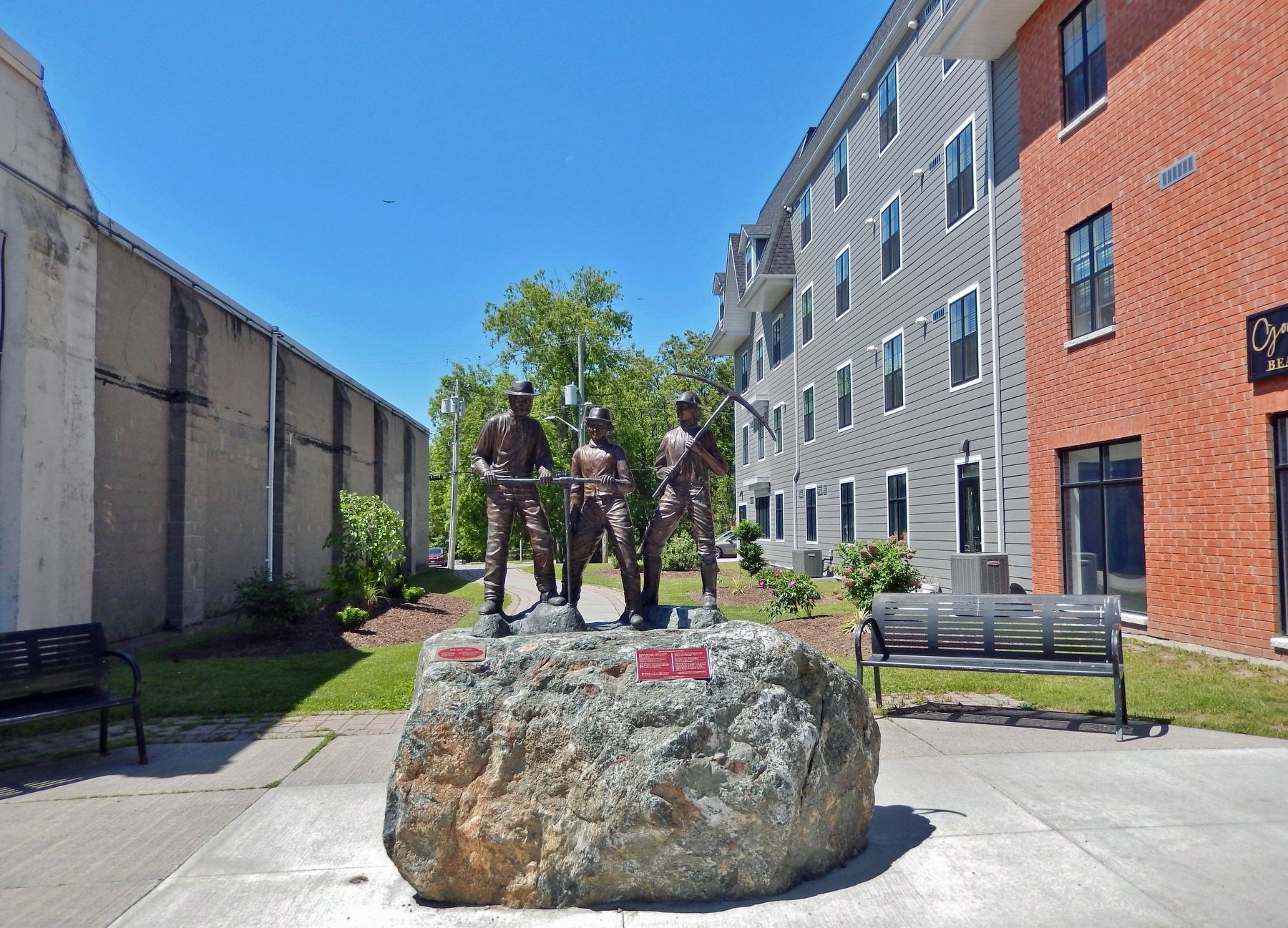
Location. 44° 29.011′ N, 77° 40.977′ W. Marker is in Marmora, Ontario, in Hastings County. It is on Forsyth Street just south of Madoc Street, on the right when traveling south. The sculpture and marker are mounted atop a large boulder located beside the sidewalk. Touch for map. Marker is at or near this postal address: 21 Forsyth Street, Marmora ON K0K 2M0, Canada. Touch for directions.

Regionally, this marker is in Eastern Ontario and specifically in Southeastern Ontario. It is also in Central Canada. Globally, it is in North America, on the Great Lakes, in the Western Hemisphere, in the Western World, and in the Anglosphere. Historically, it finds itself in what was once a British colony, the
Other nearby markers. At least 8 other markers are within 23 kilometers of this marker, measured as the crow flies: Grist & Feed Mill (about 120 meters away, measured in a direct line); In Honour of Harold Colman Rickaby (about 150 meters away); The Pearce Company (about 150 meters away); Railway to Cordova (about 150 meters away); Pioneer Irontown 1821-1875 (about 150 meters away); The Miners of Marmora and Lake (about 150 meters away); Centennial of Confederation (approx. 10.8 kilometers away); Founders of Campbellford (approx. 21.5 kilometers away). Touch for a list and map of all markers in Marmora.
Related markers. Click here for a list of markers that are related to this marker.
Also see . . . Marmora at Two Hundred - How it All Began (www.marmorahistory.ca).
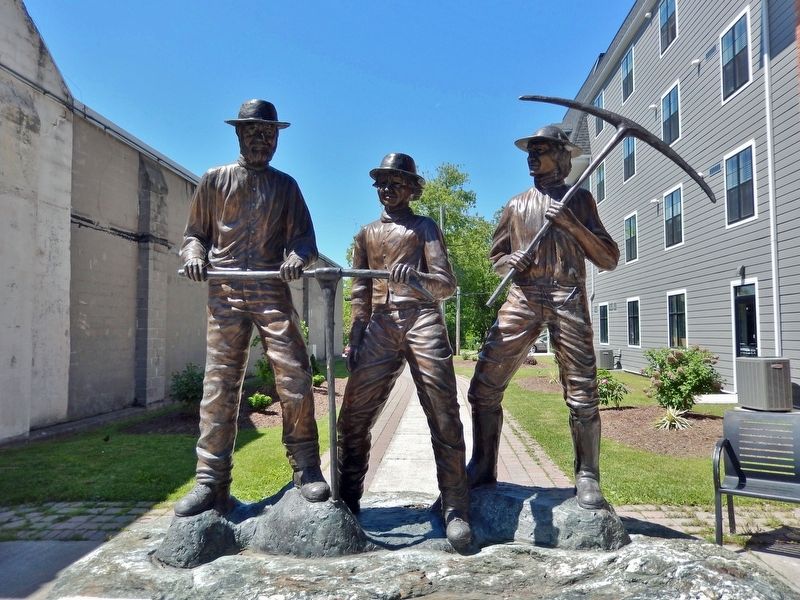
Excerpt: We are so excited to see the installation of Mitchell Webster’s sculpture depicting the miners at Marmora, as sketched by Canada’s famous pioneer, Susanna Moodie in the 1830’s. It has been a two-year team effort with the Marmora Historical Foundation and(Submitted on December 7, 2024, by Cosmos Mariner of Cape Canaveral, Florida.)the Municipality of Marmora and Lake, and the day has finally arrived... and the families of our three little miners are still here today!Photographed by Cosmos Mariner, May 31, 20243. Marmora Ironworks & Forges SculptureIn the early 1820s, Upper Canada was still recovering from a very close call in the war of 1812-14. The Empire and its Canadian colony had driven back the United States. The British, had even chased the enemy home and burnt the White House. Still, the war was at best a standoff. In Upper Canada it had been a close call. Clearly conflict might well start up again anytime; security was now constantly on the mind of the Upper Canada’s citizens.
Settlers, loyal British, Scottish, and even Irish settlers, were needed. They in turn would need all the necessities for a farming life — ironware, kettles, plows, and stoves — and perhaps even cannons. It all could have been shipped across the Atlantic but who could be sure it would arrive in time? Iron was essential, so that the colony could meet its own demands. Iron lying across on the other side of the Atlantic was no use here. Blast furnaces were needed in the colony, not thousands of miles away. But where exactly?
Credits. This page was last revised on December 7, 2024. It was originally submitted on December 7, 2024, by Cosmos Mariner of Cape Canaveral, Florida. This page has been viewed 287 times since then and 116 times this year. Photos: 1, 2, 3, 4. submitted on December 7, 2024, by Cosmos Mariner of Cape Canaveral, Florida.
