Green Tree in Pittsburgh in Allegheny County, Pennsylvania — The American Northeast (Mid-Atlantic)
Making Apple Butter in Green Tree in the Olden Days
Photographed by Bradley Owen, November 1, 2024
1. Making Apple Butter in Green Tree in the Olden Days Marker
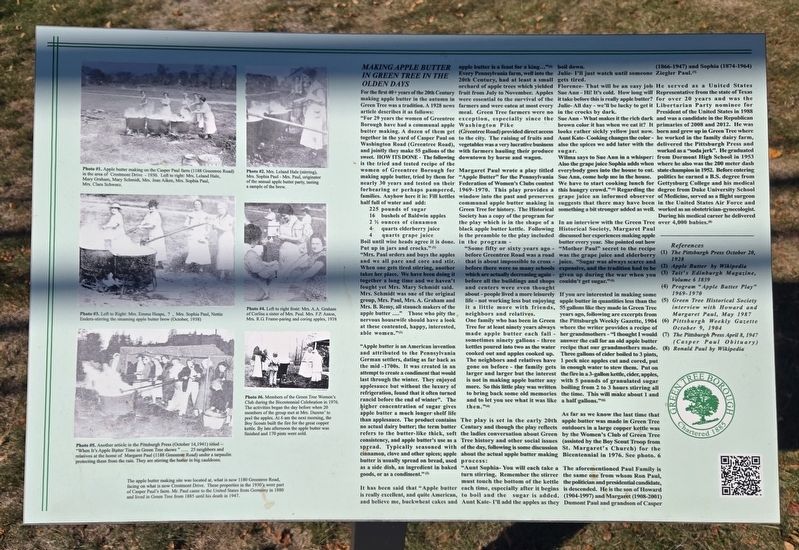
For the first 40+ years of the 20th Century making apple butter in the autumn in Green Tree was a tradition. A 1928 news article describes it as follows:
"For 29 years the women of Greentree Borough have had a communal apple butter making. A dozen of them get together in the yard of Casper Paul on Washington Road (Greentree Road), and jointly they make 55 gallons of the sweet. How Its Done - The following is the tried and tested recipe of the women of Greentree Borough for making apple butter, tried by them for nearly 30 years and tested on their forbearing or perhaps pampered, families. Anyhow here it is: Fill kettles half full of water and add:225 pounds of sugar"Mrs. Paul orders and buys the apples and we all pare and core and stir. When one gets tired stirring, another takes her place. We have been doing it together a long time and we haven't fought yet Mrs. Mary Schmidt said. Mrs. Schmidt was one of the original group,
16 bushels of Baldwin apples
2 1/2 ounces of cinnamon
4 quarts elderberry juice
4 quarts grape juice
Boil until wise heads agree it is done. Put up in jars and crocks." (1)Mrs. Paul, Mrs. A. Graham and Mrs. B. Remy, all staunch makers of the apple butter.... Those who pity the nervous housewife should have a look at these contented, happy, interested, able women." (1)
Click or scan to see
this page online
"Apple butter is an American invention and attributed to the Pennsylvania German settlers, dating as far back as the mid-1700s. It was created in an attempt to create a condiment that would last through the winter. They enjoyed applesauce but without the luxury of refrigeration, found that it often turned rancid before the end of winter". The higher concentration of sugar gives apple butter a much longer shelf life than applesauce. The product contains no actual dairy butter; the term butter refers to the butter-like thick, soft consistency, and apple butter's use as a spread. Typically seasoned with cinnamon, clove and other spices; apple butter is usually spread on bread, used as a side dish, an ingredient in baked goods, or as a condiment." (2)
It has been said that "Apple butter is really excellent, and quite American, and believe me, buckwheat cakes and apple butter is a feast for a king… (3) Every Pennsylvania farm, well into
Photographed by Bradley Owen, November 1, 2024
2. Making Apple Butter in Green Tree in the Olden Days Marker
Margaret Paul wrote a play titled "Apple Butter" for the Pennsylvania Federation of Women's Clubs contest 1969-1970. This play provides a window into the past and preserves communal apple butter making in Green Tree for history. The Historical Society has a copy of the program for the play which is in the shape of a black apple butter kettle. Following is the preamble to the play included in the program -
"Some fifty or sixty years ago - before Greentree Road was a road that is about impossible to cross - before there were so many schools which are actually decreasing again - before all the buildings and shops and centers were even thought about - people lived a more leisurely life - not working less but enjoying it a little more with friends, neighbors and relatives.
One family who has been in Green Tree for at least ninety years always made apple butter each fall - sometimes ninety gallons - three kettles poured into two as the water cooked out and apples cooked up. The neighbors and relatives have gone on before the family gets larger and larger but the interest is not in making apple butter any more. So this little play was written to bring back some old memories and to let you see what it was like then." (4)
The play is set in the early 20th Century and though the play reflects the ladies conversation about Green Tree history and other social issues of the day, following is some discussion about the actual apple butter making process:
"Aunt Sophia- You will each take a turn stirring. Remember the stirrer must touch the bottom of the kettle each time, especially after it begins to boil and the sugar is added.
Aunt Kate- I'll add the apples as they boil down.
Julie- I'll just watch until someone gets tired.
Florence- That will be an easy job
Sue Ann - Hi! It's cold. How long will it take before this is really apple butter?
Julie- All day - we'll be lucky to get it in the crocks by dark.
Sue Ann - What makes it the rich dark brown color it has when we eat it? It looks rather sickly yellow just now.
Aunt Kate- Cooking changes the color - also the spices we add later with the sugar.
Wilma says to Sue Ann in a whisper: Also the grape juice Sophia adds when everybody goes into the house to eat. Sue Ann, come help me in the house. We have to start cooking lunch for this hungry crowd." (5) Regarding the grape juice an informed observer suggests that there may have been something a bit stronger added as well.
In an interview with the Green Tree Historical Society, Margaret Paul discussed her experiences making apple butter every year. She pointed out how "Mother Paul" secret to the recipe was the grape juice and elderberry juice. "Sugar was always scarce and expensive, and the tradition had to be given up during the war when you couldn't get sugar." (5)
If you are interested in making some apple butter in quantities less than the 55 gallons like they made in Green Tree years ago, following are excerpts from the Pittsburgh Weekly Gazette, 1904 where the writer provides a recipe of her grandmothers - "I thought I would answer the call for an old apple butter recipe that our grandmothers made. Three gallons of cider boiled to 3 pints, 1 peck nice apples cut and cored, put in enough water to stew them. Put on the fire in a 3-gallon kettle, cider, apples, with 5 pounds of granulated sugar boiling from 2 to 3 hours stirring all the time. This will make about 1 and a half gallons." (6)
As far as we know the last time that apple butter was made in Green Tree outdoors in a large copper kettle was by the Women's Club of Green Tree (assisted by the Boy Scout Troop from St. Margaret's Church) for the Bicentennial in 1976. See photo. 6
The aforementioned Paul Family is the same one from whom Ron Paul, the politician and presidential candidate, is descended. He is the son of Howard (1904-1997) and Margaret (1908-2001) Dumont Paul and grandson of Casper 1866-1947) and Sophia (1874-1964) Ziegler Paul. (7)
He served as a United States Representative from the state of Texas for over 20 years and was the Libertarian Party nominee for President of the United States in 1988 and was a candidate in the Republican primaries of 2008 and 2012. He was born and grew up in Green Tree where he worked in the family dairy farm, delivered the Pittsburgh Press and worked as a "soda jerk". He graduated from Dormont High School in 1953 where he also was the 200 meter dash state champion in 1952. Before entering politics he earned a B.S. degree from Gettysburg College and his medical degree from Duke University School of Medicine, served as a flight surgeon in the United States Air Force and worked as an obstetrician-gynecologist. During his medical career he delivered over 4,000 babies. (8)
References
(1) The Pittsburgh Press October 20, 1928
(2) Apple Butter by Wikipedia
(3) Tait's Edinburgh Magazine, Volume 6 1839
(4) Program "Apple Butter Play" 1969-1970
(5) Green Tree Historical Society interview with Howard and Margaret Paul, May 1987
(6) Pittsburgh Weekly Gazette October 9, 1904
(7) The Pittsburgh Press April 8, 1947 (Casper Paul Obituary)
(8) Ronald Paul by Wikipedia
(Captions):
Photo #1. Apple butter making on the Casper Paul farm (1188 Greentree Road) in the area of Crestmont Drive 1930. Left to right: Mrs. Leland Hale, Mary Graham, Mary Schmidt, Mrs. Jean Aiken, Mrs. Sophia Paul, Mrs. Clara Schwarz.
Photo #2. Mrs. Leland Hale (stirring), Mrs. Sophia Paul - Mrs. Paul, originator of the annual apple butter party, tasting a sample of the brew.
Photo #3. Left to Right: Mrs. Emma Heaps, ? , Mrs. Sophia Paul, Nettie Enders-stirring the steaming apple butter brew (October, 1938)
Photo #4. Left to right front: Mrs. A.A. Graham of Corliss a sister of Mrs. Paul. Mrs. F.P. Anton, Mrs. R.G. Frame-paring and coring apples, 1938
Photo #5. Another article in the Pittsburgh Press (October 14, 1941) titled "When It's Apple Butter Time in Green Tree shows" ..... 25 neighbors and relatives at the home of Margaret Paul (1188 Greentree Road) under a tarpaulin protecting them from the rain. They are stirring the butter in big cauldrons.
Photo #6. Members of the Green Tree Women's Club during the Bicentennial Celebration in 1976. The activities began the day before when 20 members of the group met at Mrs. Dazens' to peel the apples. At 6 am the next morning, the Boy Scouts built the fire for the great copper kettle. By late afternoon the apple butter was finished and 170 pints were sold.
The apple butter making site was located at, what is now 1180 Greentree Road, facing on what is now Crestmont Drive. These properties in the 1930's were part of Casper Paul's farm. Mr. Paul came to the United States from Germany in 1880 and lived in Green Tree from 1885 until his death in 1947.
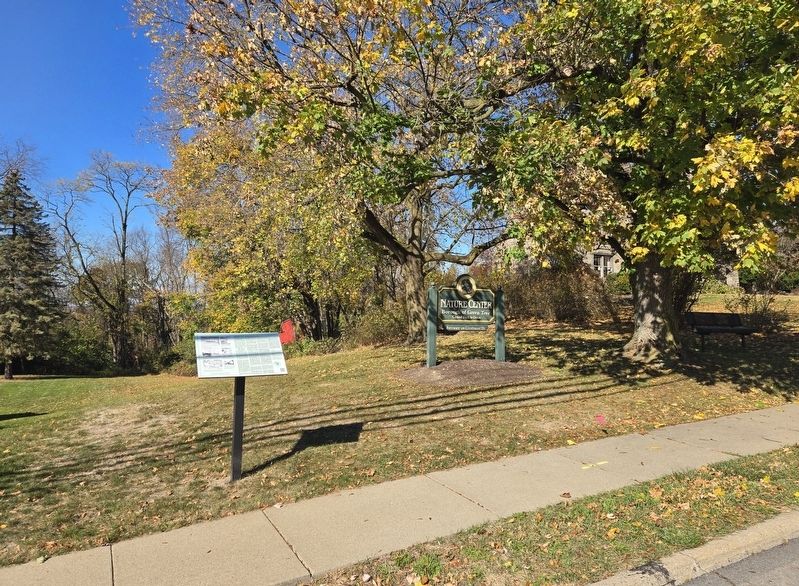
Erected 2017 by Historical Society of Green Tree.
Topics. This historical marker is listed in these topic lists: Agriculture • Entertainment • Government & Politics • Industry & Commerce. A significant historical year for this entry is 1928.
Location. 40° 24.328′ N, 80° 3.267′ W. Marker is in Pittsburgh, Pennsylvania, in Allegheny County. It is in Green Tree. It is at the intersection of Greentree Road (Pennsylvania Route 121) and Forest Drive, on the right when traveling south on Greentree Road. Touch for map. Marker is at or near this postal address: 1214 Greentree Road, Pittsburgh PA 15220, United States of America. Touch for directions.

Regionally, this marker is in the American Northeast, in the Mid-Atlantic, in the Ohio River Valley, in Appalachia, and specifically in Northern Appalachia. Globally, it is in North America, the Western Hemisphere, the Western World, and the Anglosphere. Historically, it finds itself in what was once the Viceroyalty of New France, the Haudenosaunee (Iroquois) Confederacy, and one of the original Thirteen Colonies.
Other nearby markers. At least 8 other markers are within 2 miles of this marker, measured as the crow flies: Borough of Dormont Pool (approx. ¾ mile away); The Green Tree (approx. 0.9 miles away); Greentree (approx. 0.9 miles away); Rook (approx. one mile away); Ramsey Homestead (approx. one mile away); Chartiers Valley Memorial (approx. one mile away); Civil War Monument, Chartiers Cemetery (approx. 1.1 miles away); Veterans Memorial (approx. 1.3 miles away). Touch for a list and map of all markers in Pittsburgh.
Credits. This page was last revised on July 19, 2025. It was originally submitted on December 7, 2024, by Bradley Owen of Morgantown, West Virginia. This page has been viewed 417 times since then and 31 times this year. Photos: 1, 2. submitted on December 8, 2024, by Bradley Owen of Morgantown, West Virginia.
