Hamilton Beach A , Ontario — Central Canada (North America)
A Hub of Activity

Photographed by Tim Boyd, May 9, 2023
1. A Hub of Activity Marker
For two centuries, the beach strip has served as the gateway for Hamilton’s successful trade and commerce.
The Canal
Although small boats could navigate a narrow shallow cut through the Beach Strip sand bar, Hamilton business leaders saw a commercial need for a deeper and wider opening. The canal opened in 1832, but work on it never really stopped. The canal had to be constantly dredged to keep sand from choking the channel, and to accommodate ever larger ships. Originally 60 feet wide, by the end of World War II the canal had been expanded to its current proportions, 2690 feet long, 351 feet wide, and 31 feet deep.
Lighthouse and Keeper’s Dwelling
A wooden lighthouse, built in 1837, safeguarded ships approaching the canal. The light and the keeper's dwelling were destroyed by fire in 1856. They were replaced by a 55 foot high, circular limestone tower (1858) and a brick one-storey lighthouse keeper's dwelling (1857), now the oldest surviving buildings on the Beach Strip (designated under the Ontario Heritage Act in 1996). The lighthouse served as a vital aid to navigation for cargo ships and pleasure craft until
this page online
Railways
In 1876, the Hamilton and Northwestern Railway laid track across the beach as part of an ambitious project to connect Port Dover, Hamilton, Barrie and Collingwood. After 1896, passengers travelled to the Beach on the more frequent, if less glamorous, service provided by the streetcars of the Hamilton Radial Electric Railway. The last of these electric streetcars crossed the Beach Strip in 1929, to be replaced by automobiles and buses.
Crossing the Canal
A schooner crashed into and destroyed the first swing bridge across the canal, shortly after it was constructed in 1830. Although a swing bridge for the railway was constructed in 1875, pedestrians and vehicles continued to rely on a scow-ferry, which was drawn back and forth by heavy chains. The ferry service was discontinued in 1896 with the completion of a second swing bridge, serving electric streetcars and other traffic (shown above). It was replaced in 1922 with a bascule bridge, the first of the canal bridges designed for the use of automobiles (shown below). When a

Photographed by Tim Boyd, May 9, 2023
2. A Hub of Activity Marker
(Marker Number 6.)
Topics and series. This historical marker is listed in these topic lists: Industry & Commerce • Railroads & Streetcars • Waterways & Vessels. In addition, it is included in the Lighthouses series list. A significant historical year for this entry is 1832.
Location. 43° 17.903′ N, 79° 47.718′ W. Marker is in Hamilton, Ontario. It is in Hamilton Beach A. It is on Beach Boulevard, on the left when traveling north. The marker is accessible approx. 200 metres from an entrance off of Beach Boulevard. Touch for map. Marker is at or near this postal address: 1159 Beach Boulevard, Hamilton ON L8H 6Z9, Canada. Touch for directions.

Regionally, this marker is on the Golden Horseshoe, in the Hamilton-Halton-Brant

Photographed by Tim Boyd, May 9, 2024
3. The Burlington Canal 1858 Lighthouse
Other nearby markers. At least 8 other markers are within walking distance of this marker: Burlington Bay Canal/ Le Canal de la Baie de Burlington (here, next to this marker); Light Across the Water (about 180 meters away, measured in a direct line); Strolling in the Sun (approx. 0.4 kilometers away); Jimmy Lomax (approx. 0.7 kilometers away); Dieppe Veterans’ Memorial Park (approx. 0.8 kilometers away); The Moorings (approx. 1.2 kilometers away); Architectural Heritage (approx. 1.2 kilometers away); The Pumphouse (approx. 1.3 kilometers away). Touch for a list and map of all markers in Hamilton.

4. The Burlington Canal, 1907
Public domain
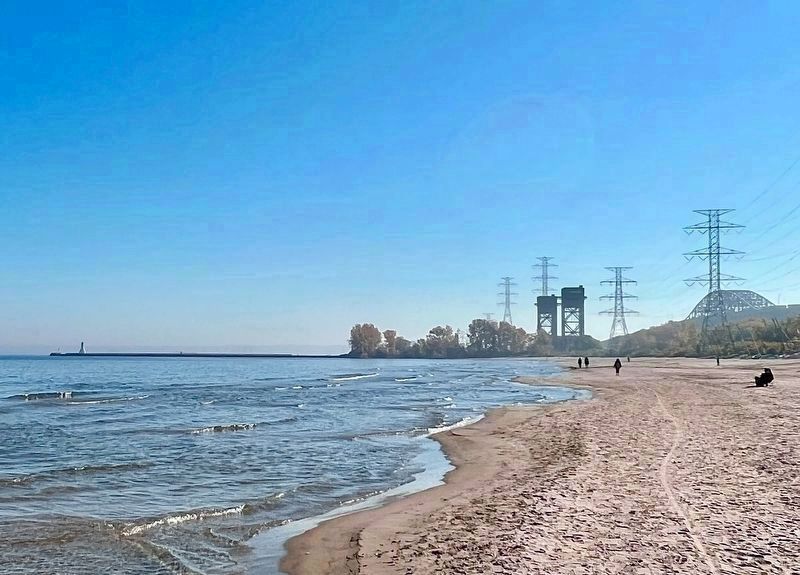
Photographed by Tim Boyd, October 24, 2022
5. Entrance to the Burlington Canal
Showing the pier and current lighthouse, the lift bridge and the Skyway
Credits. This page was last revised on December 12, 2024. It was originally submitted on December 8, 2024, by Tim Boyd of Hamilton, Ontario. This page has been viewed 152 times since then and 19 times this year. Photos: 1, 2, 3, 4, 5. submitted on December 8, 2024, by Tim Boyd of Hamilton, Ontario. • Andrew Ruppenstein was the editor who published this page.
