Clarksville in Montgomery County, Tennessee — The American South (East South Central)
Clarksville’s Civil Rights Movement
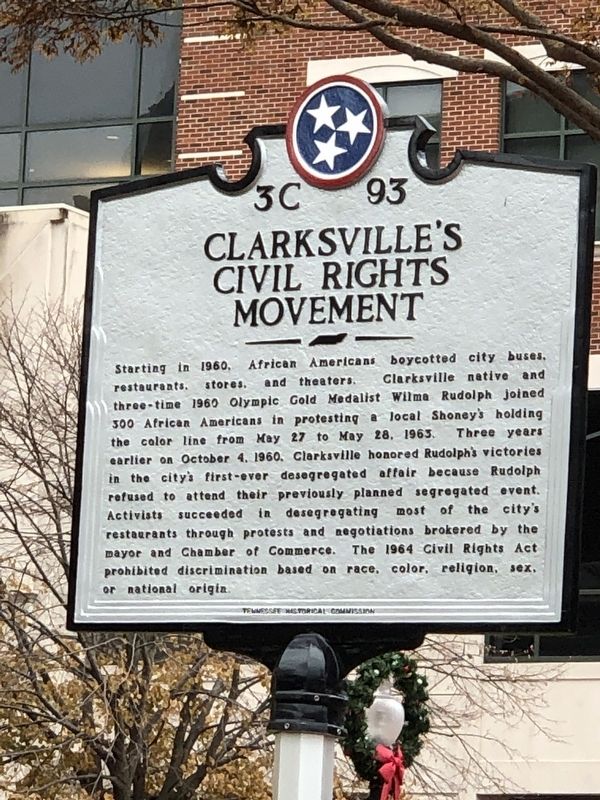
Photographed by Duane and Tracy Marsteller, December 9, 2024
1. Clarksville’s Civil Rights Movement Marker
Erected by Tennessee Historical Commission. (Marker Number 3C 93.)
Topics and series. This historical marker is listed in these topic lists: African Americans • Civil Rights • Sports. In addition, it is included in the Tennessee Historical Commission series list. A significant historical date for this entry is May 27, 1963.
Location. 36° 31.606′ N, 87° 21.459′ W. Marker is in Clarksville,
this page online

Regionally, this marker is in Middle Tennessee and in the Highland Rim. It is also in the American South and specifically in the Upper South. Globally, it is in North America, the Western Hemisphere, the Western World, and the Anglosphere. Historically, it finds itself in what was once the territory of the Mississippian Culture, one of the Confederate States of America, and the Antebellum South.
Other nearby markers. At least 8 other markers are within walking distance of this marker: Austin Peay (a few steps from this marker); Nora (within shouting distance of this marker); A Mighty Wind... Community Unites To Rebuild (within shouting distance of this marker); First Courthouse Established ... Tennessee Awaits Statehood (within shouting distance of this marker); Town Population Increases ... Move Deemed Necessary
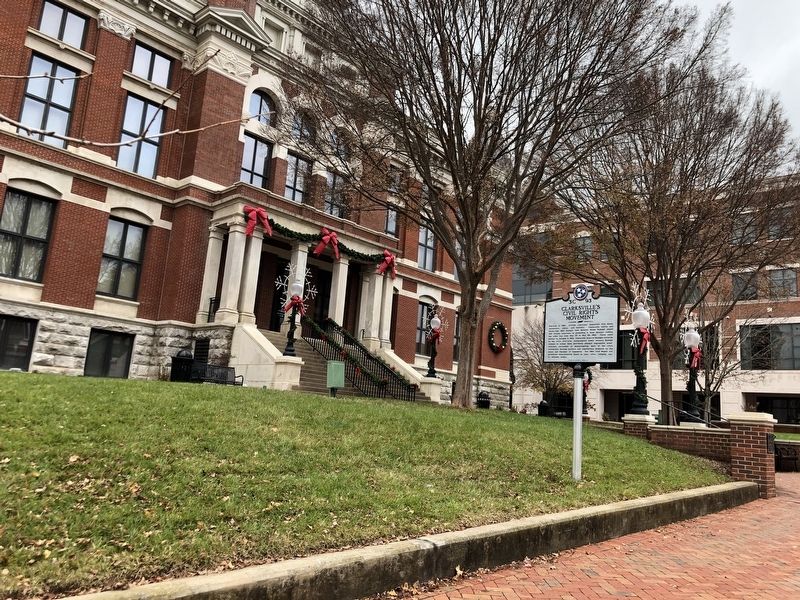
Photographed by Duane and Tracy Marsteller, December 9, 2024
2. Clarksville’s Civil Rights Movement Marker
Regarding Clarksville’s Civil Rights Movement. From Jet magazine, June 13, 1963:
Hometown Eatery Jerks Welcome Mat From Wilma
The red carpet rolled out in 1960 for Olympic champion Wilma Rudolph's homecoming to Clarksville, Tenn., was given a hefty jerk when she recently sought service in a local eatery. Accompanied by a group of local Negro citizens, Miss Rudolph found the entrance to Shoney's restaurant locked to all Negroes seeking to enter. One of the few places of public accommodation still segregated following two weeks of integration appeals by the Citizens Committee on Local Affairs, "Shoney's was the only place where we had to resort to mass demonstrations," said the Rev. Carl Liggin, head of the group. Recalling her1960 homecoming, Miss Rudolph expressed shock over the eatery's rebuff. "What a pity that "Skeeter" (Wilma's local nickname) should receive warm hospitality all over the world, and come home to something like this," snapped a long-time associate. "We're out of the movie balconies," enthused the Rev. Liggin, in recounting how "the wonderful support of the mayor, city administration and local businessmen," had sent bias-bars tumbling over the past few weeks.Telephoto via Clio: Your Guide to History (Public Domain), May 19633. Wilma Rudolph at Hometown Shoney'sNews photo from the May, 1963 protest, in which Rudolph finds Shoney's had locked its doors rather than serve African Americans.
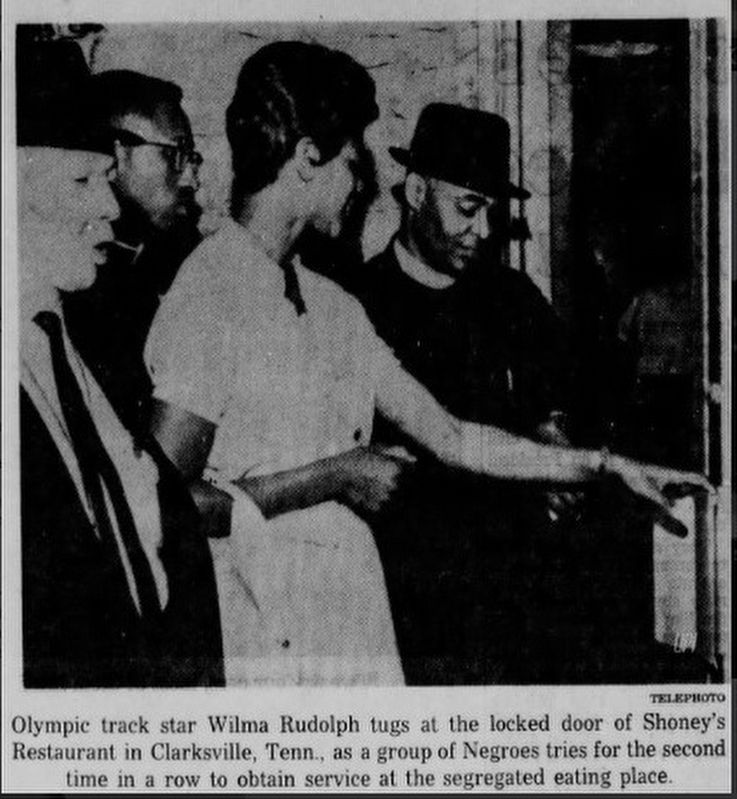
Also see . . . Olympic Gold Medalist Wilma Rudolph Leads Protest Against Segregation, 1963. [T]he presence of this local sports hero did not change the restaurant's white-only policy. However, Rudolph's joining the month-long protest at Shoneys did assure the presence of news cameras. (David J. Trowbridge, Clio: Your Guide to History, March 18, 2016) (Submitted on December 9, 2024, by Duane and Tracy Marsteller of Murfreesboro, Tennessee.)
Credits. This page was last revised on December 9, 2024. It was originally submitted on December 9, 2024, by Duane and Tracy Marsteller of Murfreesboro, Tennessee. This page has been viewed 702 times since then and 81 times this year. Photos: 1, 2, 3. submitted on December 9, 2024, by Duane and Tracy Marsteller of Murfreesboro, Tennessee.
