Onze-Lieve-Vrouw Quarter in Brugge in West-Vlaanderen, Flanders, Belgium — Northwestern Europe
Stoofstraat
Photographed by Steve Stoessel, December 12, 2024
1. Stoofstraat Marker
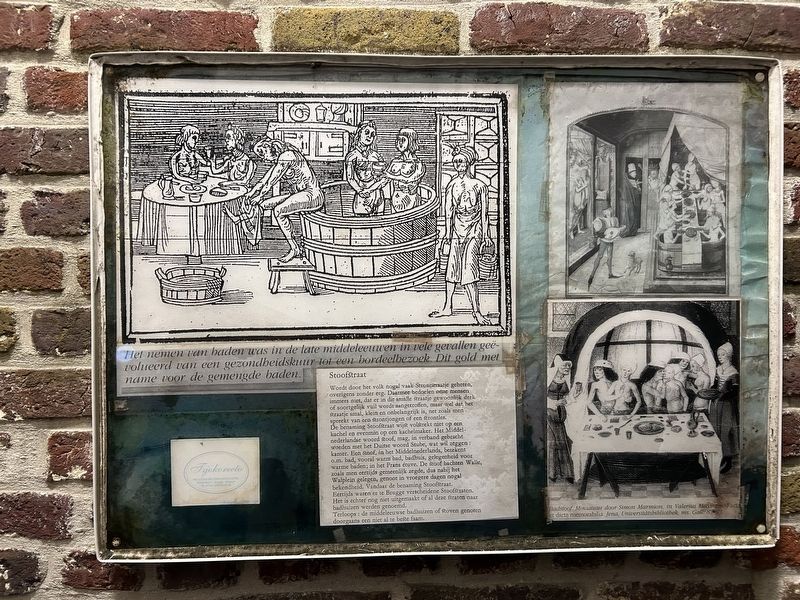
Stoofstraat is often called Strontstraatje by people, but without any real meaning. After all, people do not mean that this narrow street usually contains dirt or similar filth, but that the Straatje is narrow, small and unimportant, just as people speak of a shit boy or a Strontles.
The name Stoofstraat does not refer to a stove or a stove maker. The Middle Dutch word stoof may be associated with the German word Stube which means: room. A Stoof, in Middle Dutch, means among other things bath, especially warm bath, bathhouse, opportunity for warm baths; in French étuve. The “stove batten” [sic] [warm bath?] Walle, as it used to be called, located near the Walplein, enjoyed considerable fame in earlier days. Hence the name Stoofstraat.
In the past, there were several Stoofstraaten in Bruges. However, it has not yet been determined whether all these streets were named after bathhouses.
Incidentally: the medieval bathhouses or stoves generally did not enjoy a very good reputation.
[Nederland]
Wordt door het volk nogal vaak Strontstraatje geheten, overigens zonder erg. Daarmee bedoelen onze mensen immers niet, dat
this page online
De benaming Stoofstraat wijst volstrekt niet op een kachel en evenmin op een kachelmaker. Het Middelnederlandse woord stoof, mag, in verband gebracht worden met het Duitse woord Stube, wat wil zeggen : kamer. Een stoof, in het Middelnederlands, betekent o.m. bad, vooral warm bad, badhuis, gelegenheid voor warme baden; in het Frans étuve. De stoof bachten Walle, zoals men eertijds gemeenlijk zegde, dus nabij het Walplein gelegen, genoot in vroegere dagen nogal bekendheid. Vandaar de benaming StoofStraat. Eertiids waren er te Brugge verscheidene Stoofstraten. Het is echter nog niet uitgemaakt of al deze Straten naar badhuizen werden genoemd.
Terloops : de middeleeuwse badhuizen of Stoven genoten doorgaan een niet al te beste fame.
[Illustrations:]
In the late Middle Ages, taking baths had in many cases evolved from a health cure to a visit to a brothel. This was especially true for the mixed baths.
Het nemen van baden was in de
Photographed by Steve Stoessel, December 12, 2024
2. Stoofstraat Marker
Badstoof. Miniature by Simon Marmion, in Valerius Maninti et dicta memorabilia. Jena, Universitätsbibliothek, ms. Gall: 8788
Erected by Tsjokotreto.
Topics. This historical marker is listed in this topic list: Roads & Vehicles.
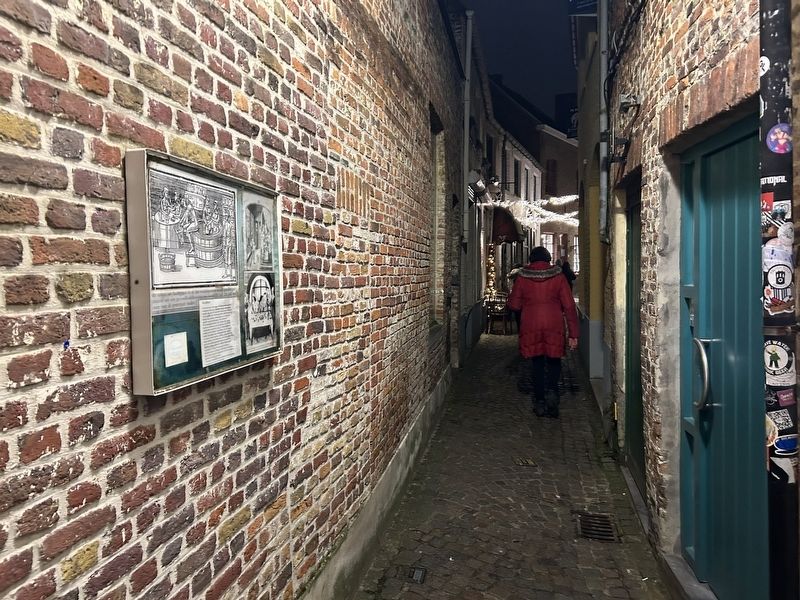
Location. 51° 12.196′ N, 3° 13.484′ E. Marker is in Brugge, Vlaanderen (Flanders), in West-Vlaanderen. It is in the Onze-Lieve-Vrouw Quarter. It is on Stoofstraat west of Katelijnestraat, on the left when traveling west. Touch for map. Marker is at or near this postal address: Stoofstraat 1, Brugge, Vlaanderen 8000, Belgium. Touch for directions.

Regionally, it is in Europe, the European Union, Atlantic Europe, the Benelux Low Countries, the Schengen Area, Western Europe, and the Western World. Historically, it finds itself in what was once the Roman Empire, the Holy Roman Empire, and the Hanseatic League.
Other nearby markers. At least one other marker is within walking distance of this marker: ’T Keerske (approx. 0.7 kilometers away).
Credits. This page was last revised on December 15, 2024. It was originally submitted on December 13, 2024, by Steve Stoessel of Niskayuna, New York. This page has been viewed 151 times since then and 29 times this year. Photos: 1. submitted on December 13, 2024, by Steve Stoessel of Niskayuna, New York. 2. submitted on December 15, 2024, by Steve Stoessel of Niskayuna, New York.
