Lanier Heights in Northwest Washington in Washington, District of Columbia — The American Northeast (Mid-Atlantic)
Welcome to the Ancestors Pavilion
Photographed by J. Makali Bruton, December 1, 2024
1. Welcome to the Ancestors Pavilion Marker
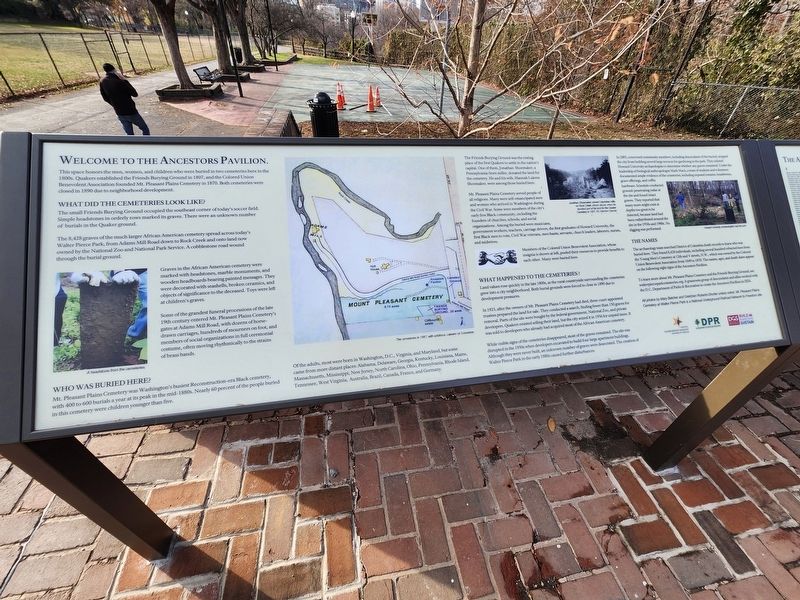
Welcome to the Ancestors Pavilion.
This space honors the men, women, and children who were buried in two cemeteries here in the 1800s. Quakers established the Friends Burying Ground in 1807, and the Colored Union Benevolent Association founded Mt. Pleasant Plains Cemetery in 1870. Both cemeteries were closed in 1890 due to neighborhood development.
What did the cemeteries look like?
The small Friends Burying Ground occupied the southeast corner of today's soccer field. Simple headstones in orderly rows marked its graves. There were an unknown number of burials in the Quaker ground.
The 8,428 graves of the much larger African American cemetery spread across today's Walter Pierce Park, from Adams Mill Road down to Rock Creek and onto land now owned by the National Zoo and National Park Service. A cobblestone road wound through the burial ground.
Graves in the African American cemetery were marked with headstones, marble monuments, and wooden headboards bearing painted messages. They were decorated with seashells, broken ceramics, and objects of significance to the deceased. Toys were left at children's
this page online
Some of the grandest funeral processions of the late 19th century entered Mt. Pleasant Plains Cemetery's gates at Adams Mill Road, with dozens of horse- drawn carriages, hundreds of mourners on foot, and members of social organizations in full ceremonial costume, often moving rhythmically to the strains of brass bands.
Who was buried here?
Mt. Pleasant Plains Cemetery was Washington's busiest Reconstruction-era Black cemetery, with 400 to 600 burials a year at its peak in the mid-1880s. Nearly 60 percent of the people buried in this cemetery were children younger than five.
Of the adults, most were born in Washington, D.C., Virginia, and Maryland, but some came from more distant places: Alabama, Delaware, Georgia, Kentucky, Louisiana, Maine, Massachusetts, Mississippi, New Jersey, North Carolina, Ohio, Pennsylvania, Rhode Island, Tennessee, West Virginia, Australia, Brazil, Canada, France, and Germany.
The Friends Burying Ground was the resting place of the first Quakers to settle in the nation's capital. One of them, Jonathan Shoemaker, a Pennsylvania-born miller, donated the land for the cemetery. He and his
Photographed by J. Makali Bruton, December 1, 2024
2. Welcome to the Ancestors Pavilion Marker
Mt. Pleasant Plains Cemetery served people of all religions. Many were self-emancipated men and women who arrived in Washington during the Civil War. Some were members of the city's early free Black community, including the founders of churches, schools, and social organizations. Among the buried were musicians, government workers, teachers, carriage drivers, the first graduates of Howard University, the first Black men to vote, Civil War veterans, merchants, servants, church leaders, laborers, nurses, and midwives.
Members of the Colored Union Benevolent Association, whose insignia is shown at left, pooled their resources to provide benefits to each other. Many were buried here.
What happened to the cemeteries?
Land values rose quickly in the late 1800s, as the rural countryside surrounding the cemeteries grew into a city neighborhood. Both burial grounds were forced to close in 1890 due to development pressures.
In 1923, after the owners of Mt. Pleasant Plains Cemetery had died, three court-appointed trustees prepared the land for sale. They conducted a search, finding fewer than 150 graves for removal. Parts of the site were bought by the federal government, National Zoo, and private developers. Quakers resisted selling their land, but the city seized it in 1956 for unpaid taxes. It was sold to developers who already had acquired most of the African American cemetery.
While visible signs of the cemeteries disappeared, most of the graves remained. The site was disrupted in the 1950s when developers excavated to build four large apartment buildings. Although they were never built, an unknown number of graves were desecrated. The creation of Walter Pierce Park in the early 1980s caused further disturbances.
In 2005, concerned community members, including descendants of the buried, stopped the city from building several large terraces for gardening in the park. They enlisted Howard University archaeologists to determine whether any graves remained. Under the leadership of biological anthropologist Mark Mack, a team of students and volunteers documented ample evidence of the cemeteries, including exposed remains, headstones, grave offerings, and coffin hardware. Scientists conducted ground-penetrating radar at the site and found intact graves. They reported that many more might exist at depths too great to be detected, because land had been redistributed around the site in the 1950s and 1980s. No digging was performed.
The Names
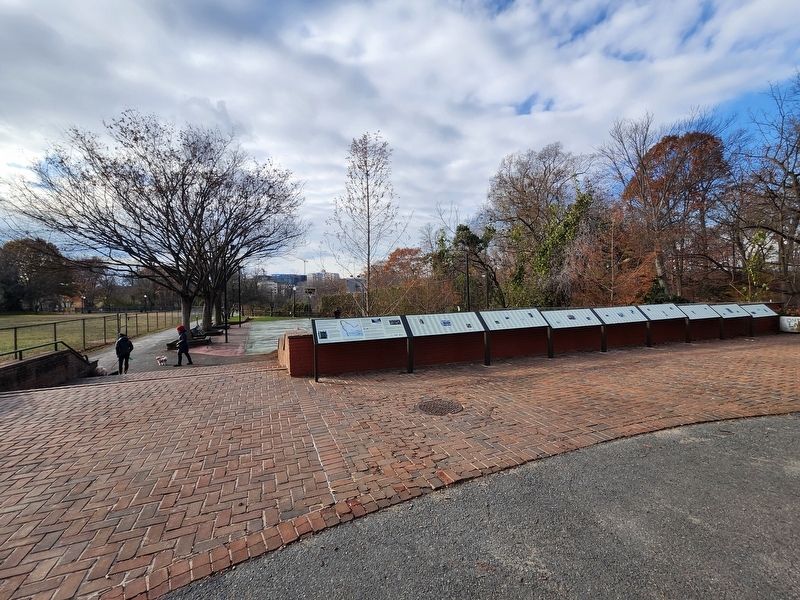
The archaeology team searched District of Columbia death records to learn who was buried here. They found 8,428 individuals, including several hundred reburied here from the Young Men's Cemetery at 12th and V streets, N.W., which was owned by the Colored Union Benevolent Association from 1849 to 1870. The names, ages, and death dates appear on the following eight signs of the Ancestors Pavilion.
To learn more about Mt. Pleasant Plains Cemetery and the Friends Burying Ground, see walterpierceparkcemeteries.org. A grassroots group of descendants and allies worked with the D.C. Department of Parks & Recreation to create the Ancestors Pavilion in 2024.
All photos by Mary Belcher and Gretchen Roberts-Shorter unless noted. Mt. Pleasant Plains Cemetery at Walter Pierce Park is a National Underground Railroad Network to Freedom site.
Captions
A headstone from the cemeteries.
The cemeteries in 1887, with additions. Library of Congress
Jonathan Shoemaker owned Columbian Mills on Rock Creek, shown above, when he donated part of his land for the Quaker Cemetery in 1807. DC History Center
Howard University archeologists map the park.
Names on additional panels not transcribed
Erected by Department of Parks and Recreation.
Topics. This historical marker is listed in these topic lists: African Americans • Cemeteries & Burial Sites. A significant historical year for this entry is 1807.
Location. 38° 55.454′ N, 77° 2.733′ W. Marker is in Northwest Washington in Washington, District of Columbia. It is in Lanier Heights. It is at the intersection of Adams Mill Road Northwest and Blue Road, on the right when traveling south on Adams Mill Road Northwest. Touch for map. Marker is in this post office area: Washington DC 20009, United States of America. Touch for directions.

Regionally, this marker is in the Washington Metropolitan Area. It is also in the American Northeast, in the Upper South, in the Mid-Atlantic, in the Tidewater, and in the Chesapeake Bay Region. Globally, it is in North America, the Western Hemisphere, the Western World, and the Anglosphere.
Other nearby markers. At least 8 other markers are within walking distance of this marker: Walter Pierce Park (about 300 feet away, measured in a direct line); Archaeology in Adams Morgan: Surveying the Walter Pierce Park Cemeteries, 2005-2013 (about 600 feet away); Soldiers, Sailors, and Refugees of War (about 600 feet away); Rediscovery and Remembrance (about 600 feet away); Seeking Freedom (about 600 feet away); Resilience and Resistance (about 600 feet away); The "Duke" Ellington Memorial Bridge (about 600 feet away); "Suburban" Development (about 700 feet away). Touch for a list and map of all markers in Northwest Washington.
Other markers no longer nearby. Archaeology in Adams Morgan (was about 600 feet away but has been replaced with another marker now near it); Soldiers and Sailors Buried at Mt. Pleasant Plains Cemetery, 1870-1890 (was about 600 feet away but has been permanently removed).
Credits. This page was last revised on December 15, 2024. It was originally submitted on December 14, 2024, by J. Makali Bruton of Washington, District of Columbia. This page has been viewed 281 times since then and 28 times this year. Photos: 1, 2. submitted on December 14, 2024, by J. Makali Bruton of Washington, District of Columbia.
