Historic District in Wilmington in New Hanover County, North Carolina — The American South (South Atlantic)
Historic St. Paul's Evangelical Lutheran Church
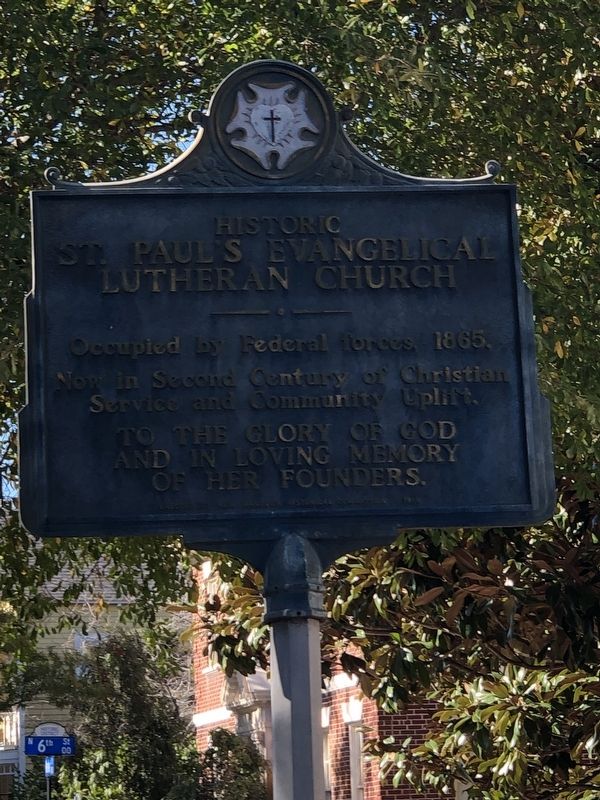
Photographed by Duane and Tracy Marsteller, November 23, 2024
1. Historic St. Paul's Evangelical Lutheran Church Marker
Now in second century of Christian service and community uplift.
To the glory of God and in loving memory of her founders.
Topics and series. This historical marker is listed in these topic lists: Religion & Religious Structures • War, US Civil. In addition, it is included in the National Register of Historic Places (NRHP) series list. A significant historical year for this entry is 1865.
Location. 34° 14.161′ N, 77° 56.499′ W. Marker is in Wilmington, North Carolina, in New Hanover County. It is in the Historic District. It is at the intersection of Market Street (Business U.S. 17) and North 6th Street, on the right when traveling west on Market Street. Touch for map. Marker is at or near this postal address: 12 N 6th St, Wilmington NC 28401, United States of America. Touch for directions.

Regionally, this marker is in the Coastal Plain and on the Cape Fear Coast. It is also in the American South, specifically in the Upper South, in the Tidewater, and on the Eastern Seaboard. Globally, it is in the North Atlantic Region, North America, the Western Hemisphere, the Western
this page online
Other nearby markers. At least 8 other markers are within walking distance of this marker: St. Paul's Evangelical Lutheran Church (a few steps from this marker); Henry Clay Bear House (within shouting distance of this marker); Grant-Thompson House (within shouting distance of this marker); William J. Price House (within shouting distance of this marker); Toon House (about 300 feet away, measured in a direct line); Henderson House (about 300 feet away); The Bellamy Mansion & Slave Quarters (about 300 feet away); Oscar Herbert Wright House (about 300 feet away). Touch for a list and map of all markers in Wilmington.
Also see . . .
1. History. After the fall of Fort Fisher in January of 1865, Wilmington was occupied by Federal troops. The enlisted troops camped in St. Paul’s churchyard. The troops stabled their horses in the unfinished church and took wooden furnishings to use as firewood.(St. Paul's Lutheran Church)
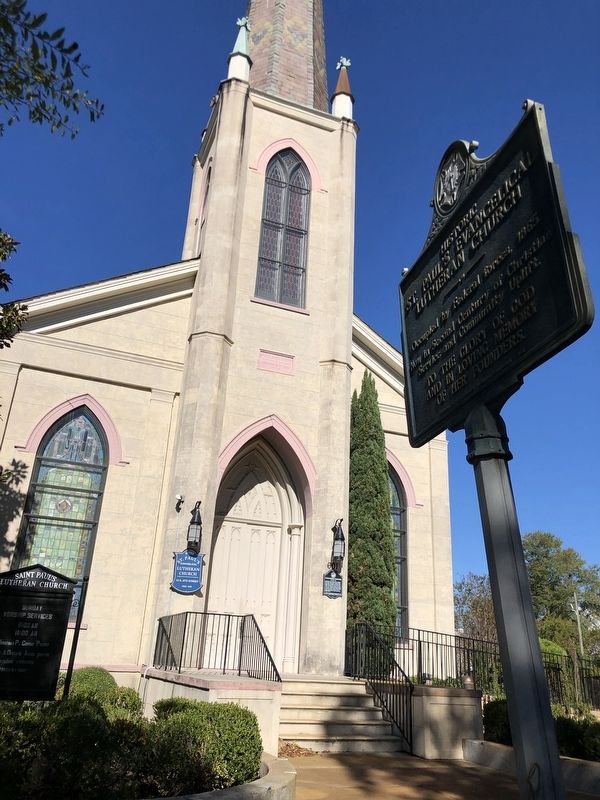
Photographed by Duane and Tracy Marsteller, November 23, 2024
2. Historic St. Paul's Evangelical Lutheran Church Marker
2. Wilmington Historic District (PDF). National Register of Historic Places nomination for the district, which includes this property and was listed in 1974. (Prepared by Survey and Planning Unit, North Carolina Division of Archives and History; via North Carolina State Historic Preservation Office) (Submitted on December 17, 2024, by Duane and Tracy Marsteller of Murfreesboro, Tennessee.)
3. Wilmington Historic District Boundary Expansion and Additional Documentation (PDF). National Register nomination that expanded the district in 2003. (Prepared by Sherry Joines Wyatt and L. Robbie King; via North Carolina State Historic Preservation Office) (Submitted on December 17, 2024, by Duane and Tracy Marsteller of Murfreesboro, Tennessee.)
Credits. This page was last revised on December 17, 2024. It was originally submitted on December 16, 2024, by Duane and Tracy Marsteller of Murfreesboro, Tennessee. This page has been viewed 153 times since then and 22 times this year. Photos: 1, 2. submitted on December 16, 2024, by Duane and Tracy Marsteller of Murfreesboro, Tennessee.
