Historic District in Wilmington in New Hanover County, North Carolina — The American South (South Atlantic)
The Bellamy Mansion & Slave Quarters
Photographed by Duane and Tracy Marsteller, November 23, 2024
1. The Bellamy Mansion & Slave Quarters Marker
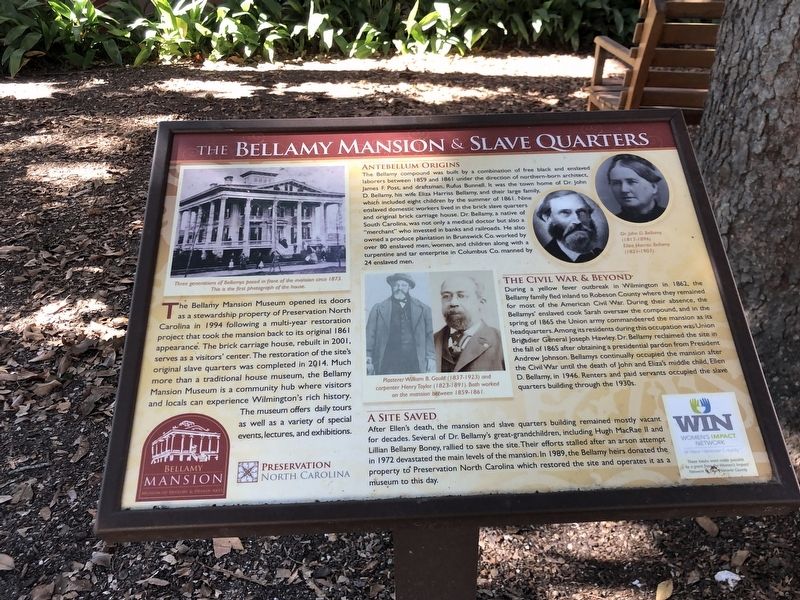
The Bellamy compound was built by a combination of free black and enslaved laborers between 1859 and 1861 under the direction of northern-born architect, James F. Post and draftsman Rufus Bunnell. It was the town home of Dr. John D. Bellamy, his wife Elza Harriss Bellamy, and their large family, which included eight children by the summer of 1861. Nine enslaved domestic workers lived in the brick slave quarters and original brick carriage house. Dr. Bellamy, a native of South Carolina, was not only a medical doctor but also a “merchant” who invested in banks and railroads. He also owned a produce plantation in Brunswick Co. worked by over 80 enslaved men, women, and children along with a turpentine and tar enterprise in Columbus Co. manned by 24 enslaved men.
The Civil War & Beyond
During a yellow fever outbreak in Wilmington in 1862, the Bellamy family fled inland to Robeson County where they remained for most of the American Civil War. During their absence, the Bellamys' enslaved cook Sarah oversaw the compound, and in the spring of 1865 the Union army commandeered the mansion as its headquarters.
this page online
A Site Saved
After Ellen's death, the mansion and slave quarters building remained mostly vacant for decades. Several of Dr. Bellamy's great-grandchildren, including Hugh MacRae II and Lillian Bellamy Boney, rallied to save the site. Their efforts stalled after an arson attempt in 1972 devastated the main levels of the mansion. In 1989, the Bellamy heirs donated the property to Preservation North Carolina which restored the site and operates it as a museum to this day.
The Bellamy Mansion Museum opened its doors as a stewardship property of Preservation North Carolina in 1994 following a multi-year restoration project that took the mansion back to its original 1861 appearance. The brick carriage house, rebuilt

Photographed by Duane and Tracy Marsteller, November 23, 2024
2. The Bellamy Mansion & Slave Quarters Marker
[Captions (left to right)]
• Three generations of Bellamys posed in front of the mansion circa 1873. This is the first photograph of the house.
• Plasterer William B. Gould (1837-1923) and carpenter Henry Taylor (1823-189 ) both worked on the mansion between 1859-1861.
• Dr. John D. Bellamy (1817-1896)
• Eliza Harriss Bellamy (1821-1907)
Erected by Bellamy Mansion Museum of History & Design Arts • Preservation North Carolina • Women's Impact Network of New Hanover County.
Topics and series. This historical marker is listed in these topic lists: African Americans • Architecture • War, US Civil. In addition, it is included in the National Register of Historic Places (NRHP) series list. A significant historical year for this entry is 1859.
Location. 34° 14.166′ N, 77° 56.563′ W.

Photographed by Duane and Tracy Marsteller, November 23, 2024
3. The Bellamy Mansion

Regionally, this marker is in North Carolina’s Coastal Plain and on the Cape Fear Coast. It is also in the American South, specifically in the Upper South, in the Tidewater, and on the Eastern Seaboard. Globally, it is in the North Atlantic Region, North America, the Western Hemisphere, the Western World, and the Anglosphere. Historically, it finds itself in what was once the territory of the Mississippian Culture, one of the original Thirteen Colonies, one of the Confederate States of America, and the Antebellum South.
Other nearby markers. At least 8 other markers are within walking distance of this marker: Grant-Thompson House (a few steps from this marker); a different marker also named The Bellamy Mansion & Slave Quarters (within shouting distance

Photographed by Duane and Tracy Marsteller, November 23, 2024
4. The Bellamy Slave Quarters
Also see . . .
1. The Place. Every aspect of the mansion’s design was deliberate. From placing the kitchen on the east side of the home so it received the first light of day to placing a belvedere at the very top that acted as a sort of early air conditioning, James F. Post and his assistant architect Rufus Bunnell left nothing to chance. (Bellay Mansion Museum of History & Design Arts) (Submitted on December 18, 2024, by Duane and Tracy Marsteller of Murfreesboro, Tennessee.)
2. Wilmington Historic District (PDF). National Register of Historic Places nomination for the district, which includes this property and was listed in 1974. (Prepared by Survey and Planning Unit, North Carolina Division of Archives and History; via North Carolina State Historic Preservation Office) (Submitted on December 18, 2024, by Duane and Tracy Marsteller of Murfreesboro, Tennessee.)
3. Wilmington Historic District Boundary Expansion and Additional Documentation (PDF). National Register nomination that expanded the district in 2003. (Prepared by Sherry Joines Wyatt and L. Robbie King; via North Carolina State Historic Preservation Office) (Submitted on December 18, 2024, by Duane and Tracy Marsteller of Murfreesboro, Tennessee.)
Credits. This page was last revised on December 18, 2024. It was originally submitted on December 16, 2024, by Duane and Tracy Marsteller of Murfreesboro, Tennessee. This page has been viewed 518 times since then and 78 times this year. Photos: 1, 2. submitted on December 16, 2024, by Duane and Tracy Marsteller of Murfreesboro, Tennessee. 3, 4. submitted on December 18, 2024, by Duane and Tracy Marsteller of Murfreesboro, Tennessee.
