St. Augustine in St. Johns County, Florida — The American South (South Atlantic)
Formative Years
Live Oak ~ St. Augustine 1918-1940
| — | Florida Memorial University A.L. Lewis Archway Plaza | — |
Photographed by Brandon D Cross
1. Formative Years Marker
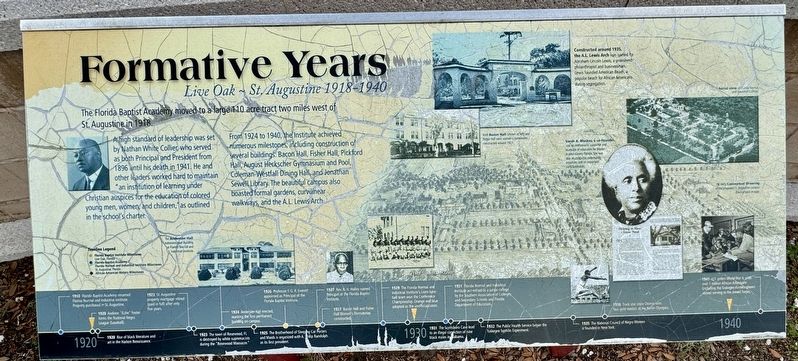
The Florida Baptist Academy moved to a large 110 acre tract two miles west of St. Augustine in 1918.
A high standard of leadership was set by Nathan White Collier, who served as both Principal and President from 1896 until his death in 1941. He and other leaders worked hard to maintain "an institution of learning under Christian auspices for the education of colored young men, women, and children," as outlined in the school’s charter.
From 1924 to 1940, the Institute achieved numerous milestones, including construction of several buildings: Bacon Hall, Fisher Hall, Pickford Hall, August Heckscher Gymnasium and Pool, Coleman-Westfall Dining Hall, and Jonathan Sewell Library. The beautiful campus also boasted formal gardens, curvilinear walkways, and the A.L. Lewis Arch.
Timeline Legend
(yellow) Florida Baptist Institute Milestones
Live Oak, Florida
(blue) Florida Baptist Academy
Florida Normal and Industrial Institute Milestones
St. Augustine, Florida
(black) African American History Milestones
(blue) 1912 Florida Baptist Academy renamed Florida Normal and Industrial Institute. Property purchased in St. Augustine.
(black) 1920 Andrew “Rube” Foster forms the National Negro League (baseball).
(black) 1920 Rise of black literature and art in the Harlem Renaissance.
(blue) 1923 St. Augustine property mortgage retired (paid in full) after only five years.
(black) 1923 The Town of Rosewood, FL is destroyed by white supremacists during the “ Rosewood Massacre.”
(blue) 1924 Anderson Hall erected, marking the first permanent building on campus.
(black) 1925 The Brotherhood of Sleeping Car Porters and Maids is organized with A. Phillip Randolph as its first president.
(yellow) 1926 Professor F. G. R. Everett appointed as Principal of the Florida Baptist Institute.
(yellow) 1927 Rev. R.H. Holley named Principal of the Baptist Institute.
(blue) 1927 Bacon Hall and Fisher Hall Woman’s Dormitories constructed.
(black) 1929 The Florida Normal and Industrial Institute’s Lion’s baseball team won the Conference Championship. Orange and Blue adopted as the unofficial colors.
1929 Stock Market Crash
(blue) 1931 FLorida Normal and Industrial Institute accredited as a junior college by the Southern Association of Colleges and Secondary Schools and Florida Department of Education,
(black) 1931 The Scottsboro Case lead to an illegal conviction of nine black males in Alabama.
(black) 1932 The Public Health Service began the Tuskegee Syphilis Experiment.
(black) 1935 The National Council of Negro Women is founded in New York.
(black) 1936 Track Star Jesse Owens wins four gold medals at the Berlin Olympics.
(black) 1941 U.S. enters World War II, with over 1 million African Americans (including the Tuskegee Airmen shown above) serving in the armed forces.
(captions)
The Anderson Hall Administration Building at Florida Normal and Industrial Institute.
Both Bacon Hall (shown at left) and Fisher Hall were women's dormitories constructed around 1927.
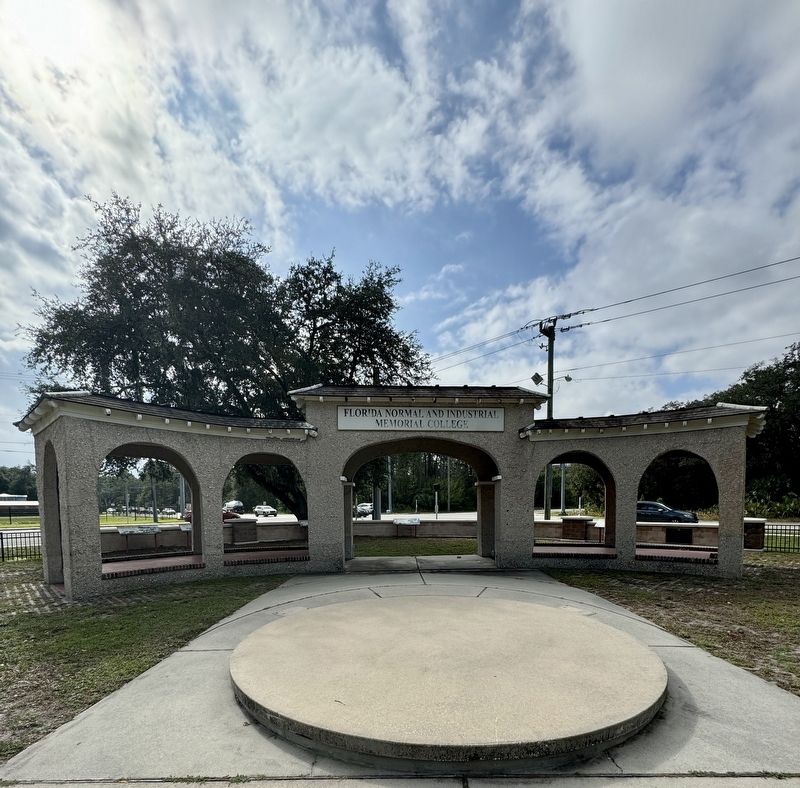
Constructed around 1935, the A.L. Lewis Arch was named for Abraham Lincoln Lewis, a prominent philanthropist and businessman, Lewis founded American Beach, a popular beach for African Americans during segregation.
Sarah A. Blocker, a co-founder, was an enthusiastic supporter and advocate for education for blacks in post-slavery Florida. She was also an instructor, community organizer, and an important early fundraiser.
An early Conceptual Drawing of the proposed St. Augustine campus (background image)
Erected by Florida
this page online
Topics. This historical marker is listed in these topic lists: African Americans • Arts, Letters, Music • Civil Rights • Education. A significant historical year for this entry is 1918.
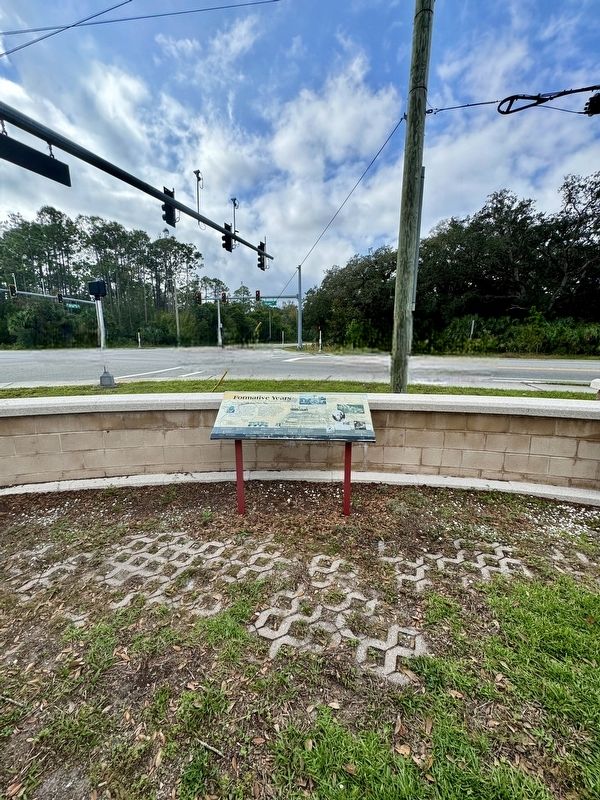
Location. 29° 53.255′ N, 81° 21.261′ W. Marker is in St. Augustine, Florida, in St. Johns County. It can be reached from the intersection of North Holmes Boulevard and West King Street, on the right when traveling north. The Marker is located within Florida Memorial University A.L. Lewis Archway Plaza. Touch for map. Marker is at or near this postal address: 10 North Holmes Boulevard, Saint Augustine FL 32084, United States of America. Touch for directions.

Regionally, this marker is in First Coast and in Greater Jacksonville. It is also in the American South and on the Eastern Seaboard. Globally, it is in the North Atlantic Region, North America, a Gulf of Mexico state, the Western Hemisphere, the Western World, and the Anglosphere. Historically, it finds itself in what was once New Spain, the territory of the Mississippian Culture, one of the Confederate States of America, and the Antebellum South.
Photographed by Brandon D Cross
2. Formative Years Marker
Other nearby markers. At least 8 other markers are within walking distance of this marker: Merger-Expansion Years (here, next to this marker); Civil Rights Movement (a few steps from this marker); Florida Memorial University (a few steps from this marker); Our Native Son Lieutenant General Ronald L. Bailey (a few steps from this marker); College Years (a few steps from this marker); University Years (a few steps from this marker); St. Johns Railway (within shouting distance of this marker); 1074 West King Street (approx. 0.3 miles away). Touch for a list and map of all markers in St. Augustine.
Also see . . .
1. Florida Memorial College. (Submitted on December 17, 2024, by Brandon D Cross of Flagler Beach, Florida.)
2. A.L. Lewis Archway: Florida Normal & Industrial Institute. (Submitted on December 17, 2024, by Brandon D Cross of Flagler Beach, Florida.)
3. The History of Florida Memorial University. (Submitted on December 17, 2024, by Brandon D Cross of Flagler Beach, Florida.)
Photographed by Brandon D Cross
3. Florida Memorial University A.L. Lewis Archway Plaza
Photographed by Brandon D Cross
4. Dedication Plaque
Credits. This page was last revised on January 9, 2025. It was originally submitted on December 17, 2024, by Brandon D Cross of Flagler Beach, Florida. This page has been viewed 198 times since then and 25 times this year. Photos: 1, 2, 3, 4. submitted on December 17, 2024, by Brandon D Cross of Flagler Beach, Florida. • Bernard Fisher was the editor who published this page.
