Cape Girardeau in Cape Girardeau County, Missouri — The American Midwest (Upper Plains)
1958
River Industry
Photographed by Edward Troxel, November 16, 2024
1. 1958 Marker
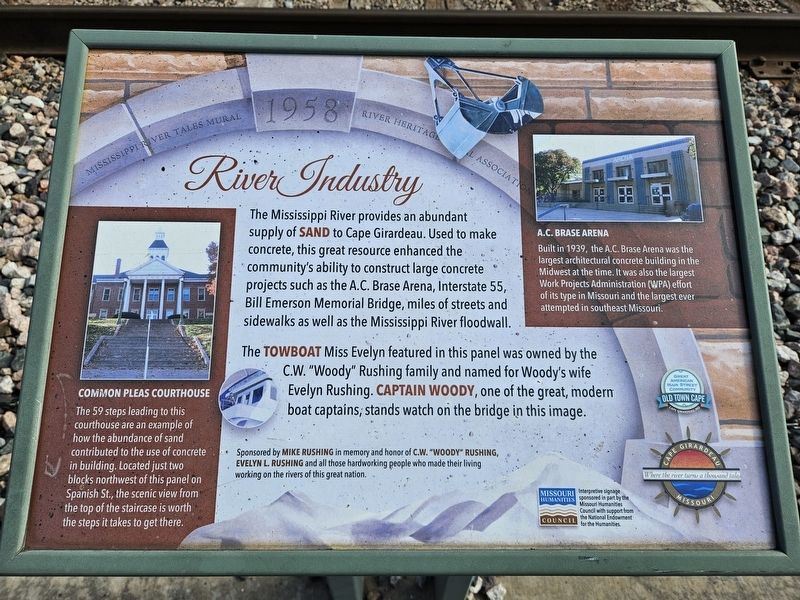
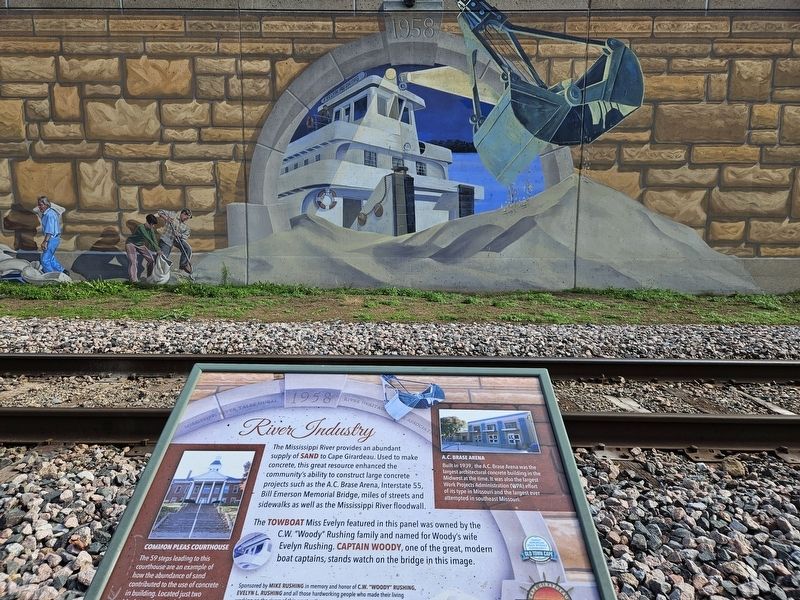
The Mississippi River provides an abundant supply of sand to Cape Girardeau. Used to make concrete, this great resource enhanced the community's ability to construct large concrete projects such as the A.C. Brase Arena, Interstate 55, Bill Emerson Memorial Bridge, miles of streets and sidewalks as well as the Mississippi River floodwall.
The towboat Miss Evelyn featured in this panel was owned by the C.W. "Woody" Rushing family and named for Woody's wife Evelyn Rushing. Captain Woody, one of the great, modern boat captains, stands watch on the bridge in this image.
Common Please Courthouse
The 59 steps leading to this courthouse are an example of how the abundance of sand contributed to the use of concrete in building. Located just two blocks northwest of this panel on Spanish St., the scenic view from the top of the staircase is worth the steps it takes to get there.
A.C. Brase Arena
Built in 1939, the A.C. Brase Arena was the largest architectural concrete building in the Midwest at the time. It was also the largest Work Projects Administration (WPA) effort of its type in Missouri
this page online
Topics. This historical marker is listed in these topic lists: Architecture • Bridges & Viaducts • Natural Resources • Waterways & Vessels. A significant historical year for this entry is 1958.
Location. 37° 18.237′ N, 89° 31.071′ W. Marker is in Cape Girardeau, Missouri, in Cape Girardeau County. It is on North Water Street north of Independence Street, on the left when traveling south. Located on Missouri Wall of Fame along the Missouri River Front. Touch for map. Marker is at or near this postal address: 20 N Water St, Cape Girardeau MO 63701, United States of America. Touch for directions.

Regionally, this marker is in Southeast Missouri. It is also in the American Ozarks, in the Lewis & Clark Corridor, in the Corn Belt, and in the Great River Road Region. Globally, it is in North America, the Western Hemisphere, the Western World, and the Anglosphere. Historically, it finds itself in what was once the territory of the Mississippian Culture, the Louisiana Purchase, and the Antebellum South.
Other nearby markers. At least 7 other markers are within
Photographed by Edward Troxel, November 16, 2024
2. 1958 Marker
Other markers no longer nearby. 1958 (has been replaced with this marker); 1964 (was a few steps from this marker but has been replaced with another marker now near it); 1927 (was a few steps from this marker but has been replaced with another marker now near it); 1925 (was within shouting distance of this marker but has been replaced with another marker now near it); 1924 (was within shouting distance of this marker but has been replaced with another marker now near it); 1980 (was within shouting distance of this marker but has been replaced with another marker now near it); 1918 - 1919 (was within shouting distance of this marker but has been replaced with another marker now near it); 2003 (was within shouting distance of this marker but has been replaced with another marker now near it); 1916 (was within shouting distance of this marker but has been replaced with another marker now near it).
Credits. This page was last revised on February 7, 2025. It was originally submitted on December 19, 2024, by Edward Troxel of Creal Springs, Illinois. This page has been viewed 137 times since then and 27 times this year. Photos: 1, 2. submitted on December 19, 2024, by Edward Troxel of Creal Springs, Illinois. • Devry Becker Jones was the editor who published this page.
