Notre Dame in Paris in Département de Paris, Île-de-France, France — Western Europe
Square de l’Île-de-France (1914)

Photographed by Andrew Ruppenstein, September 11, 2024
1. Square de l’Île-de-France (1914) Marker

L'entrée vers le Mémorial des martyrs de la Déportation s'effectue par le square. La construction de 1954 à 1964 de ce monument-crypte par Georges-Henri Pingusson a été l'occasion de remanier les espaces végétalisés. Ainsi un saule pleureur est dédié aux victimes du nazisme et des rosiers Résurrection rendent hommage à la Résistance et aux victimes de la déportation.
This eastern part of the Île de la Cité was devoid of any particular use for a long time. Called "Motte aux papelards" or "Terrain" until the 18th century, this place seems to have been the repository of a lot of rubble, after the construction of the Notre Dame Cathedral, and accumulated detritus. In 1687, a first enclosed garden was noted as accessible only to the canons of the cathedral and to men. Then, the prefect Haussmann had the capital's morgue built there between 1861-1863 by the architect Émile Gilbert. The decision to move it to Quai de la Râpée in 1914 allowed the creation of a first square after the destruction of the buildings. It was in 1929 that it was baptized with
this page online
The entrance to the Memorial to the Martyrs of the Deportation is via the square. The construction of this monument-crypt by Georges-Henri Pingusson from 1954 to 1964 was an opportunity to rework the green spaces. A weeping willow is dedicated to the victims of Nazism and Resurrection rose bushes pay tribute to the Resistance and the victims of deportation.
Erected by Ville de Paris.
Topics and series. This historical marker is listed in this topic list: Parks & Recreational Areas. In addition, it is included in the Parks and Squares of Paris series list. A significant historical year for this entry is 1687.
Location. 48° 51.109′ N, 2° 21.113′ E. Marker is in Paris, Île-de-France, in Département de Paris. It is in Notre Dame. It is on Quai de l'Archevêché, on the right when traveling north. Touch for map. Marker is at or near this postal address: 7 Quai de l'Archevêché, Paris, Île-de-France 75004, France. Touch for directions.

Regionally, it is in the North Atlantic Region, Europe, the European Union, Atlantic Europe, the Schengen Area, Western Europe, a coastal Mediterranean country, and the Western
Photographed by Andrew Ruppenstein, September 11, 2024
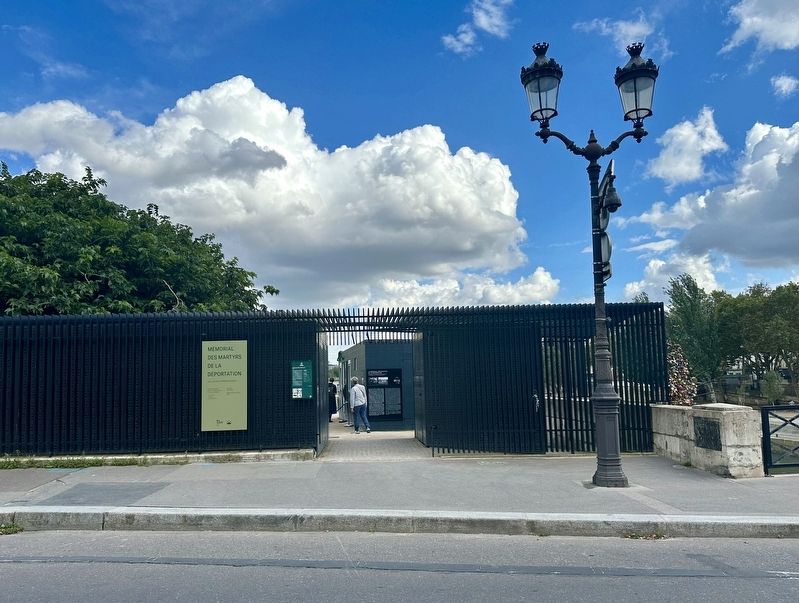
2. Square de l’Île-de-France (1914) Marker - wide view
The marker is visible here on the fence, to the left of the entrance gate. Also visible is the entrance to the Memorial to the Martyrs of the Deportation, which is accessible from within the park, but below ground level.
Other nearby markers. At least 8 other markers are within walking distance of this marker: Le mémorial des martyrs de la Déportation / The Memorial to the Martyrs of the Deportation (here, next to this marker); Ile Saint-Louis (about 90 meters away, measured in a direct line); Square Jean XXIII (about 90 meters away); Hôtel de Nesmond (about 90 meters away); Edmond Fleg (about 120 meters away); Vladimir Jankélévitch (about 120 meters away); André Dignimont (about 150 meters away); The Bells of Notre Dame (about 150 meters away). Touch for a list and map of all markers in Paris.
Also see . . . Square de l'Île-de-France (Wikipedia, in French). Recent history (in translation):
The square was created in 1914 along the Quai de l'Archevêché on the site of the morgue.(Submitted on December 19, 2024.)
To the southwest of the square, the Memorial to the Martyrs of the Deportation was built from 1954 to 1964.
In 2023, while the area around the cathedral was the subject of a redevelopment project following the fire of 2019, the work carried out by landscaperBas Smets was criticized by local residents and heritage defenders, particularly with regard to the Square de l'Île-de-France and the neighboring Square Jean-XXIII. He planned to combine the two green spaces into a single garden open day and night, without the external gates or the small grilles protecting access to the lawns, and to replace some of the historic furniture (benches, etc.) with contemporary furniture. The petition “Save the squares of Notre-Dame” was launched, gathering 44,000 signatures as of May 11.Photographed by Andrew Ruppenstein, September 11, 20243. Square de l’Île-de-France - interior viewLooking south across the park towards the park entrance (and marker). The Resurrection roses, mentioned on the marker, are visible here in the center of the picture, albeit out of season.

Credits. This page was last revised on December 19, 2024. It was originally submitted on December 19, 2024, by Andrew Ruppenstein of Lamorinda, California. This page has been viewed 179 times since then and 36 times this year. Photos: 1, 2, 3. submitted on December 19, 2024, by Andrew Ruppenstein of Lamorinda, California.
