Riverfront in Wilmington in New Hanover County, North Carolina — The American South (South Atlantic)
Underground Railroad Activity in Wilmington, N.C.
Orange Street Landing on Cape Fear
Photographed by Duane and Tracy Marsteller, November 23, 2024
1. Underground Railroad Activity in Wilmington, N.C. Marker
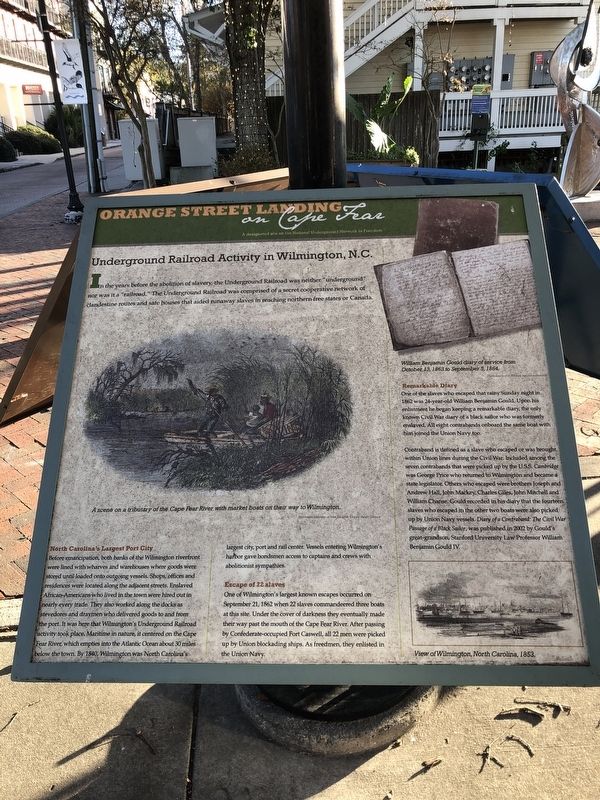
In the years before the abolition of slavery, the Underground Railroad was neither “underground” nor was it a “railroad”. The Underground Railroad was comprised of a secret cooperative network of clandestine routes and safe houses that aided runaway slaves in reaching northern free states or Canada.
North Carolina's Largest Port City
Before emancipation, both banks of the Wilmington riverfront were lined with wharves and warehouses where goods were stored until loaded onto outgoing vessels. Shops, offices and residences were located along the adjacent streets. Enslaved African-Americans who lived in the town were hired out in nearly every trade. They also worked along the docks as stevedores and draymen who delivered goods to and from the port. It was here that Wilmington's Underground Railroad activity took place. Maritime in nature, it centered on the Cape Fear River, which empties into the Atlantic Ocean about 30 miles below the town. By 1840 Wilmington was North Carolina's largest city, port and rail center. Vessels entering Wilmington's harbor gave bondsmen access to captains and crews with abolitionist sympathies.
Escape of 22 slaves
One
this page online
Remarkable Diary
One of the slaves who escaped that rainy Sunday night in 1862 was 24-year-old William Benjamin Gould. Upon his enlistment he began keeping a remarkable diary, the only known Civil War diary of a black sailor who was formerly enslaved. All eight contrabands aboard the same boat with him joined the Union Navy too.
Contraband is defined as a slave who escaped or was brought within Union lines during the Civil War. Included among the seven contrabands that were picked up by the U.5.5. Cambridge was George Price who returned to Wilmington and became a state legislator. Others who escaped were brothers Joseph and Andrew Hall, John Mackey, Charles Giles, John Mitchell and William Chanse. Gould recorded in his diary that the fourteen slaves who escaped
Photographed by Duane and Tracy Marsteller, November 23, 2024
2. Underground Railroad Activity in Wilmington, N.C. Marker
[Captions]
• Top right:William Benjamin Gould diary of service from October 13, 1863 to September 5, 1864.
• Left: A scene on a tributary of the Cape Fear River with market boats on their way to Wilmington.
• Bottom right: View of Wilmington, North Carolina, 1853
Erected by National Underground Railroad Network to Freedom • City of Wilmington, NC.
Topics and series. This historical marker is listed in these topic lists: Abolition & Underground RR • African Americans • Arts, Letters, Music. In addition, it is included in the Network to Freedom series list. A significant historical date for this entry is September 21, 1862.
Location. 34° 13.97′ N, 77° 56.959′ W. Marker is in Wilmington, North Carolina, in New Hanover County. It is in Riverfront. It is at the intersection of South Water Street and Orange Street, on the right when traveling south on South Water Street. Touch for map. Marker is at or near this postal address: 200 S Water St, Wilmington NC 28401, United States of America. Touch for directions.

Regionally, this marker is in the Coastal Plain and on the Cape Fear Coast. It is also in the American South, specifically in the Upper South, in the Tidewater, and on the Eastern Seaboard. Globally, it is in the North Atlantic Region, North America, the Western Hemisphere, the Western World, and the Anglosphere. Historically, it finds itself in what was once the territory of the Mississippian Culture, one of the original Thirteen Colonies, one of the Confederate States of America, and the Antebellum South.
Other nearby markers. At least 8 other markers are within walking distance of this marker: William Benjamin Gould: A Brief Biography (here, next to this marker); What is the National Underground Railroad Network to Freedom? (here, next to this marker); Wilmington Iron Works Machine Shop (within shouting distance of this marker); City Market House 1882 (within shouting distance of this marker); Old Wilmington City Market (within shouting distance of this marker); Caldler-Thorpe Warehouse (about 300 feet away, measured in a direct line); Mitchell-Anderson House (about 300 feet away); Seigler Building (about 400 feet away). Touch for a list and map of all markers in Wilmington.
Credits. This page was last revised on August 10, 2025. It was originally submitted on December 19, 2024, by Duane and Tracy Marsteller of Murfreesboro, Tennessee. This page has been viewed 1,293 times since then and 214 times this year. Photos: 1, 2. submitted on December 19, 2024, by Duane and Tracy Marsteller of Murfreesboro, Tennessee.
