Downtown Harrisburg in Dauphin County, Pennsylvania — The American Northeast (Mid-Atlantic)
Kousa Dogwood
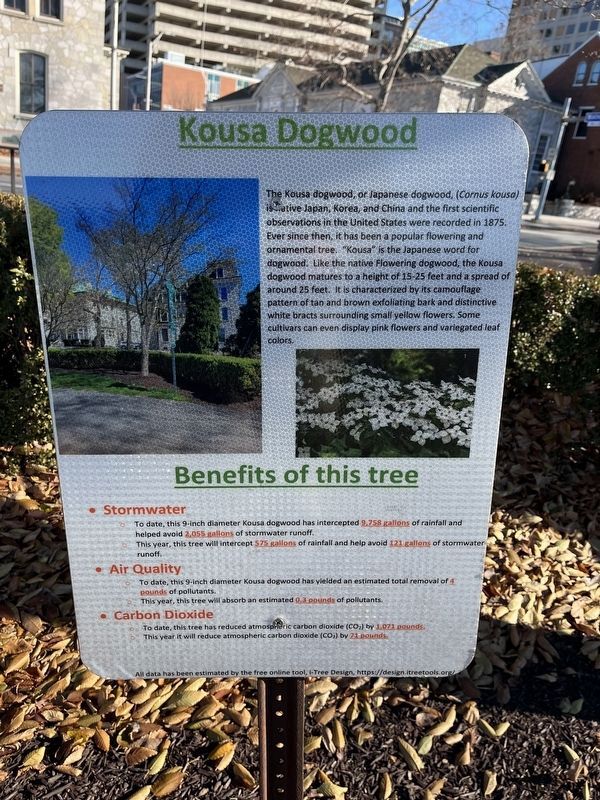
The Kousa dogwood, or Japanese dogwood, (Curnus kousa) is native Japan, Korea, and China and the first scientific observations in the United States were recorded in 1875. Ever since then, it has been a popular flowering and ornamental tree. "Kousa" is the Japanese word for dogwood. Like the native Flowering dogwood, the Kousa dogwood matures to a height of 15-25 feet and a spread of around 25 feet. It is characterized by its camouflage pattern of tan and brown exfoliating bark and distinctive white bracts surrounding small yellow flowers. Some cultivars can even display pink flowers and variegated leaf colors.
• Stormwater○ To date, this 9-inch diameter Kousa dogwood has intercepted 9.758 gallons of rainfall and helped avoid 2,055 gallons of stormwater runoff.• Air Quality
○ This year, this tree will intercept 575 gallons of rainfall and help avoid 121 gallons of stormwater runoff.○ To date, this 9-inch diameter Kousa dogwood has yielded an estimated total removal of 4 pounds of pollutants.
○ This year, this tree will absorb an estimated 0.3 pounds of pollutants.• Carbon Dioxide
Click or scan to see
this page online○ To date, this tree has reduced atmospheric carbon dioxide (CO2) by 1,071 pounds.
○ This year it will reduce atmospheric carbon dioxide (CO2) by 71 pounds.
Topics. This historical marker is listed in these topic lists: Horticulture & Forestry • Science & Medicine. A significant historical year for this entry is 1875.
Location. 40° 15.564′ N, 76° 53.074′ W. Marker is in Harrisburg, Pennsylvania, in Dauphin County. It is in Downtown Harrisburg. It is on North Front Street just north of Walnut Street, on the right when traveling south. Touch for map. Marker is at or near this postal address: 101 N Front St, Harrisburg PA 17101, United States of America. Touch for directions.

Regionally, this marker is in South-Central Pennsylvania, specifically in Pennsylvania Dutch Country, and in the Susquehanna Valley. It is also in the American Northeast and in the Mid-Atlantic. Globally, it is in North America, the Western Hemisphere, the Western World, and the Anglosphere. Historically, it finds itself
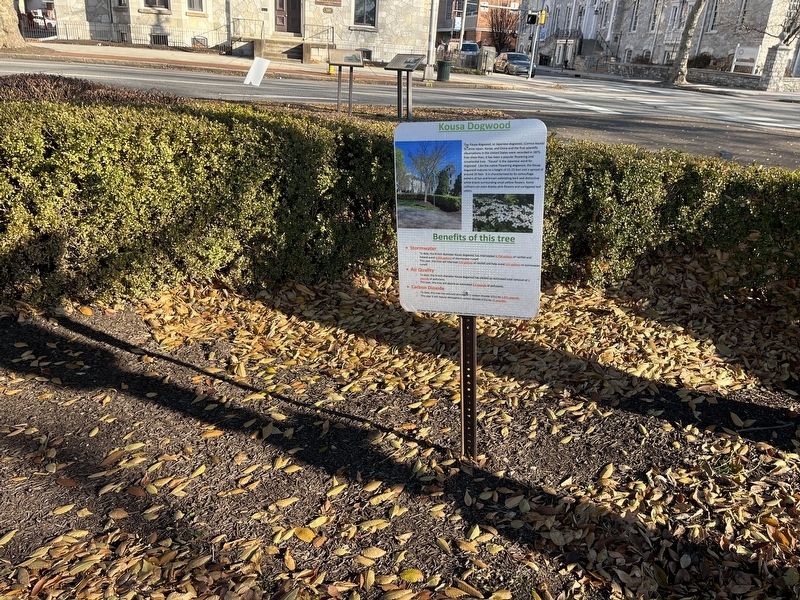
Other nearby markers. At least 8 other markers are within walking distance of this marker: Harrisburg Public Library Dauphin County Library System (a few steps from this marker); James McCormick Mansion (a few steps from this marker); Swenson Plaza Flood Memorial (a few steps from this marker); The Calder / Olmsted / McCormick Mansion (a few steps from this marker); The People’s Bridge (within shouting distance of this marker); The First River School (within shouting distance of this marker); Walnut Street Bridge (within shouting distance of this marker); Riverfront Recaptured (within shouting distance of this marker). Touch for a list and map of all markers in Harrisburg.
Additional commentary.
1. About the marker
While most signs interpreting natural history do not serve as historical markers, this one does. It interprets the human history of scientific observations of this tree which is not indigenous to the Americas.
— Submitted December 23, 2024, by Devry Becker Jones of Washington, District of Columbia.
Credits. This page was last revised on December 23, 2024. It was originally submitted on December 23, 2024, by Devry Becker Jones of Washington, District of Columbia. This page has been viewed 194 times since then and 18 times this year. Photos: 1, 2. submitted on December 23, 2024, by Devry Becker Jones of Washington, District of Columbia.
Editor’s want-list for this marker. A photo of the actual Kousa dogwood. • Can you help?
