Wallace in Wallace County, Kansas — The American Midwest (Upper Plains)
William Averill Comstock
"Ace of Scouts"
| — | 1842-1868 | — |
Photographed by Cosmos Mariner, September 5, 2024
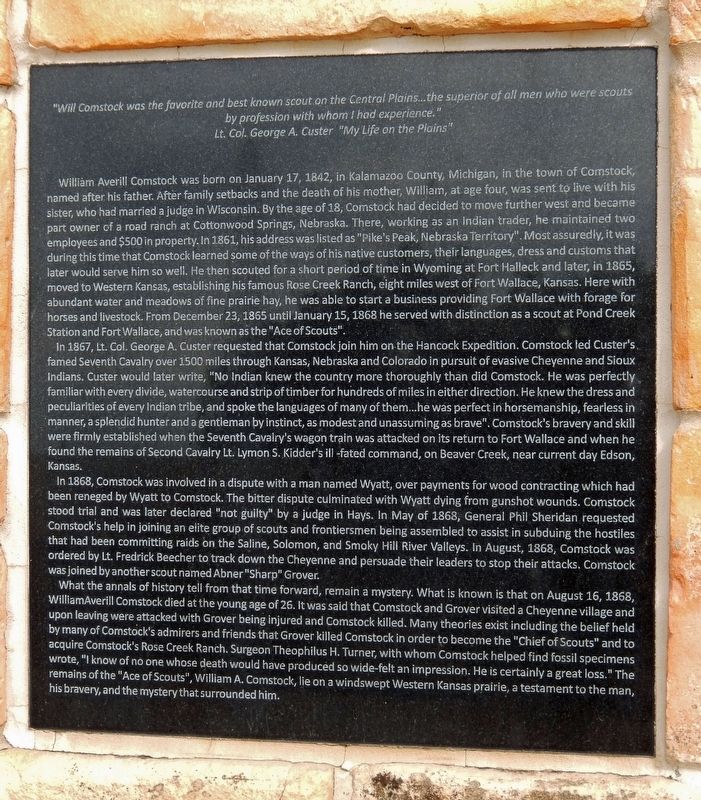
1. William Averill Comstock Marker
“Will Comstock was the favorite and best known scout on the Central Plains… the superior of all men who were scouts by profession with whom I had experience.”
— Lt. Col. George A. Custer “My Life on the Plains”
William Averill Comstock was born on January 17, 1842, in Kalamazoo County, Michigan, in the town of Comstock, named after his father. After family setbacks and the death of his mother, William, at age four, was sent to live with his sister, who had married a judge in Wisconsin. By the age of 18, Comstock had decided to move further west and became part owner of a road ranch at Cottonwood Springs, Nebraska. There, working as an Indian trader, he maintained two employees and $500 in property. In 1861, his address was listed as “Pike's Peak, Nebraska Territory”. Most assuredly, it was during this time that Comstock learned some of the ways of his native customers, their languages, dress and customs that later would serve him so well. He then scouted for a short period of time in Wyoming at Fort Halleck and later, in 1865, moved to Western Kansas, establishing his famous Rose Creek Ranch, eight miles west of Fort Wallace,
this page online
In 1867, Lt. Col. George A. Custer requested that Comstock join him on the Hancock Expedition. Comstock led Custer's famed Seventh Cavalry over 1500 miles through Kansas, Nebraska and Colorado in pursuit of evasive Cheyenne and Sioux Indians. Custer would later write, “No Indian knew the country more thoroughly than did Comstock. He was perfectly familiar with every divide, watercourse and strip of timber for hundreds of miles in either direction. He knew the dress and peculiarities of every Indian tribe, and spoke the languages of many of them… he was perfect in horsemanship, fearless in manner, a splendid hunter and a gentleman by instinct, as modest and unassuming as brave”. Comstock's bravery and skill were firmly established when the Seventh Cavalry's wagon train was attacked on its return to Fort Wallace and when

Photographed by Cosmos Mariner, September 5, 2024
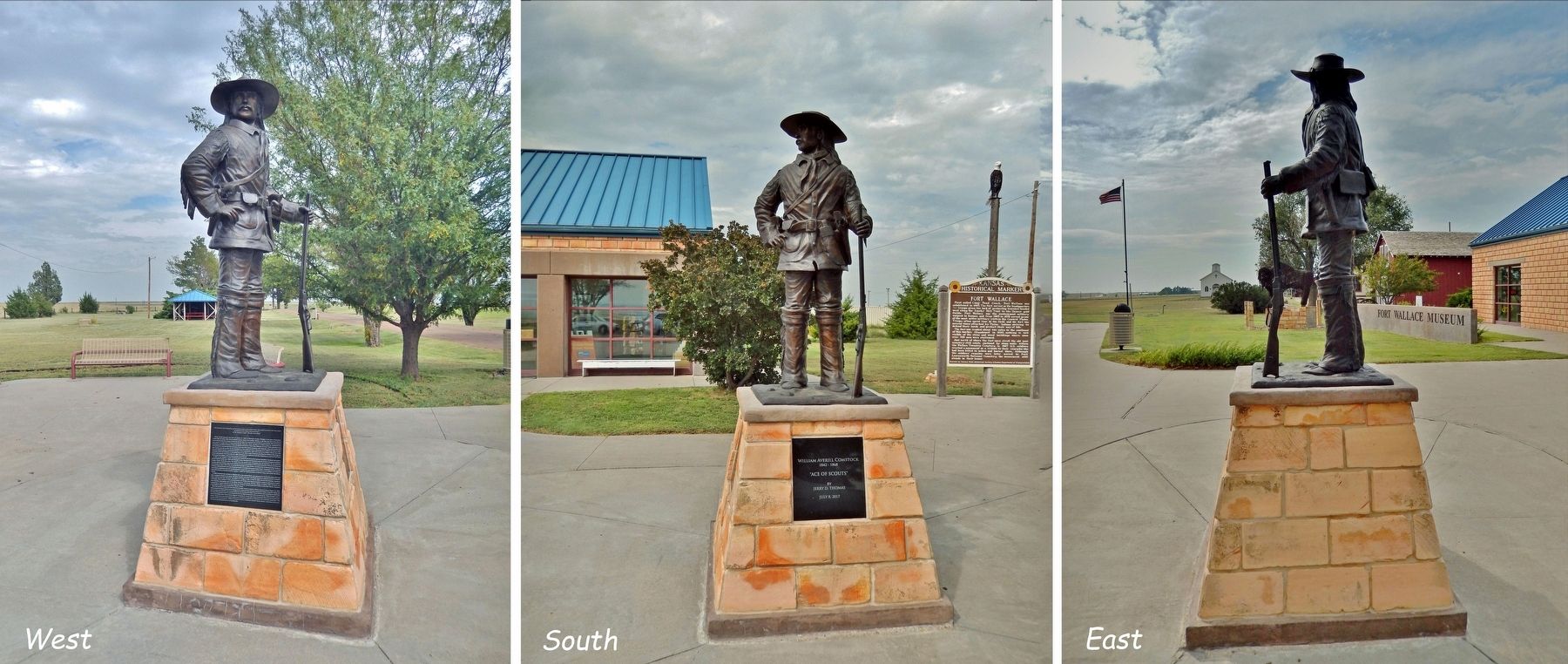
2. William Averill Comstock Monument
The historical marker is on the left/west side of the sculpture base.
In 1868, Comstock was involved in a dispute with a man named Wyatt, over payments for wood contracting which had been reneged by Wyatt to Comstock. The bitter dispute culminated with Wyatt dying from gunshot wounds. Comstock stood trial and was later declared “not guilty” by a judge in Hays. In May of 1868, General Phil Sheridan requested Comstock's help in joining an elite group of scouts and frontiersmen being assembled to assist in subduing the hostiles that had been committing raids on the Saline, Solomon, and Smoky Hill River Valleys. In August, 1868, Comstock was ordered by Lt. Fredrick Beecher to track down the Cheyenne and persuade their leaders to stop their attacks. Comstock was joined by another scout named Abner “Sharp” Grover.
What the annals of history tell from that time forward, remain a mystery. What is known is that on August 16, 1868, William Averill Comstock died at the young age of 26. It was said that Comstock and Grover visited a Cheyenne village and upon leaving were attacked with Grover
Photographed by Cosmos Mariner, September 5, 2024
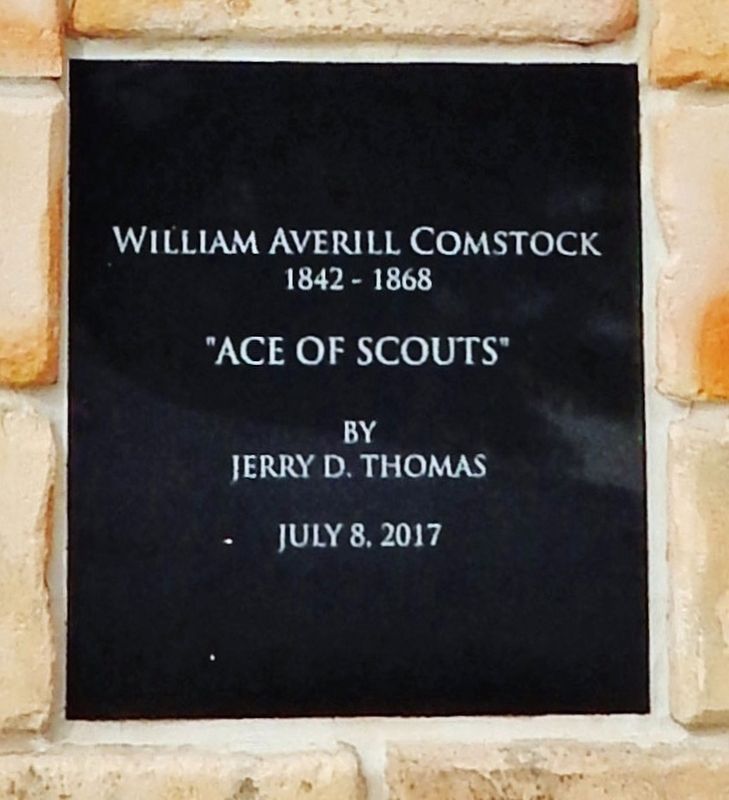
3. “Ace of Scouts”
1842-1868
“Ace of Scouts”
by
Jerry D. Thomas
July 8, 2017
Topics. This historical marker is listed in these topic lists: Exploration • Forts and Castles • Indigenous Peoples and Communities • Settlements & Settlers. A significant historical date for this entry is January 17, 1842.
Location. 38° 54.614′ N, 101° 34.969′ W. Marker is in Wallace, Kansas, in Wallace County. It is on U.S. 40 at milepost 25.5, just east of 2nd Street (Old U.S. 40), on the left when traveling east. The marker and sculpture are located directly in front of the Fort Wallace Museum. Touch for map. Marker is at or near this
Photographed by Cosmos Mariner, September 5, 2024
4. William Averill Comstock Monument

Regionally, this marker is in the American Midwest, in the Corn Belt, on the prairies, on the Great Plains, on the Southern Plains, and specifically on the High Plains. Globally, it is in North America, the Western Hemisphere, the Western World, and the Anglosphere. Historically, it finds itself in what was once the Louisiana Purchase.
Other nearby markers. At least 2 other markers are within walking distance of this marker: Fort Wallace (here, next to this marker); Camp Pond Creek & Fort Wallace on the BOD (within shouting distance of this marker).
Related markers. Click here for a list of markers that are related to this marker. The Great Buffalo Hunt
Also see . . .
1. William Comstock – Ace of Scouts (Legends of America).
Excerpt: Learning to speak several Indian languages, he became the chief of scouts and interpreter at Fort Wallace, Kansas. He was the favorite scout of General Phil Sheridan and General Armstrong Custer and became nationally known as the “Ace of Scouts.” Because of his prowess(Submitted on December 23, 2024, by Cosmos Mariner of Cape Canaveral, Florida.)with a rifle, he also had earned the title of “Buffalo Bill.” Comstock was known as “Medicine Bill” among some of his companions primarily because of his superstitious nature. However, the Indians, called him “Medicine Bill” because Comstock had cut off a man’s finger to save him from a rattlesnake bite. When the title of “Buffalo Bill” was disputed, a hunt was arranged between Comstock and “Buffalo Bill” Cody near Monument, Kansas. The prize for the horseback buffalo-hunting contest was $500 with the winner claiming the title “Buffalo Bill.” Cody apparently won the contest, killing 69 bison to Comstock’s 46.Photographed by Cosmos Mariner, September 5, 20245. William Averill Comstock Monument & Fort Wallace Museum

2. William Averill “Medicine Bill” Comstock (Find A Grave).
Excerpt: What became of Comstock's body? Early rumors said the Army had recovered the corpse and reburied it in the post cemetery. Certainly the family believed this. Wrote John Adams Comstock: "General [sic] Bankhead sent out a detachment to bring the body of Comstock into the post, and he was buried there. The grave was the third one south of the northeast corner of the post cemetery." Only it isn't.(Submitted on December 23, 2024, by Cosmos Mariner of Cape Canaveral, Florida.)Jayne Humphrey Pearce, president of the Fort Wallace Memorial Association, says there is no record of Comstock having been buried in the post cemetery. Pearce, who lives in Wallace, maintains an archive of letters and manuscripts written by residents and Kansas historians who have sought Comstock's final resting place. The documents are puzzling for a reader not intimately familiar with the terrain; some are incomplete, many composed by men who have since joined the scout in the world beyond, but they tell an interesting tale.
Credits. This page was last revised on December 23, 2024. It was originally submitted on December 23, 2024, by Cosmos Mariner of Cape Canaveral, Florida. This page has been viewed 396 times since then and 119 times this year. Photos: 1, 2, 3, 4, 5. submitted on December 23, 2024, by Cosmos Mariner of Cape Canaveral, Florida.
