Danville, Virginia — The American South (Mid-Atlantic)
"Opera House Alley"
Photographed by C. Ryan Dodson, October 31, 2024
1. Opera House Alley Marker
Danville Race Riot of 1883
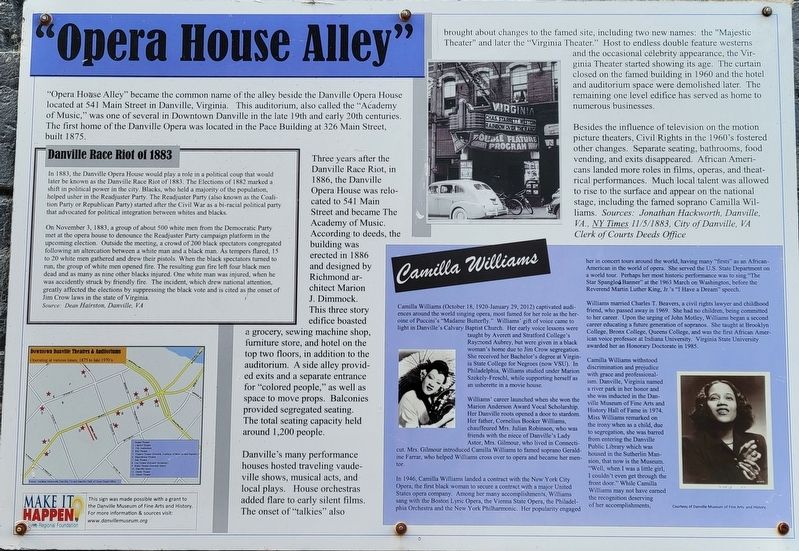
In 1883, the Danville Opera House would play a role in a political coup that would later be known as the Danville Race Riot of 1883. The Elections of 1882 marked a shift in political power in the city. Blacks, who held a majority of the population, helped usher in the Readjuster Party. The Readjuster Party (also known as the Coalition Party or Republican Party) started after the Civil War as a bi-racial political party that advocated for political integration between whites and blacks.
On November 3, 1883, a group of about 500 white men from the Democratic Party met at the opera house to denounce the Readjuster Party campaign platform in the upcoming election. Outside the meeting, a crowd of 200 black spectators congregatedfollowing an altercation between a white man and a black man. As tempers flared, 15 to 20 white men gathered and drew their pistols. When the black spectators turned to run, the group of white men opened fire. The resulting gun fire left four black dead and as many as nine other blacks injured. One white man was injured, when he was accidently struck by friendly fire. The incident, which drew national attention, greatly affected the elections by suppressing the black vote and is cited as the onset of Jim Crow laws in the state of Virginia. Source: Dean Hairston, Danville, VA
Click or scan to see
this page online
Three years after the Danville Race Riot, in 1886, the Danville Opera House was relocated to 541 Main Street and became The Academy of Music. According to deeds, the building was erected in 1886 and designed by Richmond architect Marion J. Dimmock. This three story edifice boasted a grocery, sewing machine shop, furniture store, and hotel on the top two floors, in addition to the auditorium. A side alley provided exits and a separate entrance for "colored people," as well as space to move props. Balconies provided segregated seating. The total seating capacity

Photographed by C. Ryan Dodson, October 31, 2024
2. Opera House Alley Marker
Danville's many performance houses hosted traveling vaudeville shows, musical acts, and local plays. House orchestras added flare to early silent films. The onset of "talkies" also brought about changes to the famed site, including two new names: the "Majestic Theater" and later the "Virginia Theater." Host to endless double feature westerns and the occasional celebrity appearance, the Virginia Theater started showing its age. The curtain closed on the famed building in 1960 and the hotel and auditorium space were demolished later. The remaining one level edifice has served as home to numerous businesses.
Besides the influence of television on the motion picture theaters, Civil Rights in the 1960's fostered other changes. Separate seating, bathrooms, food vending, and exits disappeared. African Americans landed more roles in films, operas, and theatrical performances. Much local talent was allowed to rise to the surface and appear on the national stage, including the famed soprano Camilla Williams. Sources: Jonathan Hackworth, Danville, VA.; NY Times 11/5/1883; City of Danville, VA Clerk of Courts Deeds Office
(sidebar)
Camilla Williams
Camilla Williams (October 18, 1920 - January 29, 2012) captivated audiences around the world singing opera, most famed for her role as the heroine of Puccini's "Madame Butterfly." Williams' gift of yvice came to light in Danville's Calvary Baptist Church. Her early voice lessons were taught by Averett and Stratford College's Raymond Aubrey, but were given in a black woman's home due to Jim Crow segregation. She received her Bachelor's degree at Virginia State College for Negroes (now VSU). In Philadelphia, Williams studied under Marion Szekely-Freschl, while supporting herself as an usherette in a movie house.
Williams' career launched when she won the Marion Anderson Award Vocal Scholarship. Her Danville roots opened a door to stardom. Her father, Cornelius Booker Williams, chauffeured Mrs. Julian Robinson, who was friends with the niece of Danville's Lady Astor, Mrs. Gilmour, who lived in Connecticut. Mrs. Gilmour introduced Camilla Williams to famed soprano Geraldine Farrar, who helped Williams cross over to opera and became her mentor.
1946, Camilla Williams landed a contract with the New York City Opera, the first black woman to secure a contract with a major United States opera company. Among her many accomplishments, Williams sang with the Boston Lyric Opera, the Vienna State Opera, the Philadelphia Orchestra and the New York Philharmonic. Her popularity engaged her in concert tours around the world, having many "firsts" as an African-American in the world of opera. She served the U.S. State Department on a world tour. Perhaps her most historic performance was to sing "The Star Spangled Banner" at the 1963 March on Washington, before the Reverend Martin Luther King, Jr.'s "I Have a Dream" speech.
Williams married Charles T. Beavers a civil rights lawyer and childhood friend, who passed away in 1969. She had no children, being committed to her career. Upon the urging of John Motley, Williams began a second career educating a future generation of sopranos. She taught at Brooklyn College, Bronx College, Queens College, and was the first African American Voice professor at Indiana University. Virginia State University awarded her an Honorary Doctorate in 1985.
Camilla Williams withstood discrimination and prejudice with grace and professionalism. Danville, Virginia named a river park in her honor and she was inducted in the Danville Museum of Fine Arts and History Hall of Fame in 1974. Miss Williams remarked on the irony when as a child, due to segregation, she was barred from entering the Danville Public Library which was housed in the Sutherlin Mansion, that now is the Museum. "Well, when I was a little girl, I couldn't even get through the front door." While Camilla Williams may not have earned the recognition deserving of her accomplishments,...Courtesy of Danville Museum of Fine Arts and History
(caption) Downtown Danville Theatres & Auditoriums Operating at various times, 1875 to late 1970's
Make It Happen Danville Regional Foundation
This sign was made possible with a grant to the Danville Museum of Fine Arts and History. For more information & sources visit: www.danvillemuseum.org
Erected 2014
Photographed by C. Ryan Dodson, October 31, 2024
3. Opera House Alley Marker
Topics. This historical marker is listed in these topic lists: African Americans • Arts, Letters, Music • Civil Rights • Entertainment. A significant historical year for this entry is 1883.
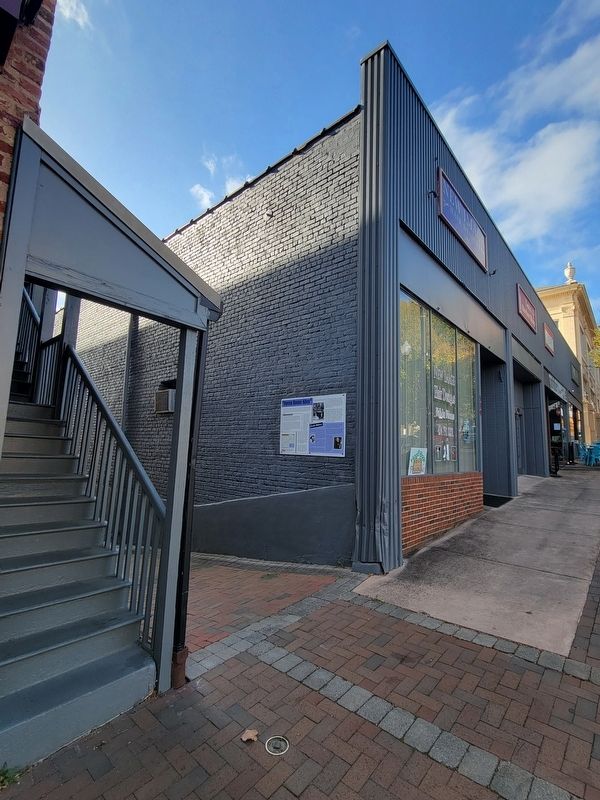
Location. 36° 35.231′ N, 79° 23.611′ W. Marker is in Danville, Virginia. It is on Main Street (Virginia Route 293) east of South Floyd Strret, on the right when traveling east. Touch for map. Marker is at or near this postal address: 539 Main Street, Danville VA 24541, United States of America. Touch for directions.

Regionally, this marker is in Southside Virginia and specifically in Central Virginia. It is also in the American South and specifically in the Upper South. Globally, it is in North America, the Western Hemisphere, the Western World, and the Anglosphere. Historically, it finds itself in what was once the territory of the Mississippian Culture, one of the original Thirteen Colonies, one of the Confederate States of America, and the Antebellum South.
Other nearby markers. At least 8 other markers are within walking distance of this
Photographed by C. Ryan Dodson, October 31, 2024
4. Opera House Alley
facing towards Main Street
More about this marker. The Marker text abruptly ends mid-sentence.
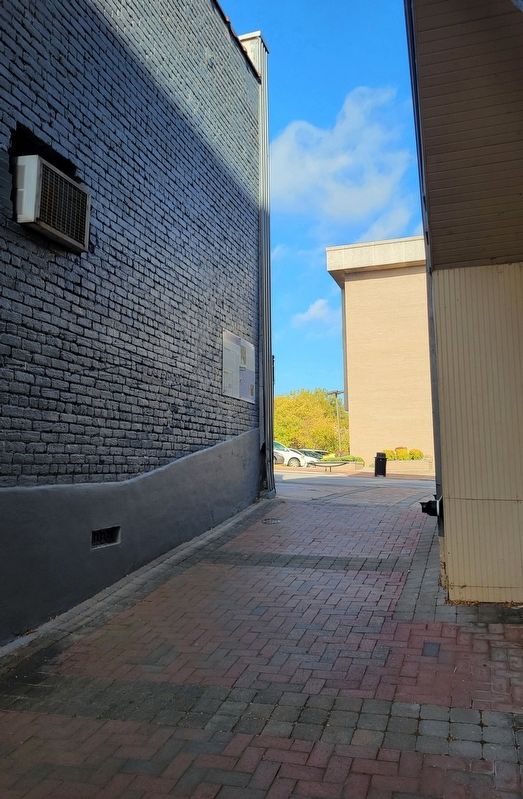
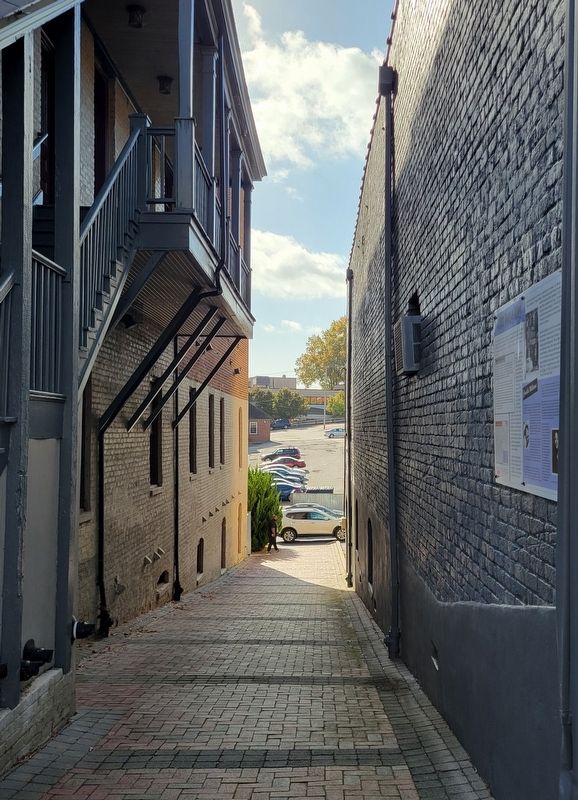
Regarding "Opera House Alley". The City of Danville secured a public walkway easement through Opera House Alley in 2014, being recorded in the Clerk of Court's Office as Instrument #14-3601.
Also see . . . Danville Museum of Fine Arts and History. (Submitted on December 31, 2024.)
Photographed by C. Ryan Dodson, October 31, 2024
5. Opera House Alley
facing towards Patton Street
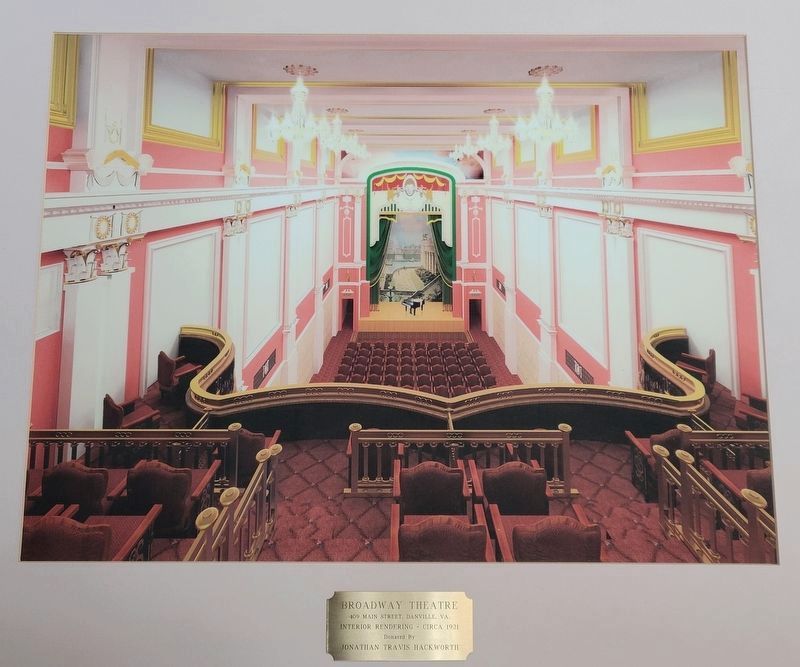
Photographed by C. Ryan Dodson, December 31, 2024
6. Broadway Theater
Danville had many opera houses and theaters in the early 20th century, such as the Broadway Theater, as seen in this portrait on display in the Danville Municipal Building.
Credits. This page was last revised on January 1, 2025. It was originally submitted on December 24, 2024, by C. Ryan Dodson of Danville, Virginia. This page has been viewed 302 times since then and 47 times this year. Photos: 1, 2, 3, 4, 5. submitted on December 24, 2024, by C. Ryan Dodson of Danville, Virginia. 6. submitted on December 31, 2024, by C. Ryan Dodson of Danville, Virginia. • Bernard Fisher was the editor who published this page.
