
Quinze-Vingts in Paris in Département de Paris, Île-de-France, France — Western Europe
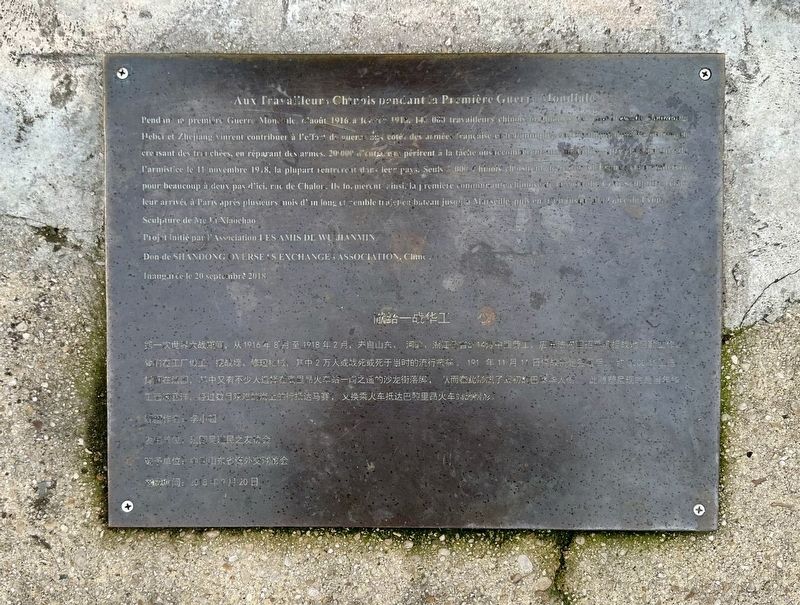
Aux Travailleurs Chinois pendant la Première Guerre Mondial
⎯⎯⎯
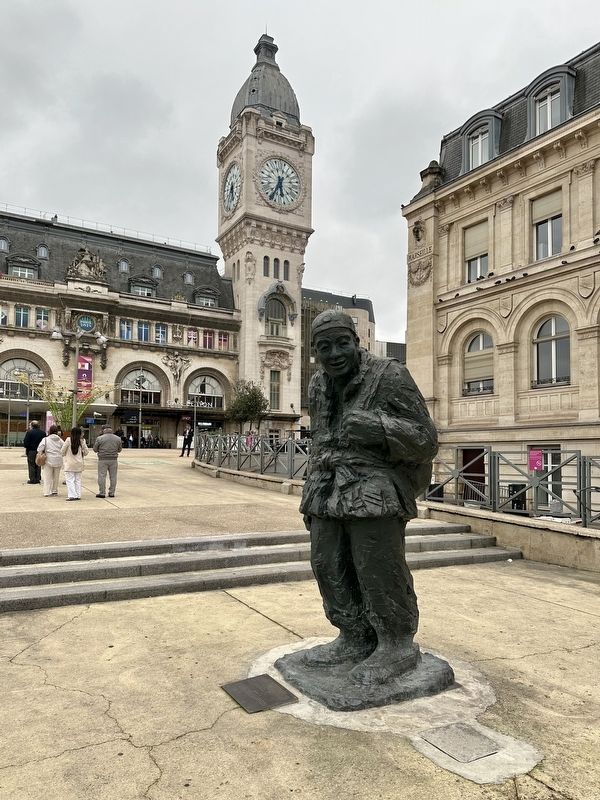
Chinese Workers WWI Monument
Photographed by Andrew Ruppenstein, September 9, 2024
1. Aux Travailleurs Chinois pendant la Première Guerre Mondial / Chinese Workers WWI Monument Marker

Sculpture de Me Li Xiaochao
Projet initié par l’Association LES AMIS DE WU JIANMIN
Don de SHANDONG OVERSEAS EXCHANGES ASSOCIATION, Chine.
Inaugarée le 20 septembre 2018
(English translation:)
During the First World War, from August 1916 to February 1918, 140,000
this page online
Sculpture by Me Li Xiaochao
Project initiated by the Association LES AMIS DE WU JIANMIN
Donation from SHANDONG OVERSEAS EXCHANGES ASSOCIATION, China.
Inaugurated on September 20, 2018
Erected 2018 by Les Amis de Wu Jianmin.
Topics. This monument and memorial is listed in these topic lists: Immigration • War, World I. A significant historical date for this entry is August 24, 1916.
Location. 48° 50.72′ N, 2° 22.349′ E. Monument is in Paris, Île-de-France, in Département
Photographed by Andrew Ruppenstein, September 9, 2024
2. Chinese Workers WWI statue and marker
The Gare de Lyon (mentioned on the marker) is visible here in the background.

Regionally, it is in the North Atlantic Region, Europe, the European Union, Atlantic Europe, the Schengen Area, Western Europe, a coastal Mediterranean country, and the Western World. Historically, it finds itself in what was once a French colony and also the Roman Empire.
Other nearby markers. At least 8 other markers are within walking distance of this marker: La Tour de l’horloge / The Clock Tower (within shouting distance of this marker); Unknown Frenchman Liberation Memorial (within shouting distance of this marker); Réseau AGIR / Network for ACTION Memorial (about 90 meters away, measured in a direct line); Jean Jemini (about 90 meters away); Commissaire Silvestri (about 90 meters away); Guy Tessier (about 150 meters away); A la mémoire des otages communistes fusillés / Executed Communist Hostages Memorial (about 240 meters away);
Photographed by Andrew Ruppenstein, September 9, 2024
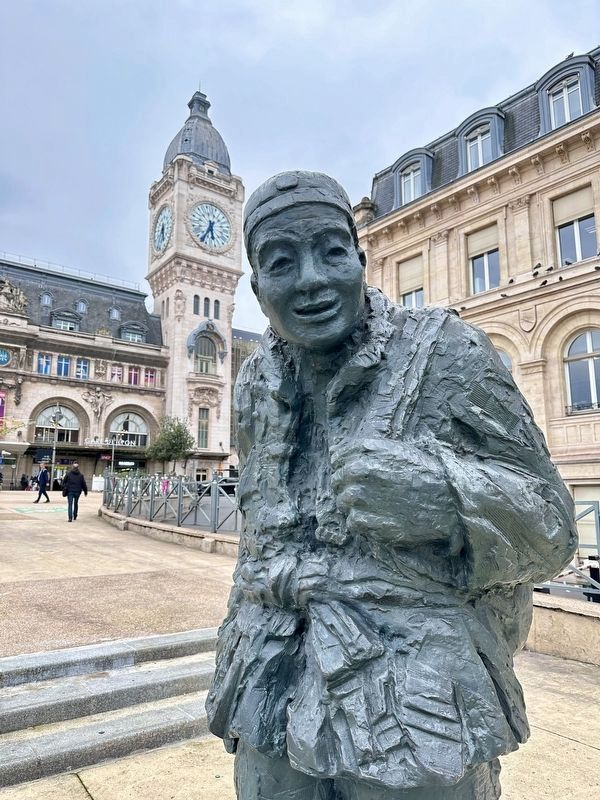
3. Chinese Workers WWI monument - statue detail
Also see . . . Travailleurs chinois pendant la Première Guerre mondiale en France (Wikipedia, in French). How they got here, excerpt (in translation):
In August 1916, France opened a hiring channel from the coastal cities of Qingdao and Pokou. The Chinese who accepted were enlisted under fixed-term civil contracts and reached Europe by sea. French companies recruited a total of 36,941 people (laborers, carpenters, translators, etc.). These were all men. The British channel was set up in January 1917 from the port of Weihai. Baptist missionaries acted as recruiters. Although the minimum wage is modest (1 franc per day) and the work rate is hard (ten hours of work per day, every day of the week), bonuses are paid to families, which lead to about 100,000 Chinese to sign up, joining the Chinese Labour Corps (CLC).(Submitted on December 25, 2024.)
Most of the recruits came from Shandong province. There were a few workers but the majority are peasants from the hinterland. Without qualifications, they were selected for their age (between 20 and 40 years old) and their build (minimum 1.80 meters). Apart from the few interpreters, the Chinese speak neither French nor English, which reinforces their malleability. Only 15% can read and write.
The boat journey, which could last from 40 days to three months, was trying for populations who often do not know the sea: nausea, illness, dementia, etc. On August 24, 1916, the first ship, carrying 1,968 people, landed in Marseille. The Germans, who became aware of these arrivals, began to sink suspicious vessels: in February 1917, the liner Athos sank in the Mediterranean, killing 754 people, including 543 Chinese. The British responded by changing their route: instead of going through the Indian Ocean and then the Suez Canal, the route now went via Canada. The North American population, known to be hostile to North Asians, led the Canadian government to put a plan in place... The Chinese who landed (from 300 to 3,000 depending on the type of ship used) were supervised by British soldiers and missionaries. They first arrived at the William Head quarantine centre, located on the south of Vancouver Island, then travelled across the country for six days in special trains, whose doors and windows were covered with black sheets. Each Chinese person had a straw mattress and a daily ration, to be heated on the stove in the car. They were lit only by gas lamps. In January 1917, the temperature reached -42 °C and 25 Chinese died of cold. Arriving in Halifax, they went to France to disembark at Le Havre or Dieppe. A total of 82,215 Chinese took this new route.
Credits. This page was last revised on December 25, 2024. It was originally submitted on December 24, 2024, by Andrew Ruppenstein of Lamorinda, California. This page has been viewed 134 times since then and 21 times this year. Photos: 1. submitted on December 24, 2024, by Andrew Ruppenstein of Lamorinda, California. 2, 3. submitted on December 25, 2024, by Andrew Ruppenstein of Lamorinda, California.
