Joshua Tree National Park in San Bernardino County, California — The American West (Pacific Coastal)
Barker Dam

Photographed by Craig Baker
1. Barker Dam Marker
Built by cowboys to water their cattle, Barker Dam today is a small, ephemeral lake that attracts an array of animal life in an otherwise parched environment. A 1.3-mile loop trail with interpretive markers leads to the rain-filled pool.
In the late 1800s and early 1900s, cattle ranching was an important business here. An average of 10 inches of annual rain fell upon the desert then (compared to 2-5 inches now), and grass ranges were lush and abundant in Lost Horse, Queen, and Pleasant valleys.
Securing rights to reliable water sources - wells, tanks, and springs - was critical, pitting rancher against rancher, rancher against miner, and miner against miner. To that end, the Barker & Shay Cattle Company built the dam in this natural basin. Rancher Bill Keys made later improvements to the dam.
photo captions:
· The Barker & Shay Cattle Company laid the lower stone dam in 1902. The Keys family added the upper concrete layer.
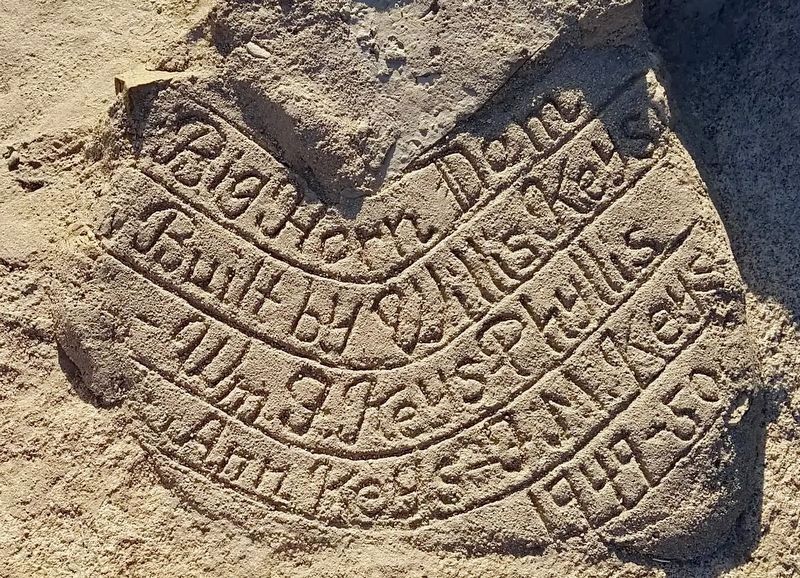
· Look for the monument inscribed by the Keys family on the top wall of the dam commemorating their improvements and renaming of the dam.
· At the edge of the Wonderland of Rocks, the waters of Barker Dam offer a refreshing scene - and attract wildlife like these big horn sheep resting on the rock ledge and reflected
this page online
Destinations and Mileages:
Barker Dam Nature Trail
The trail circles past the lake and dam, with a short rock scramble at the foot of the dam. Minor climbing through narrow rock passages is required. 1.3-mile loop trail, 1 hour. Easy.
Wall Street Mill Trail
Trail starts at the east end of the parking area, passes through desert washes, gently rolling terrain, and leads to a well-preserved gold mill. 2.2-miles round trip, 1 hour. Easy.
Know Before You Go:
· Pets are not allowed on park trails.
· Drink plenty of water.
· When the water is half-gone, it is time to return.
· Bikes are not allowed on this trail.
· Use caution near abandoned mines - stay out and stay alive.
· Camping and campfires are restricted to established campgrounds.
· Leave wildlife, plants, rocks, and artifacts undisturbed.
Barker Dam
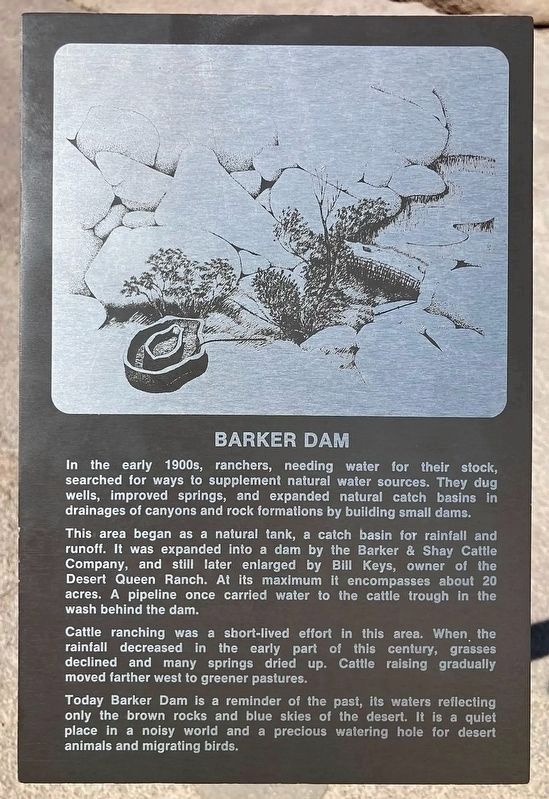
In the early 1900s, ranchers, needing water for their stock, searched for ways to supplement natural water sources. They dug wells, improved springs, and expanded natural catch basins in drainages of canyons and rock formations by building small dams.
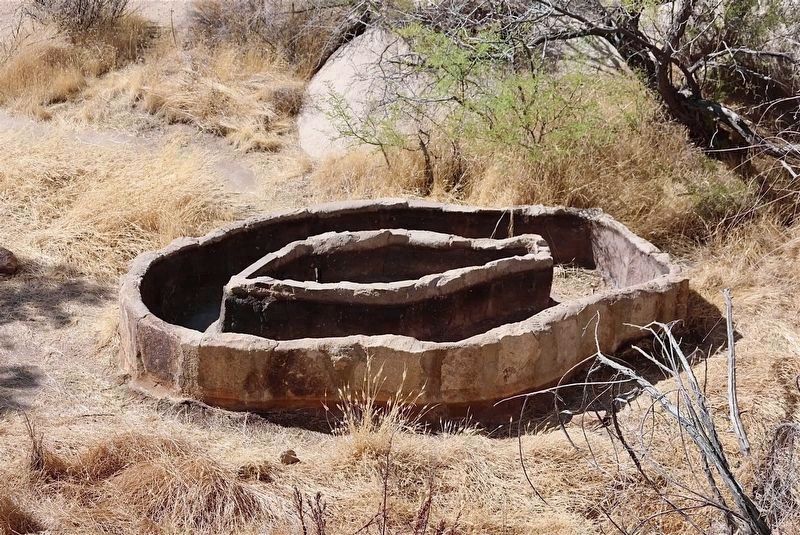
This area began as a natural tank, a catch basin for rainfall and runoff. It was expanded into a dam by the Barker & Shay Cattle Company, and still later enlarged

Photographed by Craig Baker
2. Barker Dam Marker and Trail
Cattle ranching was a short-lived effort in this area. When the rainfall decreased in the early part of this century, grasses declined and many springs dried up. Cattle raising gradually moved farther west to greener pastures.
Today Barker Dam is a reminder of the past, its waters reflecting only the brown rocks and blue skies of the desert. It is a quiet place in a noisy world and a precious watering hole for desert animals and migrating birds.
Erected by Joshua Tree National Park.
Topics. This historical marker is listed in these topic lists: Man-Made Features • Natural Resources • Settlements & Settlers. A significant historical year for this entry is 1902.
Location. 34° 1.513′ N, 116° 8.523′ W. Marker is in Joshua Tree National Park, California, in San Bernardino County. It can be reached from Barker Dam Road 1½ miles east of Park Road, on the left when traveling east. Located at the Barker Dam Parking Lot. Touch for map. Marker is in this post office area: Twentynine Palms CA 92277, United States of America. Touch for directions.

Regionally, this marker is in Greater Los Angeles, in the Coachella Valley, in the

Photographed by Craig Baker
3. Marker Detail - Trail Map
Other nearby markers. At least 8 other markers are within 5 miles of this marker, measured as the crow flies: Wall Street Mill (a few steps from this marker); Worth Bagley Stone (approx. 0.8 miles away); Linked to the Land (approx. 1½ miles away); Classic Lines (approx. 1.9 miles away); Ryan Ranch (approx. 2.6 miles away); Desert Queen Mine (approx. 4 miles away); Memorial Fire (approx. 4½ miles away); Welcome to the Indian Cove Trail (approx. 5.1 miles away). Touch for a list and map of all markers in Joshua Tree National Park.

Photographed by Craig Baker
4. Barker Dam Trail Sign
Photographed by Craig Baker
5. Barker Dam Marker

Photographed by Craig Baker
6. Barker Dam
Photographed by Craig Baker
7. Inscription on Dam
Photographed by Craig Baker
8. Cattle Trough
Photographed by Craig Baker
9. Petroglyphs

Photographed by Craig Baker
10. Mortar
Credits. This page was last revised on December 27, 2024. It was originally submitted on December 27, 2024, by Craig Baker of Sylmar, California. This page has been viewed 315 times since then and 45 times this year. Photos: 1, 2, 3, 4, 5, 6, 7, 8, 9, 10. submitted on December 27, 2024, by Craig Baker of Sylmar, California.
