Near Fort Davis in Jeff Davis County, Texas — The American South (West South Central)
McDonald Observatory of the University of Texas
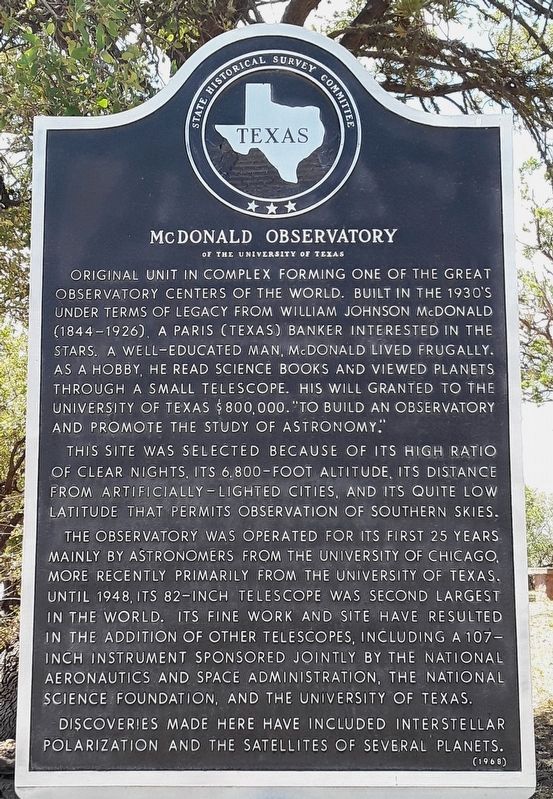
Photographed by Kayla Harper, July 8, 2023
1. McDonald Observatory of the University of Texas Marker
This site was selected because of its high ratio of clear nights, its 6,800-foot altitude, and its quite low latitude that permits observation of southern skies.
The observatory was operated for its first 25 years mainly by astronomers from the University of Chicago, more recently primarily from the University of Texas. Until 1948, its 82-inch telescope was second largest in the world. Its fine work and site have resulted in the addition of other telescopes including a 107-inch instrument sponsored jointly by the National Aeronautics and Space Administration, the National Science Foundation, and the University of Texas.
Discoveries made here have included
this page online
Erected 1968 by State Historical Survey Committee. (Marker Number 10480.)
Topics. This historical marker is listed in these topic lists: Notable Buildings • Notable Places • Science & Medicine. A significant historical year for this entry is 1948.
Location. 30° 40.277′ N, 104° 1.369′ W. Marker is near Fort Davis, Texas, in Jeff Davis County. It is on State Highway 78. From Fort Davis, take SH 118 W approx. 11.5 miles to the top of Mt. Locke, McDonald Observatory. Touch for map. Marker is in this post office area: Fort Davis TX 79734, United States of America. Touch for directions.

Regionally, this marker is in Texas’ Trans-Pecos & Big Bend Region. It is also in the American Borderlands and in the Southwest. Globally, it is in North America, a Gulf of Mexico state, the Western Hemisphere, the Western World, and the Anglosphere. Historically, it finds itself in what was once New Spain, the Republic of Texas, and one of the Confederate States of America.
Other nearby markers. At least 8 other markers are within 10 miles of this marker, measured
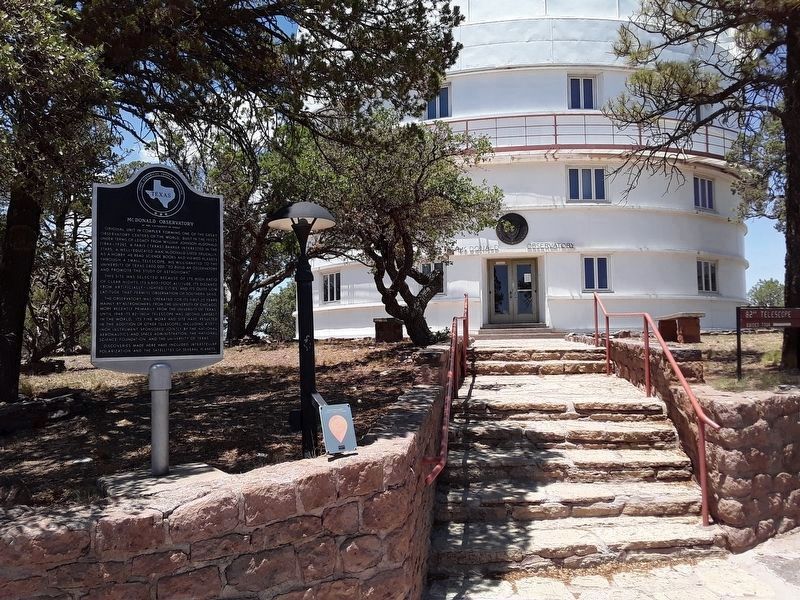
Photographed by Kayla Harper, July 8, 2023
2. McDonald Observatory of the University of Texas Marker
Marker is in front of the Otto Struve Telescope.
Also see . . .
1. University of Texas, McDonald Observatory website. (Submitted on January 15, 2010, by Richard Denney of Austin, Texas.)
2. Hobby-Eberly Telescope. The University of Texas McDonald Observatory
With its 11-meter (433-inch) mirror, the Hobby-Eberly Telescope (HET) is one of the world's largest optical telescopes. It was designed specifically for spectroscopy, the decoding of light from stars and galaxies to study their properties. This makes it ideal in searching for planets around other stars, studying distant galaxies, exploding stars, black holes and more.(Submitted on July 13, 2023, by Kayla Harper of Dallas, Texas.)
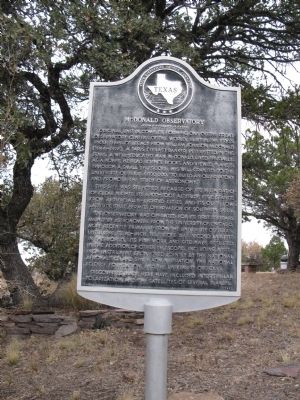
Photographed by Richard Denney, December 22, 2009
3. McDonald Observatory of the University of Texas Marker
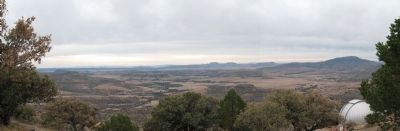
Photographed by Richard Denney
4. Panorama Mt. Locke
Photographed by Richard Denney, December 22, 2009
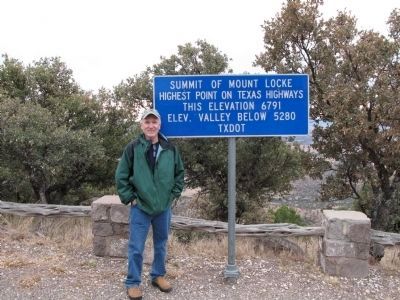
5. Highest Point on Texas Highways
Sign reads: Summit of Mount Locke, Highest Point on Texas Highways, This Elevation 6791, Elev. Valley Below 5280, TXDOT (Texas Department of Tranportation)
Photographed by Richard Denney, December 22, 2009
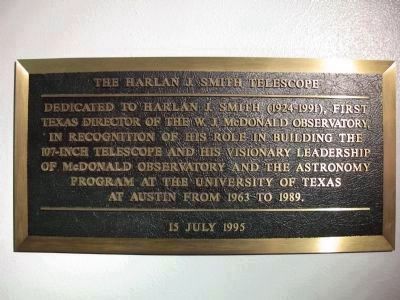
6. Harlan J. Smith plaque
Plaque is inside the Harlan J. Smith telescope dome. The photographer -- Richard Denney -- is proud to note he took undergraduate astronomy from Dr. Smith in the 70s.
Photographed by Richard Denney, December 22, 2009
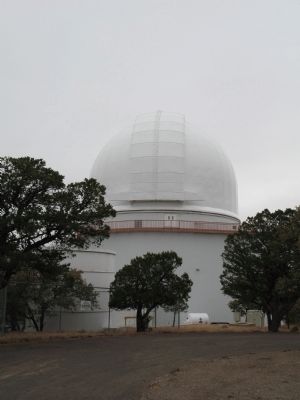
7. Harlan J. Smith telescope
Photographed by Richard Denney, December 22, 2009
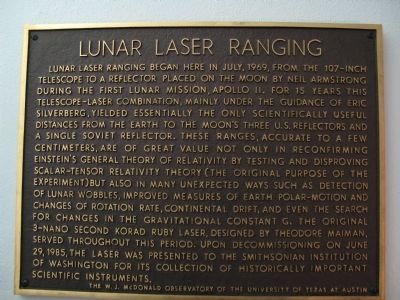
8. Lunar Laser Ranging
This plaque inside the Harlan J. Smith telescope dome describes experiments carried out with this telescope in bouncing laser beams off reflectors placed on the moon by Apollo 11.
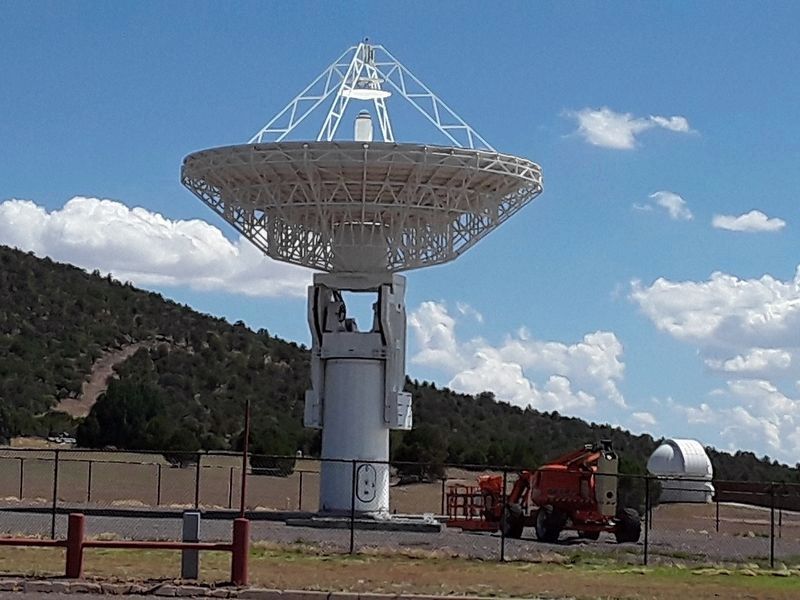
Photographed by Kayla Harper, July 8, 2023
9. McDonald Observatory
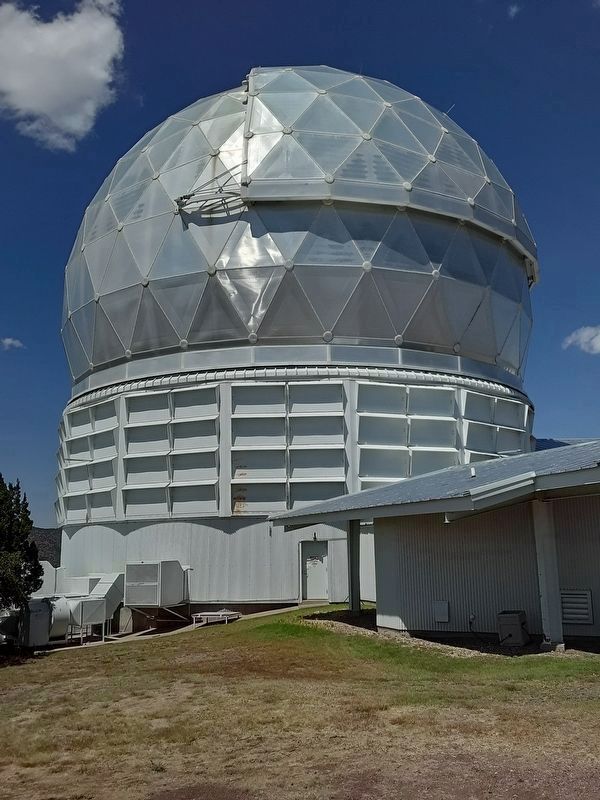
Photographed by Kayla Harper, July 8, 2023
10. Hobby-Eberly Telescope
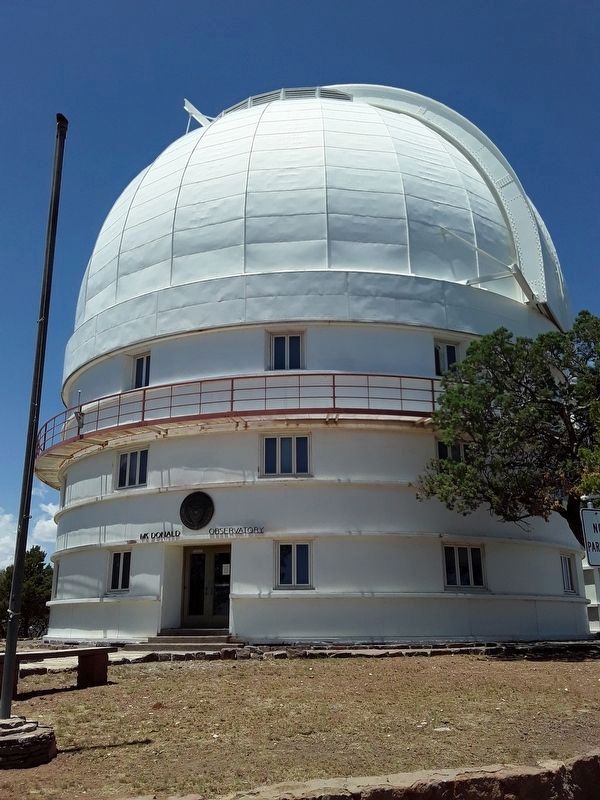
Photographed by Kayla Harper, July 8, 2023
11. Otto Struve Telescope
Credits. This page was last revised on July 19, 2023. It was originally submitted on January 12, 2010, by Richard Denney of Austin, Texas. This page has been viewed 1,755 times since then and 64 times this year. Last updated on July 17, 2023, by Kayla Harper of Dallas, Texas. Photos: 1. submitted on July 11, 2023, by Kayla Harper of Dallas, Texas. 2. submitted on July 17, 2023, by Kayla Harper of Dallas, Texas. 3, 4, 5, 6, 7, 8. submitted on January 15, 2010, by Richard Denney of Austin, Texas. 9, 10. submitted on July 11, 2023, by Kayla Harper of Dallas, Texas. 11. submitted on July 17, 2023, by Kayla Harper of Dallas, Texas. • James Hulse was the editor who published this page.
