
Breisach am Rhein in Breisgau-Hochschwarzwald, Baden-Württemberg, Germany — Central Europe
Ehemalige Spitalkirche St. Martin
⎯⎯⎯
Former Hospital Church
Photographed by Steve Stoessel, December 19, 2024
1. Ehemalige Spitalkirche St. Martin / Former Hospital Church Marker
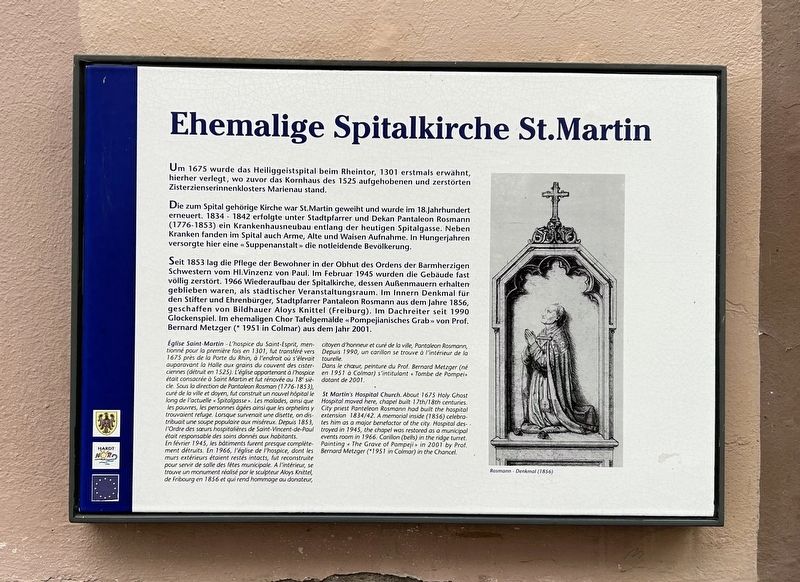
Die zum Spital gehörige Kirche war St.Martin geweiht und wurde im 18.Jahrhundert erneuert. 1834 - 1842 erfolgte unter Stadtpfarrer und Dekan Pantaleon Rosmann (1776-1853) ein Krankenhausneubau entlang der heutigen Spitalgasse. Neben Kranken fanden im Spital auch Arme, Alte und Waisen Aufnahme. In Hungerjahren versorgte hier eine «Suppenanstalt» die notleidende Bevölkerung.
Seit 1853 lag die Pflege der Bewohner in der Obhut des Ordens der Barmherzigen Schwestern vom HI.Vinzenz von Paul. Im Februar 1945 wurden die Gebäude fast völlig zerstört. 1966 Wiederaufbau der Spitalkirche, dessen Außenmauern erhalten geblieben waren, als städtischer Veranstaltungsraum. Im Innern Denkmal für den Stifter und Ehrenbürger, Stadtpfarrer Pantaleon Rosmann aus dem Jahre 1856, geschaffen von Bildhauer Aloys Knittel (Freiburg). Im Dachreiter seit 1990 Glockenspiel. Im ehemaligen Chor Tafelgemälde «Pompejianisches Grab» von Prof. Bernard Metzger (* 1951
this page online
Église Saint-Martin - L'hospice du Saint-Esprit, mentionné pour la première fois en 1301, fut transféré vers 1675 près de la Porte du Rhin, à l'endroit où s'élevait auparavant la Halle aux grains du couvent des cisterciennes (détruit en 1525). L'église appartenant à l'hospice était consacrée à Saint Martin et fut rénovée au 18' siècle. Sous la direction de Pantaleon Rosman (1776-1853), curé de la ville et doyen, fut construit un nouvel hôpital le long de l'actuelle «Spitalgasse», Les malades, ainsi que les pauvres, les personnes âgées ainsi que les orphelins y trouvaient refuge. Lorsque survenait une disette, on distribuait une soupe populaire aux miséreux. Depuis 1853, /'Ordre des sœurs hospitalières de Saint-Vincent-de-Paul était responsable des soins donnés aux habitants.
En février 1945, les bâtiments furent presque complètement détruits. En 1966, l'église de l'hospice, dont les murs extérieurs étaient restés intacts, fut reconstruite pour servir de salle des fêtes municipale. A l'intérieur, se trouve un monument réalisé par le sculpteur Aloys Knittel, de Fribourg en 1856 et qui rend hommage au
Photographed by Steve Stoessel, December 19, 2024
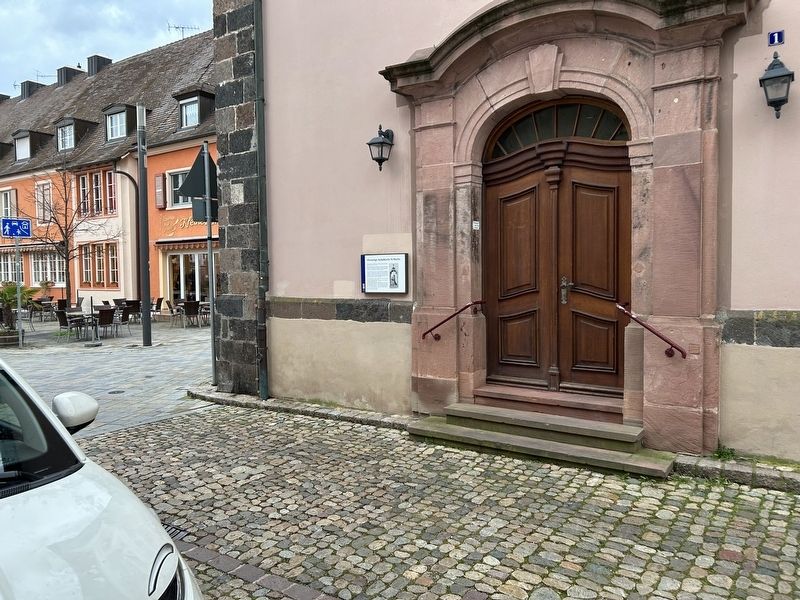
2. Ehemalige Spitalkirche St. Martin / Former Hospital Church Marker
Dans le chœur, peinture du Prof. Bernard Metzger (né en 1951à Colmar) s'intitulant « Tombe de Pompei» datant de 2001.
St Martin's Hospital Church. About 1675 Holy Ghost Hospital moved here, chapel built 17th/18th centuries. City priest Panteleon Rosmann had built the hospital extension 1834/42. A memorial inside (1856) celebrates him as a major benefactor of the city. Hospital destroyed in 1945. The chapel was restored as a municipal events room in 1966. Carillon (bells) in the ridge turret. Painting “The Grave of Pompeji”in 2001 by Prof. Bernard Metzger (*1951 in Colmar) in the Chancel.
[Drawing Caption:]
Rosmann - Denkmal (1856)
[Unoffical English Translation]
Around 1675, the Holy Spirit Hospital at the Rhine Gate, first mentioned in 1301, was moved here, where the granary of the Marienau Cistercian monastery, which was abolished and destroyed in 1525, previously stood.
The church belonging to the hospital was dedicated to St. Martin, and was renovated in the 18th century. Between
Photographed by Steve Stoessel, December 19, 2024
3. Ehemalige Spitalkirche St. Martin / Former Hospital Church Marker
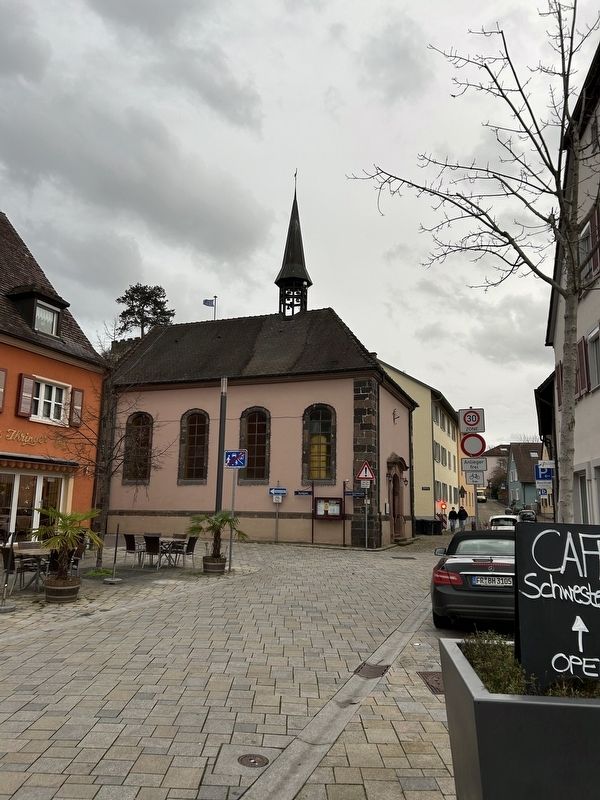
Since 1853, the care of the residents has been in the care of the Order of the Sisters of Mercy of St. Vincent de Paul. In February 1945 the buildings were almost completely destroyed. 1966 reconstruction of the hospital church, whose outer walls had been preserved, as a municipal event space. Inside there is a monument to the founder and honorary citizen, parish priest Pantaleon Rosmann from 1856 created by Blanauer Aloys Knittel (Freiburg). Carillon in the roof turret since 1990. In the former choir there is a panel painting “Pompeian Tomb” by Prof. Bernard Metzger (* 1951 in Colmar) from 2001.
Topics. This historical marker is listed in these topic lists: Religion & Religious Structures • Science & Medicine. A significant historical year for this entry is 1675.
Location. 48° 1.665′ N, 7° 34.956′ E. Marker is in Breisach am Rhein, Baden-Württemberg, in Breisgau-Hochschwarzwald. It is on Marienau near Spitelgasse, on the left when traveling south. Touch for map. Marker is at or near this postal address: Marienau 1, Breisach am Rhein BW 79206, Germany. Touch for directions.

Regionally, it is in Europe, the European Union, Atlantic Europe, Central Europe, the Schengen Area, Western Europe, and the Western World. Historically, it finds itself in what was once the Roman Empire and specifically also the Holy Roman Empire.
Other nearby markers. At least 8 other markers are within walking distance of this marker: Zum Rheinischen Hof (within shouting distance of this marker); Eckartsberg (about 90 meters away, measured in a direct line); Eckartberg Obelisk (about 90 meters away); Kurmärkischen Dragone (about 120 meters away); Breisacher Zeitung / Breisach Newpaper (about 120 meters away); Der Eckartsberg im 17. Jahrhundert (about 120 meters away); Martin-Schongauer-Gymnasium (about 150 meters away); Old City Wall (about 180 meters away). Touch for a list and map of all markers in Breisach am Rhein.
Credits. This page was last revised on January 1, 2025. It was originally submitted on January 1, 2025, by Steve Stoessel of Niskayuna, New York. This page has been viewed 179 times since then and 39 times this year. Photos: 1, 2, 3. submitted on January 1, 2025, by Steve Stoessel of Niskayuna, New York.
