West Loop in Chicago in Cook County, Illinois — The American Midwest (Great Lakes)
Union Park

Photographed by Sean P. Flynn, January 2, 2025
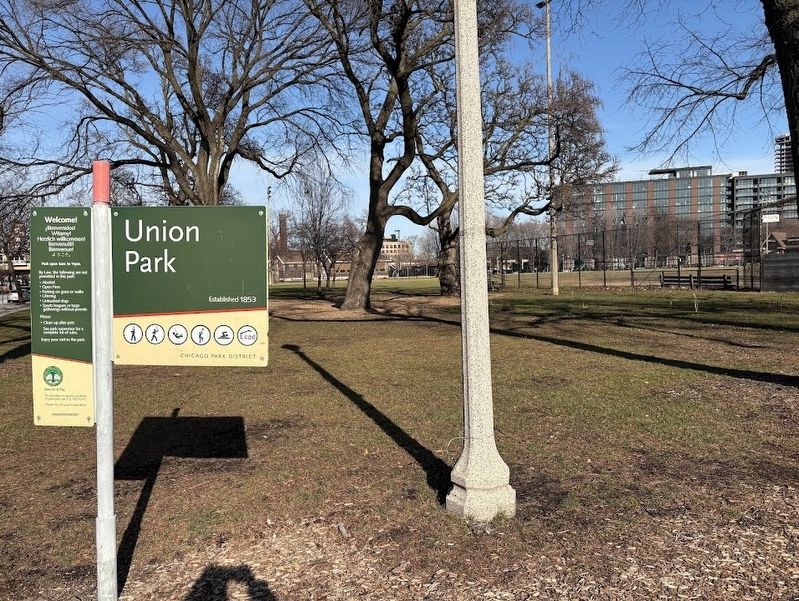
1. Union Park Marker
Union Park, named for the federal union, was created in the center of a fashionable neighborhood in 1853. Originally the park had an artificial lake, a zoo, and several buildings including an observation tower.
Between the 1880's and the 1910's, nationally renowned designers created innovative works of architecture and landscape art in Union Park. This included an experimental wildflower garden planted by Jens Jensen, the dean of the Prairie Style in landscape architecture.
In the 1910's, African Americans began settling in the neighborhood, and Union became the first integrated park. In later years the park became well-known for musical and theatrical productions, dances, and other social events.
Erected by Chicago Park District.
Topics and series. This historical marker is listed in these topic lists: African Americans • Arts, Letters, Music • Horticulture & Forestry • Parks & Recreational Areas. In addition, it is included in the Jens Jensen series list. A significant historical year for this entry is 1853.
Location. 41° 53.01′ N, 87° 39.997′ W. Marker is in Chicago, Illinois, in Cook County.
this page online

Regionally, this marker is in the American Midwest. Globally, it is in North America, on the Great Lakes, in the Western Hemisphere, in the Western World, and in the Anglosphere. Historically, it finds itself in what was once the Viceroyalty of New France, the territory of the Mississippian Culture, and the Northwest Territory.
Other nearby markers. At least 8 other markers are within walking distance of this marker: Carter H. Harrison (about 300 feet away, measured in a direct line); James Connolly (about 300 feet away); The Mary Thompson Hospital for Women and Children (about 400 feet away); a different marker also named Union Park (about 500 feet away); West Side YMCA/YWCA Complex (approx. ¼ mile away); Wieboldt's Department Store (approx. ¼ mile away); Jackson Boulevard (approx. 0.3 miles away); Robert Marvin "Bobby" Hull (approx.
Photographed by Sean P. Flynn, January 2, 2025
2. Union Park
The historical text is on the rear of the sign.
More about this marker. The historical text is on the rear of the Union Park sign that faces Washington Blvd. A larger sign with identical text can be found a few blocks north of here, near the gymnasium and pool.
Also see . . . Chicago Park District: Union Park.
(Submitted on January 2, 2025, by Sean P. Flynn of Oak Park, Illinois.)Excerpt: "Between the 1920s and the 1950s, the park became well-known for cultural and social events, and a number of notable musicians performed there. Among them were the noted pioneer of gospel music Thomas A. Dorsey; trumpeter Sunny Cohn; and jazz pianist Ramsey Lewis."
Photographed by Sean P. Flynn, January 2, 2025
3. Union Park Marker
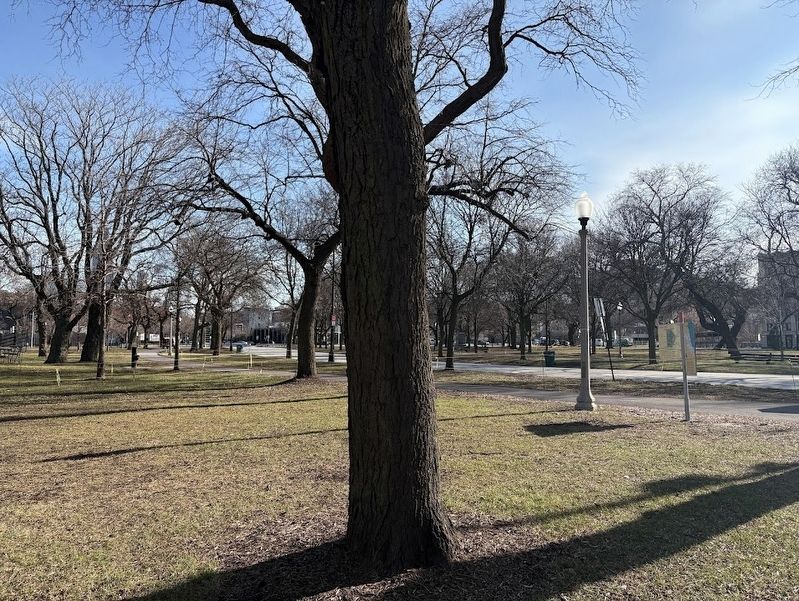
In the background of this photo, to the right of the tree, is a statue of Carter H. Harrison, the mayor of Chicago who was assassinated in 1893 a few blocks from this location just hours after giving a speech at the Columbian Exposition. In the background on the left, mostly obscured by trees, is Willis Tower, Chicago's tallest building.
Chicago Daily News Collection, Chicago History Museum, circa 1912
4. Union Park
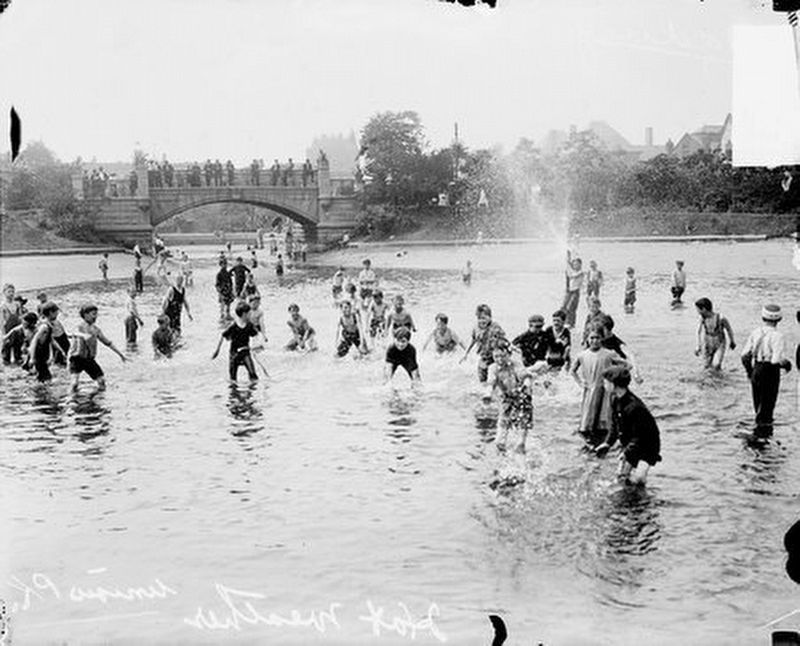
Children play in the Union Park lake with onlookers behind them on the bridge.
Credits. This page was last revised on August 6, 2025. It was originally submitted on January 2, 2025, by Sean P. Flynn of Oak Park, Illinois. This page has been viewed 352 times since then and 82 times this year. Photos: 1, 2, 3. submitted on January 2, 2025, by Sean P. Flynn of Oak Park, Illinois. 4. submitted on January 3, 2025, by Sean P. Flynn of Oak Park, Illinois.
