Eatonton in Putnam County, Georgia — The American South (South Atlantic)
The Smithy

Photographed by Mark Parker, December 27, 2024
1. The Smithy Marker
Blacksmiths were most closely associated with horses, for they were renown for keeping horses and mules shod and repairing and making horse related items. Blacksmiths showed even greater skills in their ability to create tools for construction of buildings, cooking ware, farm implements, weapons of war, and creative items.
The smithy was an essential member of the community. His work was so specialized, his skills so unique, and his tools so precise that his service was invaluable. Blacksmiths were not necessarily educated individuals, but intelligent skilled craftsman with imagination and the ability to visualize
this page online
The blacksmith workshop was a mesmerizing place with a roaring fire, flying sparks, the smell of smoke, the clinking of hammers, and the hissing of the hot metal as it was dipped into the slack tub to cool and temper. The smithy deftly worked metal using a collection of staple tools. Basic essential tools were the forge, the centerpiece of his workshop; a chimney to allow the smoke to escape; the hearth to allow the metal to heat; bellows to create a steady flow of air to the fire; and the slack tub to cool the metal and make it stronger. The most recognizable tool associated with a blacksmith was the anvil which typically weighed from 100 to 300 pounds. A collection of hand tools consisting of hammers, hardies, tongs, vice grips, chisels, and files

Photographed by Mark Parker, December 27, 2024
2. Full view of the blacksmith shop and the Smithy Marker
The industrialization of America brought about the demise of blacksmiths, but their creative ability, technical skills, and indomitable spirit made them a cornerstone of American history.
According to the 1810 census, 10,029 people resided in Putnam County, an area that covered 360.7 square miles. For the purpose of order and protection, the county was divided into twelve militia districts and Eatonton. Difficulty of travel and the immediate needs of patrons resulted in the establishment of 40 forges throughout the county.
This display, containing a collection of blacksmith artifacts from forges located in Putnam County, provides a view of one of America's most intriguing crafts and its tools.
Eagle Scout Project completed on July 20th, 2019
John Kendrick Holmes
Troop
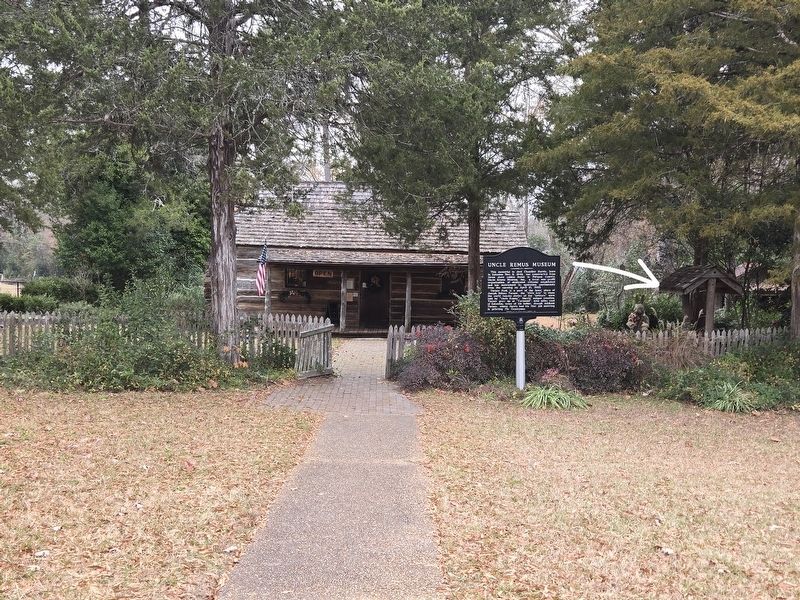
Photographed by Mark Parker, December 27, 2024
3. Full view of the Uncle Remus Museum. Blacksmith shop indicated by the arrow
Grandson of local Eatonton residents David and Carole Thomas.
Erected 2019.
Topics. This historical marker is listed in these topic lists: Agriculture • Animals • Industry & Commerce.
Location. 33° 19.289′ N, 83° 23.307′ W. Marker is in Eatonton, Georgia, in Putnam County. It can be reached from the intersection of South Washington Avenue and Oak Street (Business U.S. 129), on the right when traveling north. The marker is attached to a blacksmith shop, an exhibit of the Uncle Remus Museum. Touch for map. Marker is at or near this postal address: 214 Oak St, Eatonton GA 31024, United States of America. Touch for directions.

Regionally, this marker is in Georgia’s Antebellum Trail and in the Piedmont. It is also in the American South and specifically in the Deep South. Globally, it is in North America, the Western Hemisphere, the Western World, and the Anglosphere. Historically, it finds itself in what was once the territory of the Mississippian Culture, one of the original Thirteen Colonies, one of

Photographed by Mark Parker, December 27, 2024
4. The Blacksmith Shop interior
Various items are marked, but at the time of the visit there was no key displayed for the items
Other nearby markers. At least 8 other markers are within walking distance of this marker: The Town Well Shelter (a few steps from this marker); Uncle Remus Museum (a few steps from this marker); Branch Bank of the State of Georgia at Eatonton (approx. 0.3 miles away); Lucius Quintus Cincinnatus Lamar (approx. 0.3 miles away); In Honor of Joel Chandler Harris (approx. 0.3 miles away); Putnam County Court House (approx. 0.3 miles away); The Stoneman Raid (approx. 0.3 miles away); Putnam County (approx. 0.3 miles away). Touch for a list and map of all markers in Eatonton.
Also see . . . Uncle Remus Museum. (Submitted on January 4, 2025.)

Photographed by Mark Parker, December 27, 2024
5. Restored Blacksmith Shop plaque
Credits. This page was last revised on January 4, 2025. It was originally submitted on January 4, 2025, by Mark Parker of Hickory, North Carolina. This page has been viewed 201 times since then and 40 times this year. Photos: 1, 2, 3, 4, 5. submitted on January 4, 2025, by Mark Parker of Hickory, North Carolina. • Bernard Fisher was the editor who published this page.
