Hot Springs in Garland County, Arkansas — The American South (West South Central)
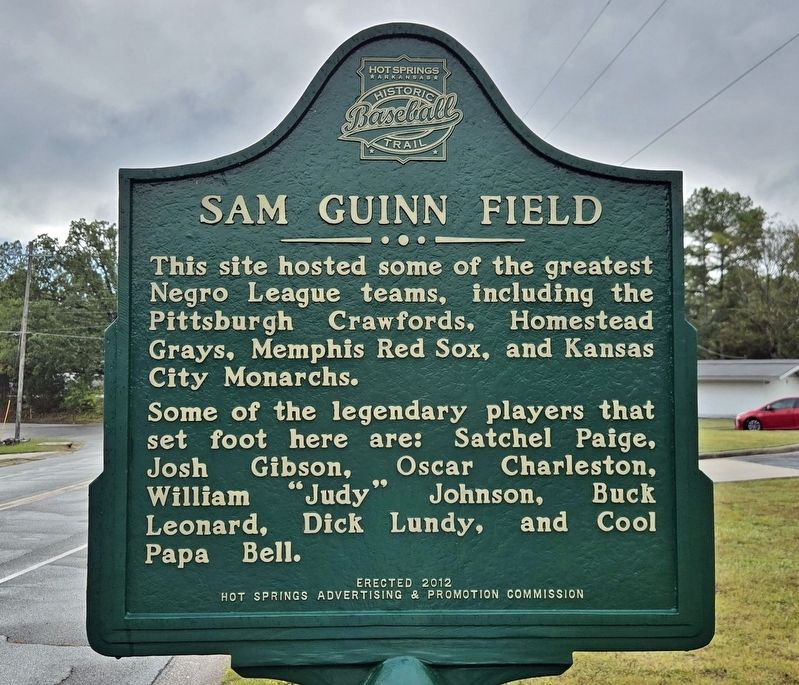
Sam Guinn Field
| — | Hot Springs Historic Baseball Trail | — |
Photographed by Cosmos Mariner, September 15, 2024
1. Sam Guinn Field Marker
This site hosted some of the greatest Negro League teams, including the Pittsburgh Crawfords, Homestead Grays, Memphis Red Sox, and Kansas City Monarchs.
Some of the legendary players that set foot here are: Satchel Paige, Josh Gibson, Oscar Charleston, William “Judy” Johnson, Buck Leonard, Dick Lundy and Cool Papa Bell.
Erected 2012 by Hot Springs Advertising and Promotion Commission. (Marker Number 7.)
Topics. This historical marker is listed in these topic lists: African Americans • Civil Rights • Sports.
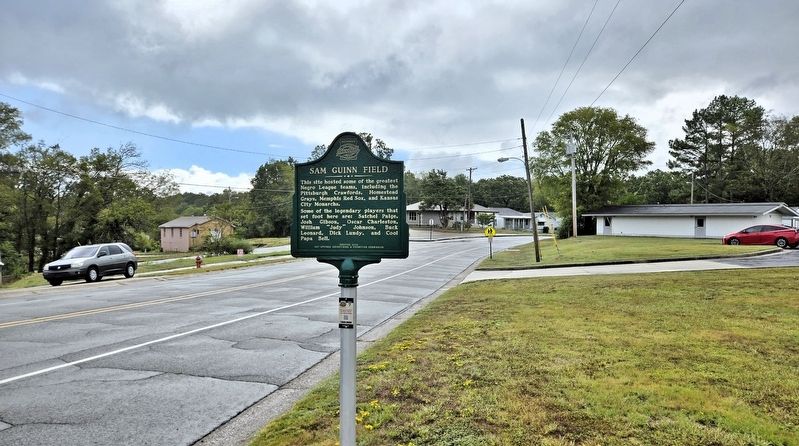
Location. 34° 30.214′ N, 93° 2.281′ W. Marker is in Hot Springs, Arkansas, in Garland County. It is on Crescent Avenue just south of Ash Street, on the right when traveling south. Touch for map. Marker is at or near this postal address: 497 Crescent Avenue, Hot Springs National Park AR 71901, United States of America. Touch for directions.

Regionally, this marker is in Arkansas’ Ouachita Mountains. It is also in the American South and specifically in the Upper South. Globally, it is in North America, the Western Hemisphere, the Western
this page online
Other nearby markers. At least 8 other markers are within walking distance of this marker: Mamie Phipps Clark (approx. half a mile away); John C. Puckett (approx. half a mile away); Edith Irby Jones (approx. half a mile away); Eureka Missionary Baptist Church (approx. 0.7 miles away); National Baptist Hotel (approx. 0.7 miles away); The Great Fire of 1913 Left this City in Ruins (approx. ¾ mile away); In Memory of the Students of Senior High School Who Made the Supreme Sacrifice (approx. ¾ mile away); Fallen Hero Memorial (approx. 0.8 miles away). Touch for a list and map of all markers in Hot Springs.
Also see . . .
1. Sam Guinn Stadium (Arkansas Baseball Encyclopedia).
Excerpt: Sam Guinn Field was a ballpark in Hot Springs, Arkkansas, used by Negro baseball teams for exhibition games and spring training during the 1930s and 1940s. Sam Guinn Stadium was built in 1935 and named after Sam Guinn, a student(Submitted on January 4, 2025, by Cosmos Mariner of Cape Canaveral, Florida.)at Langston High School in Hot Springs who died on November 24th, 1933 as a result of a fractured spine injury sustained during football practice. Little is known about the structural features of the ballpark. The field was mostly used for football games and practice in later part of the 20th century. In the mid 1990s, Greater St. Paul Baptist Church was built at the present-day site of Sam Guinn Field. A marker now stands as part of the Hot Springs Baseball Trail to note the importance of the site.Photographed by Cosmos Mariner, September 15, 20242. Sam Guinn Field MarkerLooking south along Crescent Avenue.
2. Exhibit brings insight into Negro Leagues’ history.
(by Bryan Rice, The Sentinel-Record, 3/14/2023) Excerpt: "The Negro League came here for spring training," says Jean Lacefield, the development officer for Gateway Community Association. "They came during the same time Babe Ruth and all the other players were coming for spring training. Since the color barrier had not been broken, baseball was still segregated at that time. They played on the field at Sam Guinn Stadium. Most of the Negro League's players, if they were from Arkansas, they went(Submitted on January 4, 2025, by Cosmos Mariner of Cape Canaveral, Florida.)to Langston high school. Langston was the segregated high school. Prior to 1965, schools were segregated, and baseball was almost exclusively segregated. Most of the minority players came out of the Negro League to play for National and American Leagues."Photographed by Cosmos Mariner, September 15, 20243. Sam Guinn Field MarkerLooking north along Crescent Avenue.

3. Hot Springs Historic Baseball Trail.
Excerpt: Every stop on the Hot Springs Historic Baseball Trail unveils something new and exciting about the game. Rich in history, Hot Springs was a haven for spring training and leisure of some of the game’s best players.(Submitted on January 4, 2025, by Cosmos Mariner of Cape Canaveral, Florida.)
Credits. This page was last revised on January 4, 2025. It was originally submitted on January 4, 2025, by Cosmos Mariner of Cape Canaveral, Florida. This page has been viewed 200 times since then and 36 times this year. Photos: 1, 2, 3. submitted on January 4, 2025, by Cosmos Mariner of Cape Canaveral, Florida.
