Brownsville in Cameron County, Texas — The American South (West South Central)
A natural fortress
⎯⎯⎯
Una fortaleza natural

Photographed by James Hulse, April 19, 2023
1. A natural fortress / Una fortaleza natural Marker
 Areas of thick brush crown the high ground at Palo Alto. This dense vegetation-known as chaparral once covered much of the region. Development of the Rio Grande delta since the war has led to the removal of much of the chaparral. Today, sites like Palo Alto preserve portions of these rapidly-disappearing thickets.
Vast ranks of vegetation
During the U.S.-Mexican War, dense groves of mesquite, cactus and other brush extended for miles along the banks of the river. Many of these plants are of the acacia family, including the guajillo or acacia berlandieri, named in honor of Jean Luis Berlandier - a naturalist who also served in the Mexican army at Palo Alto.
Home on the range
The islands of brush that remain provide shelter to a number of animals that once roamed freely throughout the region.
A thorny foe
In 1846, the chaparral was so thick that the armies moved along narrow roads carved into the vegetation. Other times, soldiers struggled to cut their own paths through spiny thickets of plants like goat bush and lote bush.
Captions
(Photo #1) Guajillo
(Photo #2) Wright acacia
(Photo #3) Tarantula
(Photo #4) Javelina
(Photo #5) Racoon
(Photo #6) Lote bush
(Photo #7) Goat bush
Las
this page online
Vastos rangos de vegetación
En 1846, vastas bosquecillos de mesquite, cactus y otros arbustos se extendían por varias millas a lo largo de la ribera. Muchas de estas plantas pertenecen a la familia de las acacias, incluyendo al guajillo o Acacia berlandieri, así llamadas en honor de Jean Louis Berlandier - un naturalista que también sirvió en el Ejército Mexicano en Palo Alto.
Hogar en la pradera
Las islas de maleza que prevalecen ofrecen refugio a un número de animales que alguna vez deambulaban libremente por toda la región.
Un espinoso enemigo
En 1846, el chaparral era tan espeso que los ejércitos se desplazaban a través de estrechos caminos tallados en la vegetación, En otras ocasiones, los soldados luchaban por
Photographed by James Hulse, April 19, 2023
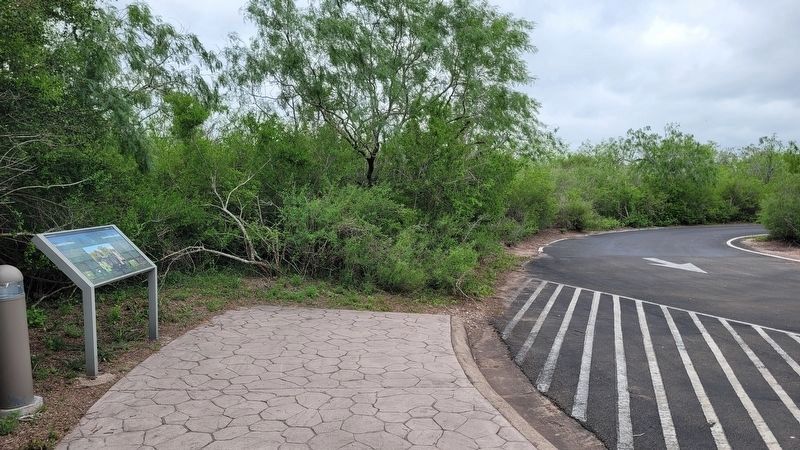
2. A natural fortress / Una fortaleza natural Marker
The view of the marker along the driveway at the visitor’s center.
Subtítulos
(Foto #1) Guajillo
(Foto #2) Uña de gato
(Foto #3) Tarántula
(Foto #4) Jabali
(Foto #5) Mapache
(Foto #6) Clepe
(Foto #7) Amargosa
Erected by Palo Alto Battlefield National Historical Park, National Park Service, US. Department of the Interior.
Topics. This historical marker is listed in these topic lists: Horticulture & Forestry • Parks & Recreational Areas • War, Mexican-American. A significant historical year for this entry is 1846.
Location. 26° 0.997′ N, 97° 28.759′ W. Marker is in Brownsville, Texas, in Cameron County. It is on Paredes Line Road north of State Road 550. The marker is located at the visitor's center to Palo Alto Battlefield National Historical Park. Touch for map. Marker is at or near this postal address: 7200 Paredes Line Rd, Brownsville TX 78526, United States of America. Touch for directions.

Regionally, this marker is in South Texas. It is also in the American Borderlands, in the South, and on the Gulf Coast. Globally, it is in North America, a Gulf of Mexico state, the Western

Photographed by James Hulse, April 19, 2023
3. The Palo Alto Battlefield National Historical Park’s Visitor’s Center
The marker is located to the right side just off camera.
Other nearby markers. At least 8 other markers are within walking distance of this marker: Palo Alto Battlefield (within shouting distance of this marker); a different marker also named Palo Alto Battlefield (approx. 0.2 miles away); The Battle of Palo Alto (approx. 0.2 miles away); Historic Battlefield Trail (approx. 0.2 miles away); Border War / Guerra de fronteras (approx. 0.3 miles away); Chosen Ground / Arena decidida (approx. half a mile away); Cavalry Charge / Se lanzaba la caballería (approx. half a mile away); Three Hundred Supply Wagons / Trescientas carretas de viveres (approx. 0.7 miles away). Touch for a list and map of all markers in Brownsville.
Credits. This page was last revised on January 6, 2025. It was originally submitted on January 6, 2025, by James Hulse of Medina, Texas. This page has been viewed 189 times since then and 26 times this year. Photos: 1, 2, 3. submitted on January 6, 2025, by James Hulse of Medina, Texas.
