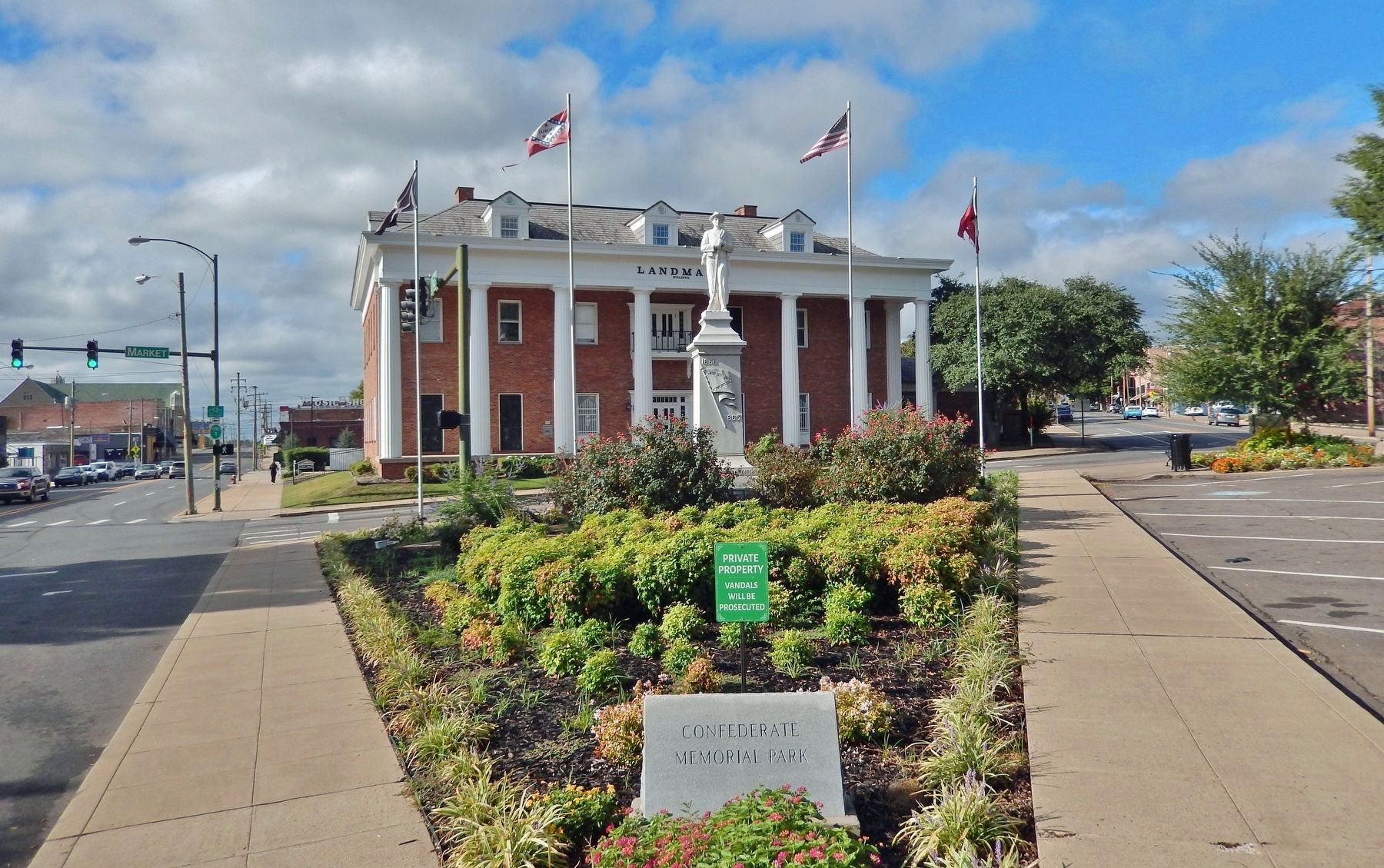
Confederate Memorial Park

United Daughters of the Confederacy
Hot Springs Chapter 80
Chapter chartered 1896
statue erected 1934
Placed on National Historical Register
1996
[memorial north side]
Confederate Soldiers
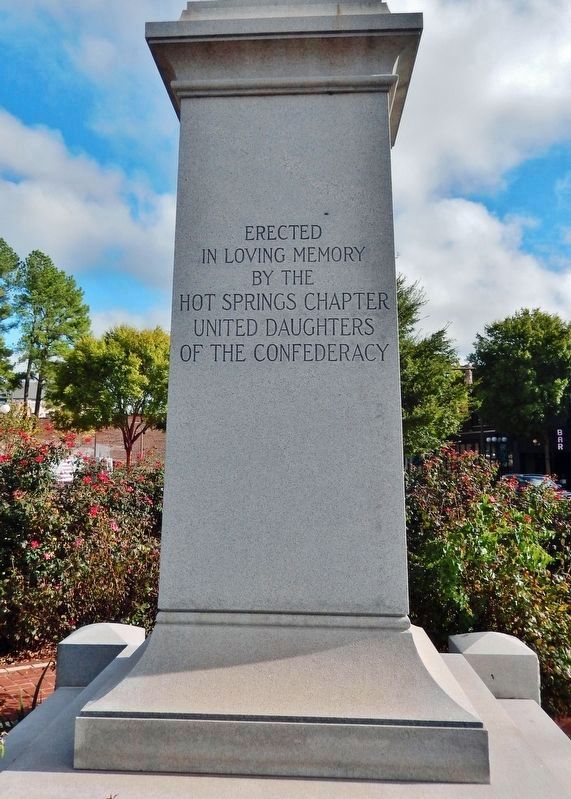
[memorial south side]
in loving memory
by the
Hot Springs Chapter
United Daughters
of the Confederacy
Erected 1934 by Hot Springs Chapter, United Daughters of the Confederacy.
Topics and series. This memorial is listed in these topic lists: Charity & Public Work • Fraternal or Sororal Organizations • Patriots & Patriotism • War, US Civil. In addition, it is included in the National Register of Historic Places (NRHP), and the United Daughters of the Confederacy series lists.
Location. 34° 30.479′ N, 93° 3.284′ W. Memorial is in Hot Springs, Arkansas, in Garland County. It is at the intersection of Central Avenue (State Highway 7) and Market Street, on the right when traveling south on Central Avenue. The Confederate Monument is the centerpiece of Confederate Memorial Park/Landmark Plaza, a triangle bounded by Central Avenue, Market Street and Ouachita
this page online

Regionally, this memorial is in the Ouachita Mountains. It is also in the American South and specifically in the Upper South. Globally, it is in North America, the Western Hemisphere, the Western World, and the Anglosphere. Historically, it finds itself in what was once the territory of the Mississippian Culture, the Louisiana Purchase, one of the Confederate States of America, and the Antebellum South.
Other nearby markers. At least 8 other markers are within walking distance of this marker: “We Bathe the World” (within shouting distance of this marker); Ouachita and Central Avenue (within shouting distance of this marker); Honus Wagner (about 300 feet away, measured in a direct line); The Malco Theatre (about 300 feet away); In June 1919 (about 500 feet away); Spencer's Corner (about 500 feet away); The National Humane Alliance Fountain (about 600 feet away); Hot Springs' History is as Rich as its Natural Resources (about 600 feet away). Touch for a list and map of all markers
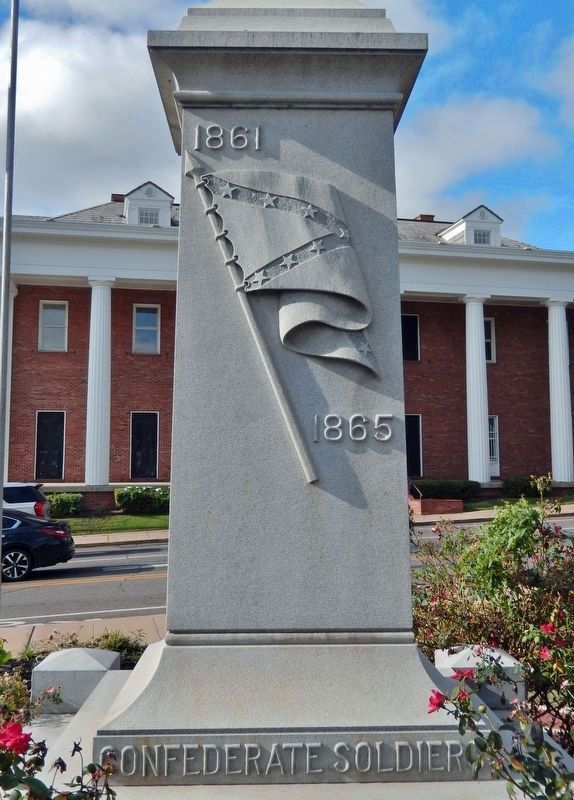
(north base detail)
Regarding Confederate Memorial Park. National Register of Historic Places № 96000457.
From the National Register Nomination prepared by John Slater, Arkansas Historic Preservation Program, 3/5/1996:
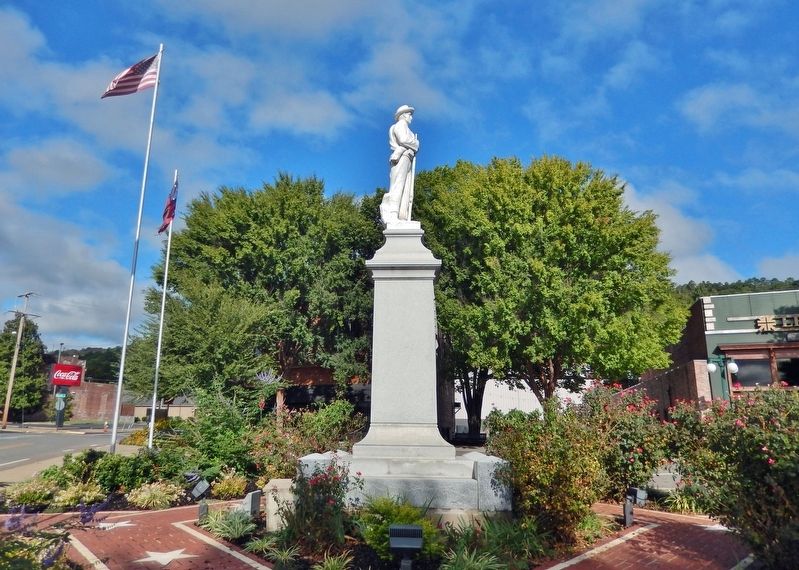
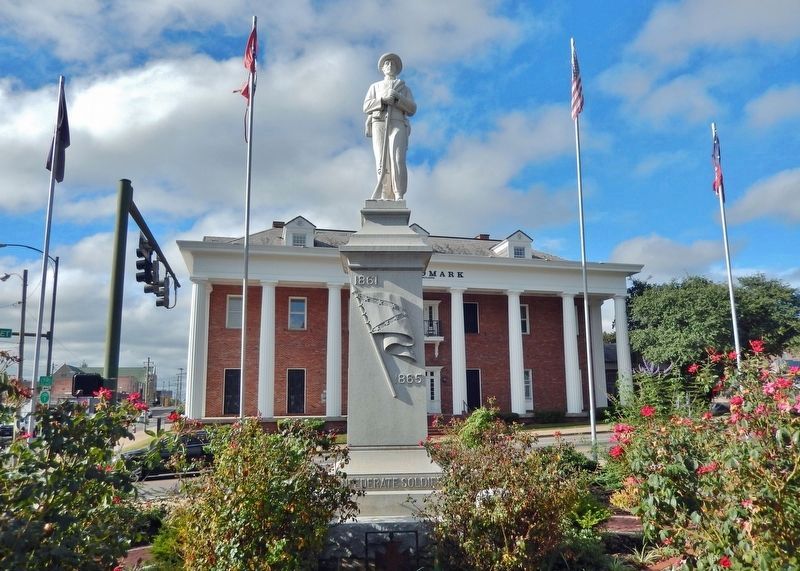
The monument, which faces northeast, was made by the McNeel Marble Co. of Marietta, Georgia. It depicts a standing Confederate soldier wearing a hat, coat, and pants typical of the Civil War era. His proper left foot is forward, and his hands are clasped at the top of a rifle barrel that has the butt to the ground in front of the proper right foot. A bedroll is draped over his proper left shoulder and is tied at the proper right waistline. The figure is wearing a belt with a canteen and bullet pouch on the proper right and a scabbard on the proper left. The sculpture, made of marble, is 6'x24"x24". The base, made of granite, is 12'x6'x6'.June 2, 1934, marked the end of a long struggle by the Hot Springs Chapter No. 80 of the United Daughters of the Confederacy to put a Confederate memorial in Hot Springs, which had been the only major city in the state without one. The campaign began in 1907, when Mrs. J. Davidson
Smith moved to Hot Springs from Alabama, a state that had already erected many Confederate monuments, and suggested that Hot Springs build its own tribute to its Civil War soldiers. Several contributions were immediately made, and a special fund was set up to handle the finances. In 1913 U.D.C. Treasurer Mrs. S. E. Dillon oversaw a special Tag Day to raise money, as well as card parties, teas, dinners, and so forth. By 1929 the monument fund was still lacking, however, so Mrs. Dillon, now President of the State Division of the U.D.C., asked the state chapter for $1,000, payable at $200 per year. This plan was unanimously approved, but the monument was still several years from completion.Photographed by Cosmos Mariner, September 14, 20243. Confederate Memorial
(south base detail)Following this financial victory, the next obstacle for Dillon and the U.D.C. was to find an appropriate location for their memorial. In 1933, Mr. and Mrs. Dillon convinced the city council to pass a special ordinance to allow it to be placed on what was then Como Triangle. A U.D.C. committee was then created to select a style and design for the monument. Finally, after much planning and effort, the Hot Springs Confederate Memorial was dedicated on
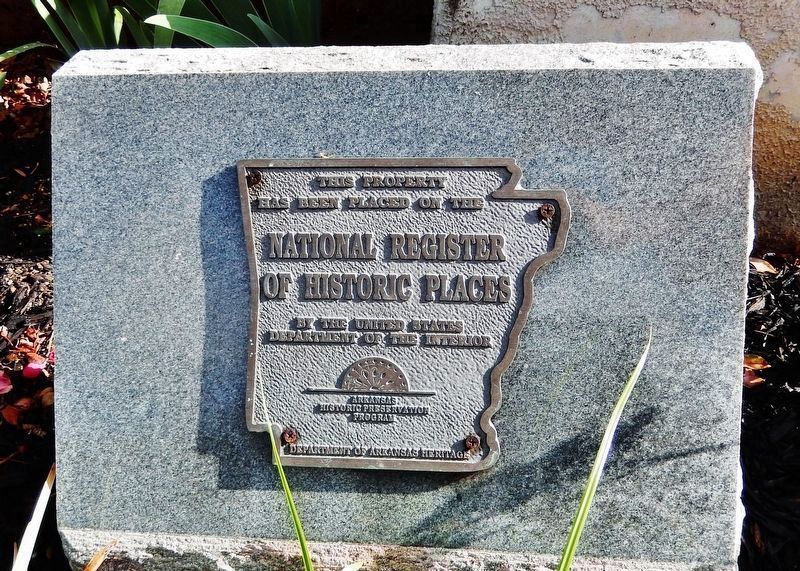
June 2, 1934, with a ceremony that included speeches by chapter members and an address by the mayor. The final cost of the monument is believed to be approximately $5,000. In 1953 the city formally gave the U.D.C. the deed to the memorial plot.Photographed by Cosmos Mariner, September 14, 20244. Arkansas Heritage & National Register Marker(mounted ground level on south side of the memorial)
This property
has been placed on the
National Register
of Historic Places
by the United States
Department of the InteriorArkansas Historic Preservation Program
Department of Arkansas Heritage
Also see . . .
1. Hot Springs Confederate Monument (Wikipedia).
Excerpt: The Hot Springs Confederate Monument is a marble representation of a Confederate Army soldier. The monument was placed in 1934 by the local chapter of the United Daughters of the Confederacy and was the last Confederate monument placed in one of Arkansas' major cities. The monument was listed on the National Register of Historic Places in 1996.(Submitted on January 8, 2025, by Cosmos Mariner of Cape Canaveral, Florida.)
2. Lynchings hidden in the history of the Hot Springs Confederate monument (Arkansas Times).
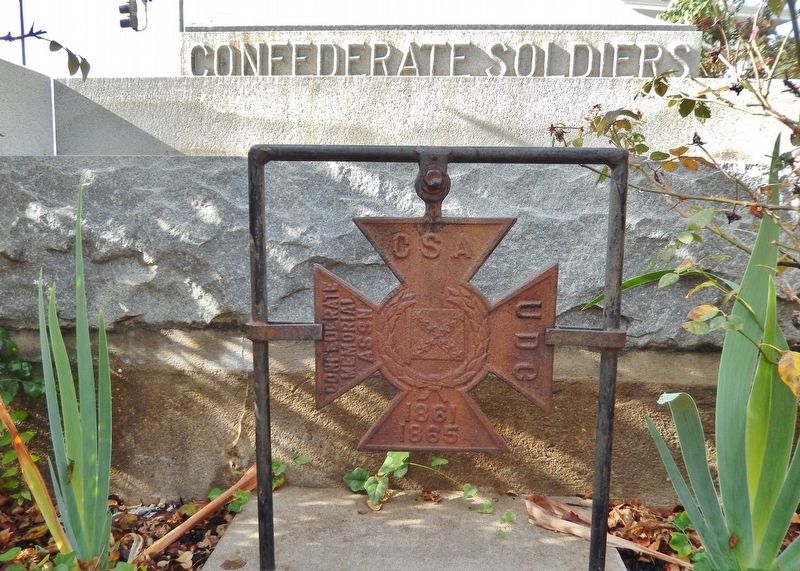
(By by Guy Lancaster, 8/18/2027) Excerpt: During the early 20th century, Hot Springs twice erupted into the kind of violence that has its roots in the issues left unresolved by the Civil War, and both times, it happened right where that monument to Confederate soldiers stands today. Will(Submitted on January 8, 2025, by Cosmos Mariner of Cape Canaveral, Florida.)Norman, a black man, was murdered there on June 19, 1913. Norman had worked as a servant for the family of C. Floyd Huff, a prominent man who had served as county judge from 1898 to 1900. After Huff’s daughter, Garland, was found stuffed in a closet with her head bashed in, suspicion immediately fell upon Norman...Photographed by Cosmos Mariner, September 14, 20245. UDC Confederate Veteran Grave MarkerMounted at ground level on north side of the memorial.The next lynching in Hot Springs took place on August 1, 1922. Gilbert Harris, nicknamed “Bunk” or “Punk,” had reportedly shot Maurice Connelly, a young businessman and nephew of the county judge, during a botched robbery attempt the previous evening. Harris was quickly arrested, and an armed mob soon surrounded the jail. At the news that Connelly had died, the mob grew angrier, its members openly discussing plans to lynch Harris...

Credits. This page was last revised on January 8, 2025. It was originally submitted on January 6, 2025, by Cosmos Mariner of Cape Canaveral, Florida. This page has been viewed 371 times since then and 71 times this year. Photos: 1, 2, 3, 4, 5, 6, 7, 8, 9. submitted on January 8, 2025, by Cosmos Mariner of Cape Canaveral, Florida.
