Hot Springs in Garland County, Arkansas — The American South (West South Central)
Garland County Courthouse
Photographed by Cosmos Mariner, September 14, 2024
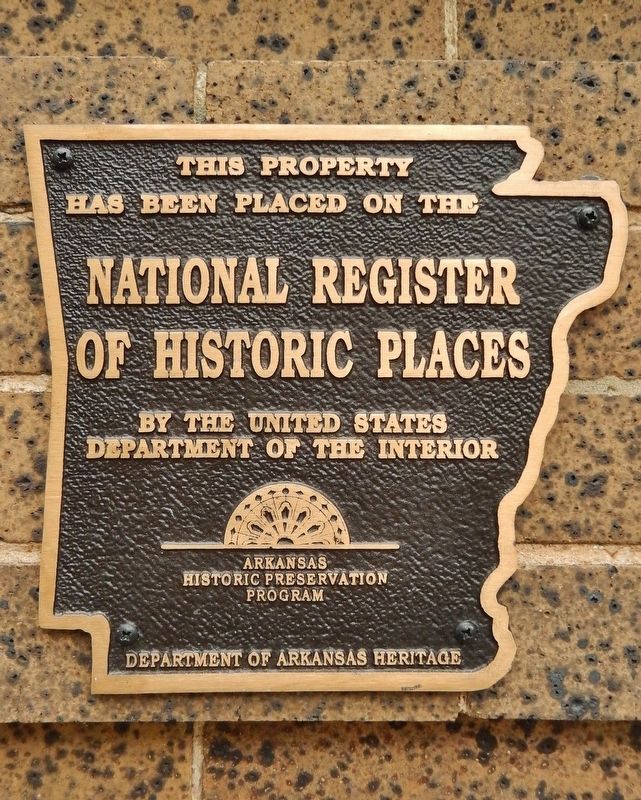
1. Garland County Courthouse Marker
has been placed on the
National Register
of Historic Places
by the United States
Department of the Interior
Arkansas Historic Preservation Program
Department of Arkansas Heritage
Erected by Department of Arkansas Heritage.
Topics and series. This historical marker is listed in these topic lists: Architecture • Law Enforcement • Notable Buildings. In addition, it is included in the National Register of Historic Places (NRHP), and the Time Capsules series lists. A significant historical year for this entry is 1905.
Location. 34° 30.291′ N, 93° 3.524′ W. Marker is in Hot Springs, Arkansas, in Garland County. It is on Ouachita Avenue just west of Hawthorne Street, on the left when traveling west. The marker is mounted at eye-level, directly on the subject building, on the left side of the northwest/front entrance. Touch for map. Marker is at or near this postal address: 501 Ouachita Avenue, Hot Springs National Park AR 71901, United States of America. Touch for directions.

Regionally, this marker is in the Ouachita Mountains. It is also in the American South and specifically in the Upper South. Globally,
this page online
Other nearby markers. At least 8 other markers are within walking distance of this marker: The Ed. B. Mooney Tree (within shouting distance of this marker); Hot Springs Baseball Grounds (within shouting distance of this marker); Orange Street Presbyterian Church (about 800 feet away, measured in a direct line); Central Methodist Church (approx. 0.2 miles away); Walter Beauchamp House (approx. 0.2 miles away); Dr. and Mrs. D.E. Kloss (approx. ¼ mile away); Walter Johnson (approx. ¼ mile away); Honus Wagner (approx. ¼ mile away). Touch for a list and map of all markers in Hot Springs.
Regarding Garland County Courthouse. National Register of Historic Places № 79000441.
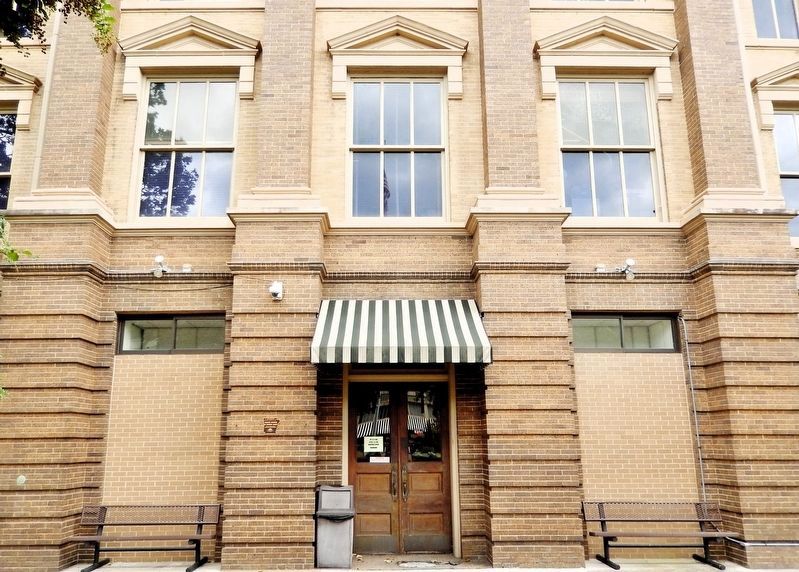
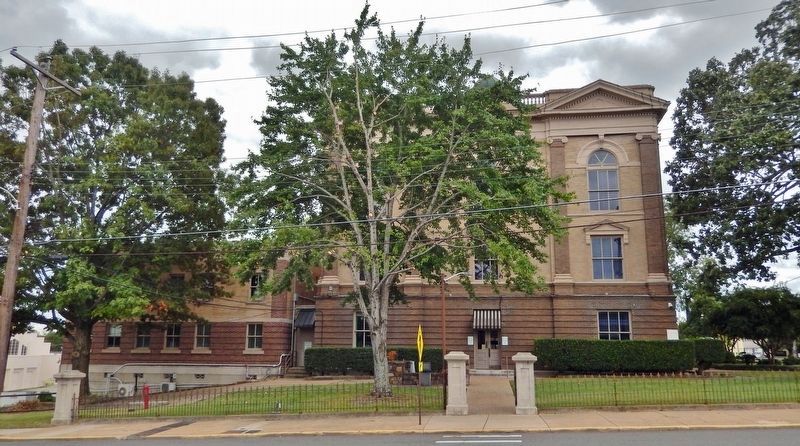
From the National Register Nomination prepared by Mike Shinn & Darcy D. Dobson, 4/16/1979: The Garland County Courthouse is a brick Renaissance inspired classic structure possessingarchitectural significance. It is a five-bay four-story building that is built over a full basement. The plan of the building is rectangular with projecting central bays on both the north (entrance) and south elevations. The original symmetry of the courthouse has been altered by the attachment of unobtrusive rectangular two-story additions to both the south and west elevations. A domed-cupola (1913) sustained by paired Ionic columns centers the roof. The courthouse rests on a large tree covered tract which is partially enclosed by a wrought-iron fence.Photographed by Cosmos Mariner, September 14, 20242. Garland County Courthouse (north/front entrance)The marker is mounted at eye-level on the left side of the entrance.In size and appearance the Garland County Courthouse is one of the finest and is the largest Renaissance Revival structure in Hot Springs, Arkansas. The building is one of the largest and oldest of Arkansas' county courthouses.
Among the noteworthy features of the courthouse is a domed lantern which centers the roof and which is sustained by paired Ionic columns. Balustrades are located at the eastern and western extremities of the roof. The cornice is a full entablature. Each corner of the building is articulated by pediments that are supported by two-story Ionic pilasters.
Darcy
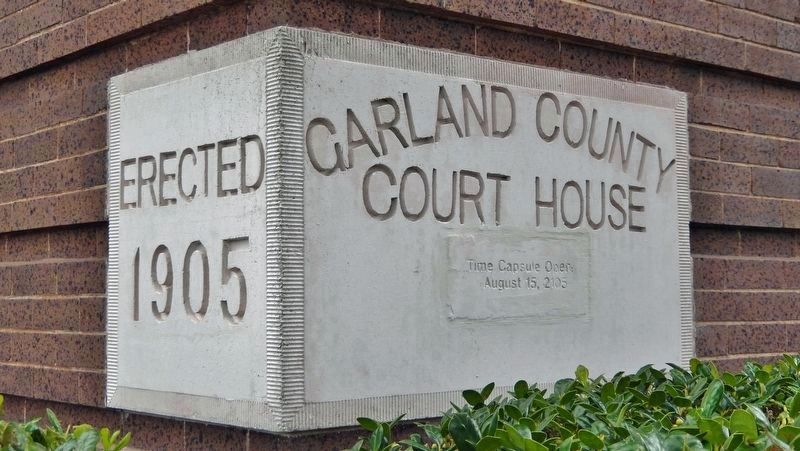
D. Dobson, who is a member of the Garland County Judge's staff, has prepared a history of the courthouse which details significant events relating to the building. The following is from Mr. Dobson's history of the building.Photographed by Cosmos Mariner, September 14, 20243. Garland County Courthouse Cornerstone/Time CapsuleErected 1905
Time Capsule Open:
August 15, 2105• 1905 The old Garland County Courthouse was a victim of a disastrous fire which destroyed more than twenty blocks of the City of Hot Springs. Later in the same year a new Courthouse was constructed at the corner of Hawthorne and Ouachita. The corner stone was laid August 15, 1905.
• 1906 Permission was given to a woman's organization, Fort-Nightly, for use of a large room at the east end of the fourth floor. This became a regular meeting place for that women's organization.
• 1910 In August, Jacob "Jake" Houpt was shot during a gun fight battle while serving as Sheriff of Garland County. The battle started in the Sheriff's office which led to a chase, resulting in the injury of Sheriff Houpt. Houpt died August 20, 1910, in a local hospital.
• September 5, 1913 The Courthouse was again severely damaged by another calamitous fire, which not only gutted the newly constructed Courthouse, but also swept through fifty blocksof the City of Hot Springs. In spite of the fire the masonry-concrete frame was able to still remain standing.Photographed by Cosmos Mariner, September 14, 20244. Garland County Courthouse (northeast elevation)
• June 2, 1913 The last legal hanging took place in Garland County at the west end of the Courthouse. A boxed-in scaffold was constructed to conceal the execution from the public. At this time the jail was located at the west entrance.
• 1930 A new jail was built in the southeast portion of the Courthouse.
• 1974 An addition to the west wing of the Courthouse added more county business offices and an entrance to facilitate the handicapped. The cost of the new addition was in the vicinity of $282,000. The new addition was completed in December of 1975.
• 1978 Renovation of the building began under the administration of County Judge W. J. "Bill" McCuen and included such improvements as the replacement of the concrete floors in the restrooms with new concrete floors and the addition of grab bars to each handicapped toilet stall. The County Courtroom, the County Clerk's Office, and the Revenue Office were also altered. The alterations to these rooms consisted of installing suspended ceilings, refinishing walls, reworking electricalpanels by adding central heat and air conditioning, and laying carpet. The total cost of the 1978 renovation of the Garland County Courthouse amounted to $113,118.Photographed by Cosmos Mariner, September 14, 20245. Garland County Courthouse (west elevation)
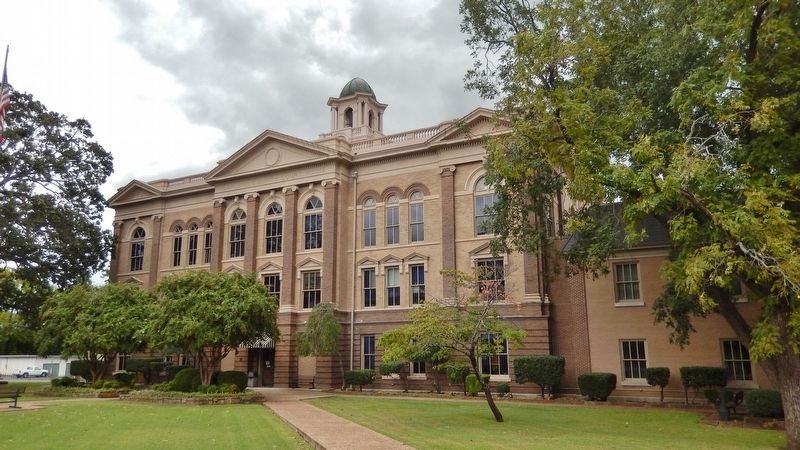
Also see . . . Garland County Courthouse (Wikipedia).
Excerpt: The Garland County Courthouse is a rectangular four-story brick structure with Classical Revival styling. It has projecting entry sections on the north and south sides, with stylistically sympathetic additions to the south and west. It was built in 1905, gutted by a major fire in 1913, after which its interior was rebuilt. In a statewide survey of county courthouses conducted in 1979, it was judged to be one of the state's most architecturally significant courthouse buildings. The courthouse was listed on the National Register of Historic Places in 1979.(Submitted on January 9, 2025, by Cosmos Mariner of Cape Canaveral, Florida.)
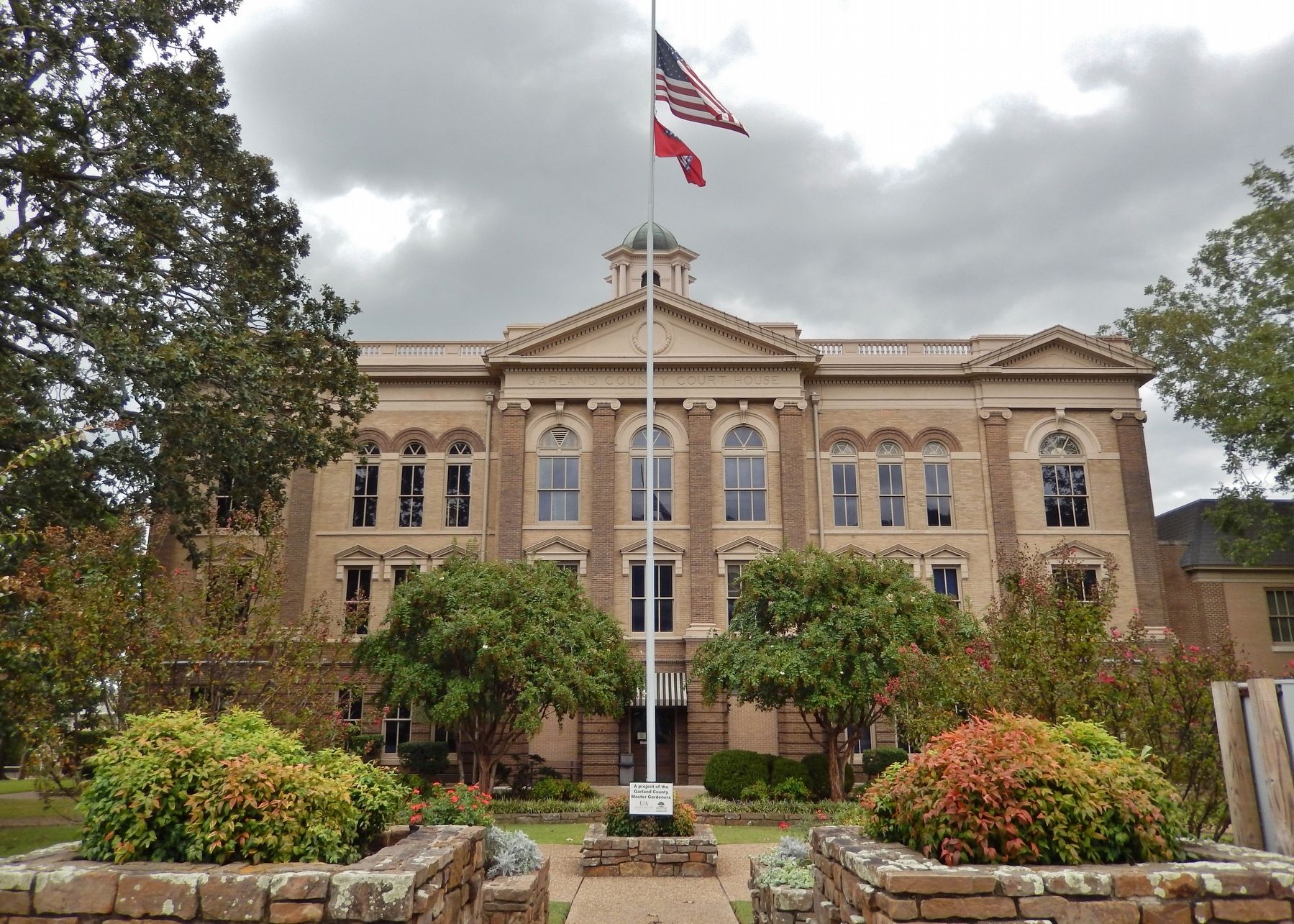
Photographed by Cosmos Mariner, September 14, 2024
6. Garland County Courthouse (northwest/front elevation)
Credits. This page was last revised on January 9, 2025. It was originally submitted on January 9, 2025, by Cosmos Mariner of Cape Canaveral, Florida. This page has been viewed 203 times since then and 36 times this year. Photos: 1, 2, 3, 4, 5, 6. submitted on January 9, 2025, by Cosmos Mariner of Cape Canaveral, Florida.
