Hot Springs in Garland County, Arkansas — The American South (West South Central)
Jimmy Driftwood
Country Music
| — | Hot Springs Arkansas Walk of Fame | — |
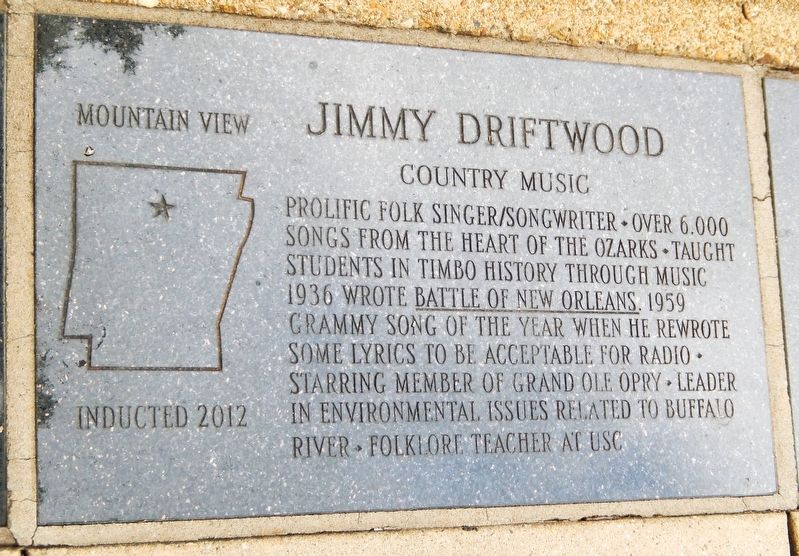
Photographed by Cosmos Mariner, September 13, 2024
1. Jimmy Driftwood Marker
Prolific folk singer/songwriter • Over 6,000 songs from the heart of the Ozarks • Taught students in Timbo history through music • 1936 wrote Battle of New Orleans, 1959 Grammy Song of the Year when he rewrote some lyrics to be acceptable for radio • Starring member of Grand Ole Opry • Leader in environmental issues related to Buffalo River • Folklore teacher at USC
Mountain View, Arkansas • Inducted 2012
Erected by Hot Springs Arkansas Walk of Fame.
Topics. This historical marker is listed in these topic lists: Arts, Letters, Music • Education • Entertainment • Environment. A significant historical year for this entry is 1959.
Location. 34° 30.628′ N, 93° 3.224′ W. Marker is in Hot Springs, Arkansas, in Garland County. It is at the intersection of Spring Street and Central Avenue (State Highway 7), on the right when traveling west on Spring Street. The marker is embedded in the sidewalk on the south side of the Hot Springs City Visitor Center. Touch for map. Marker is at or near this postal address: 629 Central Avenue, Hot Springs National Park AR 71901, United States of America. Touch for directions.

Regionally,
this page online
Other nearby markers. At least 8 other markers are within walking distance of this marker: Jay Hanna Dizzy Dean & Paul Dee Daffy Dean (here, next to this marker); Chester Lauck & Norris Goff (here, next to this marker); Edward Durell Stone (here, next to this marker); Dizzy and Daffy Dean (here, next to this marker); Bobby Mitchell (here, next to this marker); Hot Springs: The Birthplace of Spring Baseball (here, next to this marker); Charlie Rich (here, next to this marker); Glen Campbell (here, next to this marker). Touch for a list and map of all markers in Hot Springs.
Also see . . .
1. Jimmy Driftwood (Wikipedia).
Excerpt: James Corbitt Morris (June 20, 1907 – July 12, 1998), known professionally as Jimmy Driftwood,(Submitted on January 14, 2025, by Cosmos Mariner of Cape Canaveral, Florida.)was an American folk-style songwriter and musician, most famous for his songs "The Battle of New Orleans" and "Tennessee Stud". Driftwood was born in Timbo, Arkansas. His father was folk singer Neal Morris. Driftwood learned to play the guitar at a young age on his grandfather's homemade instrument. Driftwood used that unique guitar throughout his career and noted that its neck was made from a fence rail, its sides from an old ox yoke, and the head and bottom from the headboard of his grandmother's bed. This homemade instrument produced a pleasant, distinctive, resonant sound. Driftwood attended John Brown College in northwest Arkansas and later received a degree in education from Arkansas State Teacher's College. He started writing songs during his teaching career to teach his students history in an entertaining manner.Photographed by Cosmos Mariner, September 13, 20242. Jimmy Driftwood MarkerLooking north from Spring Street; it is the 2nd from left of four markers in this photo. The Hot Springs City Visitor Center is in the background.He wrote his later famous "Battle of New Orleans" in 1936, to help a high school class he was teaching become interested in the event. Singer Johnny Horton, after hearing the song, contacted Driftwood and told him that he wished to record his own version. The popular peak of Driftwood's career came in 1959, when he
had no fewer than six songs on the popular and country music charts, including Johnny Horton's recording of his "The Battle of New Orleans", which remained in first place on the country music singles chart for ten weeks, and atop the popular music chart for six weeks that year.

2. Timbo (Encyclopedia of Arkansas).
(By Kenneth Rorie) Excerpt: Originally part of the Locust Grove community, Timbo is located on Highway 66 thirteen miles west of Mountain View, the county seat of Stone County. Timbo’s main claim to fame is the role it played in the folk music revival in the late 1950s, primarily through James Morris (who later took the name of Jimmy Driftwood). Folklorist Alan Lomax visited Timbo to record Driftwood’s father, Neil Morris, and to record and interview others relating to the rich folk heritage of the area. When RCA Records heard Neil Morris’s son James play “The Battle of New Orleans,” they contracted with him to record it, thus launching his career as a songwriter and musician.(Submitted on January 14, 2025, by Cosmos Mariner of Cape Canaveral, Florida.)
Credits. This page was last revised on January 14, 2025. It was originally submitted on January 14, 2025, by Cosmos Mariner of Cape Canaveral, Florida. This page has been viewed 184 times since then and 20 times this year. Photos: 1, 2. submitted on January 14, 2025, by Cosmos Mariner of Cape Canaveral, Florida.
