Original Downtown in Plano in Collin County, Texas — The American South (West South Central)
Path to Progress
Photographed by James Hulse, January 7, 2025
1. Path to Progress Marker
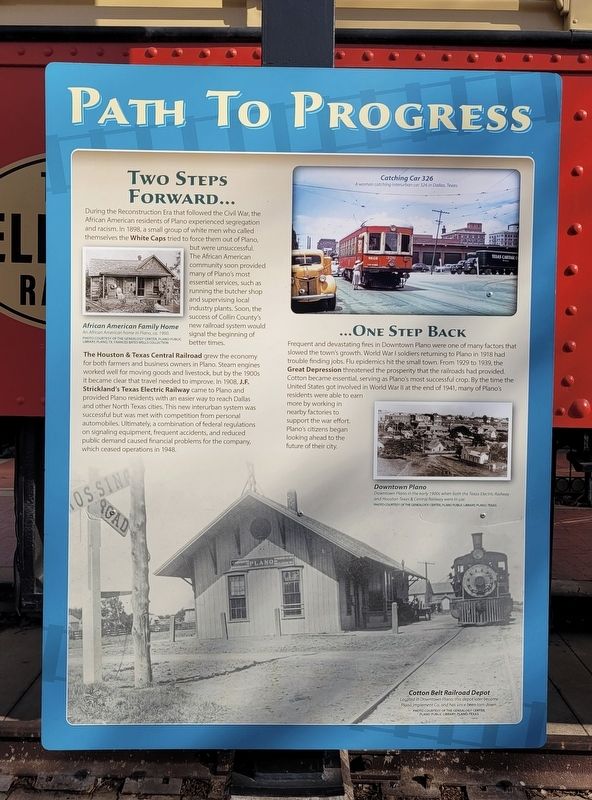
During the Reconstruction Era that followed the Civil War, the African American residents of Plano experienced segregation and racism. In 1898, a small group of white men who called themselves the White Caps tried to force them out of Plano, but were unsuccessful.
The African American community soon provided many of Plano's most essential services, such as running the butcher shop and supervising local industry plants. Soon, the success of Collin County's new railroad system would signal the beginning of better times.
The Houston & Texas Central Railroad grew the economy for both farmers and business owners in Plano. Steam engines worked well for moving goods and livestock, but by the 1900s it became clear that travel needed to improve. In 1908, J.F. Strickland's Texas Electric Railway came to Plano and provided Plano residents with an easier way to reach Dallas and other North Texas cities. This new interurban system was successful but was met with competition from personal automobiles. Ultimately, a combination of federal regulations on signaling equipment, frequent accidents, and reduced
this page online
...One Step Back
Frequent and devastating fires in Downtown Plano were one of many factors that slowed the town's growth. World War I soldiers returning to Plano in 1918 had trouble finding jobs. Flu epidemics hit the small town. From 1929 to 1939, the Great Depression threatened the prosperity that the railroads had provided, Cotton became essential, serving as Plano's most successful crop. By the time the United States got involved in World War II at the end of 1941, many of Plano's residents were able to earn more by working in nearby factories to support the war effort. Plano's citizens began looking ahead to the future of their city.
Captions
(Photo #1) African American Family Home
An African American home in Plano, ca. 1900. Photo courtesy of the Genealogy center, Plano Public Library, Plano, Texas, taken from the Frances Bates Wells Collection
(Photo #2) Catching Car 326
A woman catching interurban car 326 in Dallas, Texas.
(Photo #3) Downtown Plano
Downtown Plano in the early 1900s when both the Texas Electric Railway and Houston & Texas Central Railway were in use. Photo courtesy of the Genealogy Center, Plano Public Library, Plano, Texas.
(Photo #4) Cotton Belt Railroad Depot
Located in Downtown Plano, this depot later became Plano Implement Co. and has since been torn down.
Erected by Interurban
Photographed by James Hulse, January 7, 2025
2. Path to Progress Marker
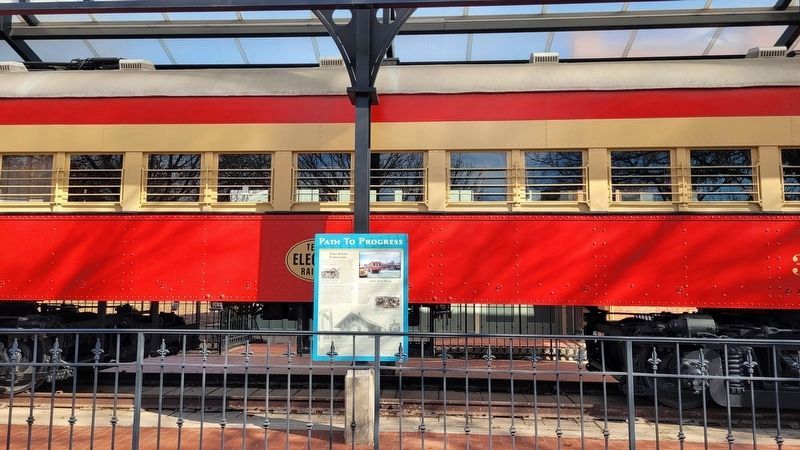
The marker is located at the middle side of Railway Car 360
Topics. This historical marker is listed in these topic lists: African Americans • Civil Rights • Railroads & Streetcars. A significant historical year for this entry is 1898.
Location. 33° 1.202′ N, 96° 42.114′ W. Marker is in Plano, Texas, in Collin County. It is in Original Downtown. It is at the intersection of East 15th Street and I Ave on East 15th Street. The marker is located on the grounds of the Interurban Railway Museum. Touch for map. Marker is at or near this postal address: 901 E 15th St, Plano TX 75074, United States of America. Touch for directions.

Regionally, this marker is in the Prairies & Lakes Region and in the Dallas-Fort Worth Metropolitan Area. Globally, it is in North America, a Gulf of Mexico state, the Western Hemisphere, the Western World, and the Anglosphere. Historically, it finds itself in what was once New Spain, the Republic of Texas, one of the Confederate States of America, and the Antebellum South.
Other nearby markers. At least 8 other markers are within walking distance of this marker: Texas Electric Railway (here, next to this marker); Pioneering Plano (here,
Photographed by James Hulse, January 7, 2025
3. Texas Electric Railway Car 360
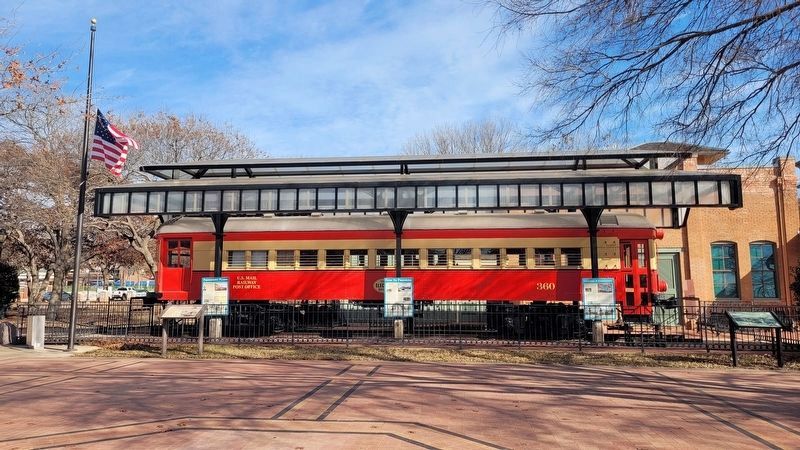
The marker is the second marker from the left of the markers
Also see . . . Interurban Railway Museum - Discover Texas History. (Submitted on January 14, 2025, by James Hulse of Medina, Texas.)
Credits. This page was last revised on January 14, 2025. It was originally submitted on January 14, 2025, by James Hulse of Medina, Texas. This page has been viewed 199 times since then and 24 times this year. Photos: 1, 2, 3. submitted on January 14, 2025, by James Hulse of Medina, Texas.
