Quartier Royal in Bruxelles in Bruxelles-Capitale, Brussels, Belgium — Northwestern Europe
Parc de Bruxelles
Entrée Ducal
⎯⎯⎯
Warandepark
Hertog Ingang
| — | 203 | — |

Photographed by Steve Stoessel, December 12, 2024
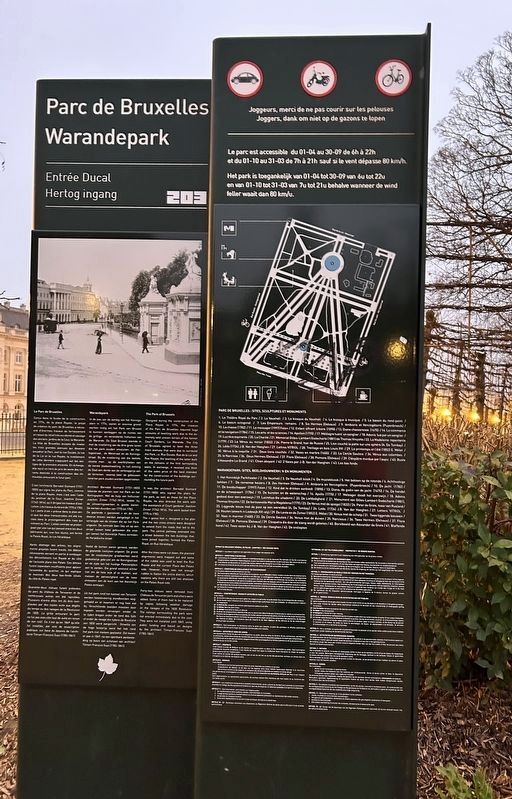
1. Parc de Bruxelles Warandepark Marker
Le Parc de Bruxelles
Conçu dans la foulée de la construction, en 1774, de la place Royale, le projet de création du parc de Bruxelles a nécessité d'énormes travaux de terrassement en raison du relief très accidenté et sauvage des anciens jardins de la Cour, la Warande La Ville de Bruxelles accepta de niveler les trois grandes avenues qui devaient encadrer le Parc, soit la rue Ducale, la rue de la Loi et la rue Royale, le nivellement de cette dernière s’appuyant sur les vestiges de la première enceinte. En échange. elle reçut un tiers du prix de vente des terrains destinés à la construction des immeubles entourant le futur parc.
C’est l'architecte Barnabé Guimard (1731- 1805) qui signa les plans du Parc, comme de la place Royale, mais c'est avec l'aide du jardinier de la Cour, Joachim Zinner (1742-1814), qu'il dirigea les travaux d'exécution. Les travaux durèrent de 1775 à 1783. La - patte d’oie » prévue dans le plan ainsi que les deux transversales ont été tracées dans le prolongement des rues qui mènent au Parc. L'allée centrale se prolongeait par une rue qui passait entre les deux bâtiments qui, une fois réunis,
this page online
Après abattage des arbres, les alignements projetés furent tracés, les déblais nécessaires servant en partie à remblayer les dénivellations rue Royale et du côté de l'actuelle place des Palais. Ces déblais furent cependant insuffisants pour aplanir l'ensemble du quartier, ce qui explique le maintien des deux bas-fonds situés du côté du Palais royal.
Quarante-deux statues furent prélevées du parc du château de Tervueren et de nombreuses autres ont été rajoutées Plusieurs d'entre elles ont dû être remplacées par des copies suite aux dégâts du temps ou des ravages de la Révolution de 1830 La grille entourant le parc ne fut pas exécutée tout de suite en raison de son coût Ce n’est qu'en 1849 quelle fut installée, par voie de souscription publique, sur base de dessins de (architecte Tilman-François Suys (1783-1861)
Warandepark
In de pas van de aanleg van het Konings-plein in 1774, waren er enorme grondwerken nodig om het Park van Brussel te kunnen aanleggen op de ruïnes van de grillige en verwilderde holtuinen van de Warande. De Stad Brussel stemde in met de nivellering van de drie grote
Photographed by Steve Stoessel, December 12, 2024
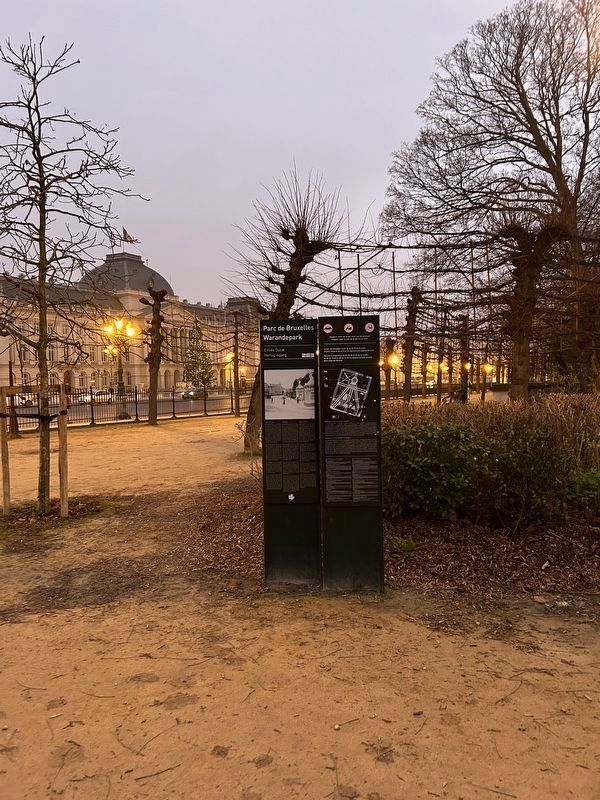
2. Parc de Bruxelles Marker
Architect Barnabé Guimard (1731-1805) tekende de plannen voor het Park en het Koningsplein. Met de hulp van hoftuinier Joachim Zinner (1742-1814), leidde hij de uitvoeringswerken in goede banen. De werken duurden van 1775 tot 1783 De geplande - ganzevoet - en de twee dwarse dreven werden aangelegd in het verlengde van de straten die op het Park uitgeven. De centrale laan liep uit op een straat tussen twee gebouwen die vroeger samen het Koninklijk Paleis vormden de Heraldische straat.
Nadat de bomen waren gerooid, werden de geplande rooilijnen uitgezet. De grond van de noodzakelijke graafwerken werd gedeeltelijk gebruikt om de Koningsstraat en de zijde van het huidige Paleizenplein aan te aarden Die grond volstond echter niet om de hele wijk al te vlakken, wat meteen de aanwezigheid van de twee ondiepten aan
Photographed by Steve Stoessel, December 12, 2024
3. Parc de Bruxelles Marker
Uit het park rond het kasteel van Tervuren werden tweeënveertig standbeelden weggehaald en er kwamen er nog heel wat bij Verschillende beelden moesten door kopieën worden vervangen omdat ze te lijden kregen onder de tand des tijds of ander de ravage die tijdens de Revolutie van 1830 werd aangericht. Omwille van de hoge kostprijs werd het hek rond het park niet meteen geplaatst Dat kwam er pas in 1849, na een openbare aanbesteding op basis van schetsen van architect Tilman-François Suys (1783-1861)
The Park of Brussels
Designed during the construction of the Place Royale in 1774, the creation of the Parc de Bruxelles required huge amounts of levelling work due to the extremely wild uneven terrain of the former Court Gardens, La Warande. The City of Brussels agreed to level the three main avenues that were due to surround the Park, i.e. Rue Ducale, Rue de la Loi and Rue Royale, the levelling of the latter built on the remains of the first surrounding walls. In exchange, it received one third of the sales price of the land intended for the construction of the buildings surrounding the future park.
It was the architect Barnabé Guimard (1731-1805) who signed the plans for the park, as well as those for the Place Royale; he also directed the work with the assistance of Court gardener Joachim Zinner (1742-1814). The work lasted from 1775 to 1783. The “goose foot”, designed in the plan and the two cross-streets were designed to extend from the roads that led to the park. The central pathway extended into a street between the two buildings that, once joined together, formed the Palais Royal, on Rue Héraldique,
After the trees were cut down, the planned alignments were mapped out and some of the rubble was used to level the Rue Royale and the current Place des Palais side. However, there was not enough rubble to flatten the entire district, which explains why there are stilt two shallows on the Palais Royal side.
Forty-two statues were removed from Château de Tervueren park and others were added Some of them had to be replaced by copies following weather damage or the ravages of the 1830 Revolution. The railings surrounding the park were not erected immediately due to the cost They were not installed until 1849, using public funding and based on designs by the architect Tilman-François Suys (1783-1861).
[Site map was not transcribed]
Topics. This historical marker is listed in this topic list: Parks & Recreational Areas. A significant historical year for this entry is 1774.
Location. 50° 50.555′ N, 4° 21.874′ E. Marker is in Bruxelles, Région Bruxelloise (Brussels), in Bruxelles-Capitale. It is in Quartier Royal. It is at the intersection of Rue Ducale and Place des Palais on Rue Ducale. Touch for map. Marker is in this post office area: Bruxelles, Région Bruxelloise 1000, Belgium. Touch for directions.

Regionally, it is in Europe, the European Union, Atlantic Europe, the Benelux Low Countries, the Schengen Area, Western Europe, and the Western World. Historically, it finds itself in what was once the Roman Empire and specifically also the Holy Roman Empire.
Other nearby markers. At least 8 other markers are within walking distance of this marker: The Academy Palace (within shouting distance of this marker); a different marker also named Parc de Bruxelles / Warandepark (within shouting distance of this marker); Le Parc de Bruxelles / Warandepark / The Park of Brussels (approx. 0.3 kilometers away); a different marker also named Parc de Bruxelles / Warandepark (approx. 0.3 kilometers away); Musée de la Dynastie / Museum van de Dynastie / The Dynasty Museum / Das Museum der Dynastie (approx. 0.3 kilometers away); Eglise Saint-Jacques / Kerk Sint-Jakob / Saint Jacques’ Church / Saint-Jacques-Kirche (approx. 0.4 kilometers away); Godefroid de Bouillon / Godevaart van Bullioen / Godfrey of Bouillon (approx. 0.4 kilometers away); Koning Albert / Le Roi Albert / King Albert (approx. 0.4 kilometers away). Touch for a list and map of all markers in Bruxelles.
Also see . . . Brussels Park (Wikipedia). (Submitted on January 24, 2025, by Steve Stoessel of Niskayuna, New York.)
Credits. This page was last revised on January 24, 2025. It was originally submitted on January 17, 2025, by Steve Stoessel of Niskayuna, New York. This page has been viewed 124 times since then and 17 times this year. Photos: 1, 2, 3. submitted on January 17, 2025, by Steve Stoessel of Niskayuna, New York.
