Original Downtown in Plano in Collin County, Texas — The American South (West South Central)
Tayshas to Texas
Photographed by James Hulse, January 7, 2025
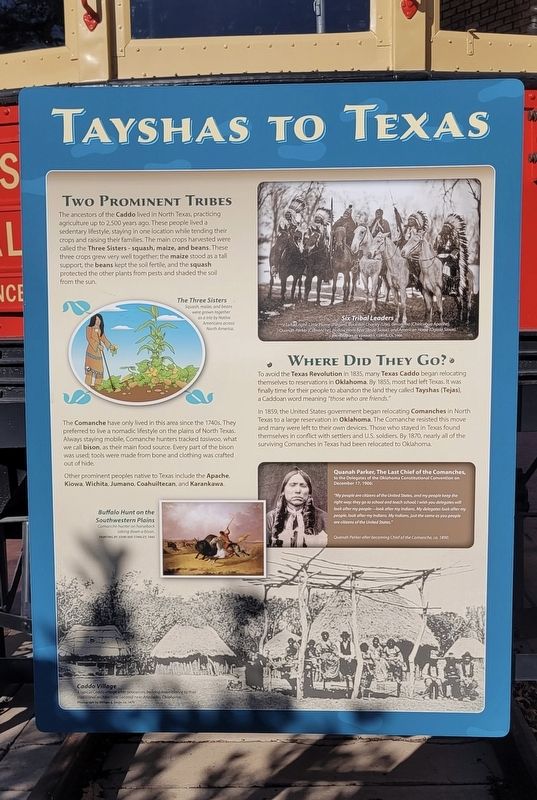
1. Tayshas to Texas Marker
The ancestors of the Caddo lived in North Texas, practicing agriculture up to 2,500 years ago. These people lived a sedentary lifestyle, staying in one location while tending their crops and raising their families. The main crops harvested were called the Three Sisters - squash, maize, and beans. These three crops grew very well together; the maize stood as a tall support, the beans kept the soil fertile, and the squash protected the other plants from pests and shaded the soil from the sun.
The Comanche have only lived in this area since the 1740s. They preferred to live a nomadic lifestyle on the plains of North Texas. Always staying mobile, Comanche hunters tracked tasiwoo, what we call bison, as their main food source. Every part of the bison was used; tools were made from bone and clothing was crafted out of hide.
Other prominent peoples native to Texas include the Apache, Kiowa, Wichita, Jumano, Coahuiltecan, and Karankawa.
Where Did They Go?
To avoid the Texas Revolution in 1835, many Texas Caddo began relocating themselves to reservations in Oklahoma. By 1855, most had left Texas. It was finally time for their people to abandon the land they called Tayshas (Tejas), a Caddoan word meaning "those who are friends."
In 1859, the United States government began relocating Comanches in North Texas to a large reservation in Oklahoma. The Comanche resisted this move and many were left to their own devices. Those who stayed in Texas found themselves in conflict with settlers and U.S. soldiers. By 1870, nearly all of the surviving Comanches in Texas had been relocated to Oklahoma.
Quanah Parker, The Last Chief of the Comanches, to the Delegates of the Oklahoma Constitutional Convention on December 17, 1906:
"My people are citizens of the United States, and my people keep the right way, they go to school and teach school; I wish you delegates will look after my people - look after my Indians. My delegates look after my people, look after my Indians. My Indians, just the same as you people are citizens of the United States.
Quanah Parker after becoming Chief of the Comanche, ca. 1890.
Captions
(Photo #1) The Three Sisters
Squash, maize, and beans were grown together as a tria by Native Americans across North America.
(Photo #2) Buffalo Hunt on the Southwestern Plains
Comanche hunter on horseback taking down a bison.
(Photo #3) Caddo Village
A typical Caddo village after relocation, bearing resemblance to their traditional architecture. Located near Anadarko, Oklahoma. Photograph by William S. Souje, ca. 1870.
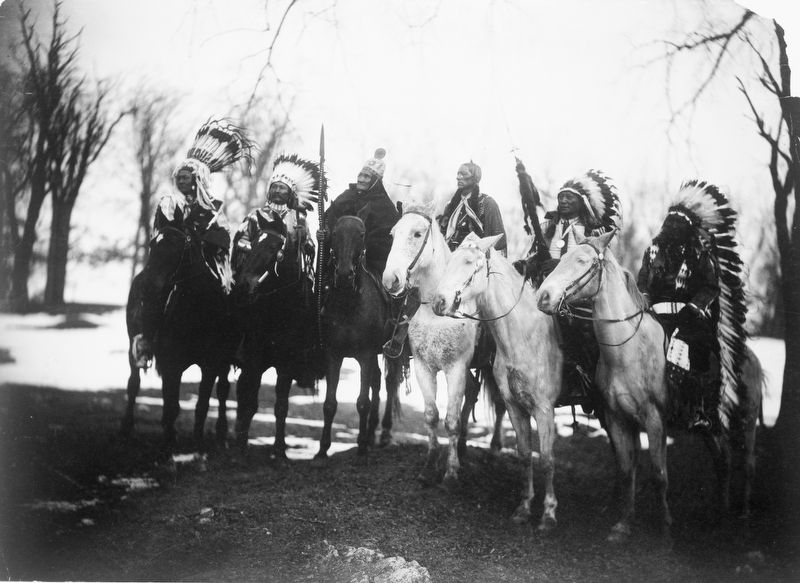
(Photo #4) Six Tribal Leaders
Left to Right: Little Plume (Piegan), Buckskin Charley (Ute), Geronimo (Chiricahua Apache), Quanah Parker (Comanche), Hollow Horn Bear (Brute Sioux), and American Horse (Oglala Sioux). Photograph by Edward S. Curtis, ca. 1900.
Erected by Interurban
this page online
Topics. This memorial is listed in this topic list: Indigenous Peoples and Communities. A significant historical date for this entry is December 17, 1906.
Location. 33° 1.195′ N, 96° 42.112′ W. Memorial is in Plano, Texas, in Collin County. It is in Original Downtown. It is at the intersection of East 15th Street and I Ave on East 15th Street. The marker is located on the grounds of the Interurban Railway Museum. Touch for map. Memorial is at or near this postal address: 901 E 15th St, Plano TX 75074, United States of America. Touch for directions.

Regionally, this memorial is in the Prairies & Lakes Region and in the Dallas-Fort Worth Metropolitan Area. Globally, it is in North America, a Gulf of Mexico state, the Western Hemisphere, the Western World, and the Anglosphere. Historically, it finds itself in what was once New Spain, the Republic of Texas, one of the Confederate States of America, and the Antebellum South.
Other nearby markers. At least 8 other markers are within walking distance of this marker: Rail Switch (here, next to this marker); Creating a Community (here, next to this marker); Streets of Historic Downtown Plano
Photographed by James Hulse, January 7, 2025
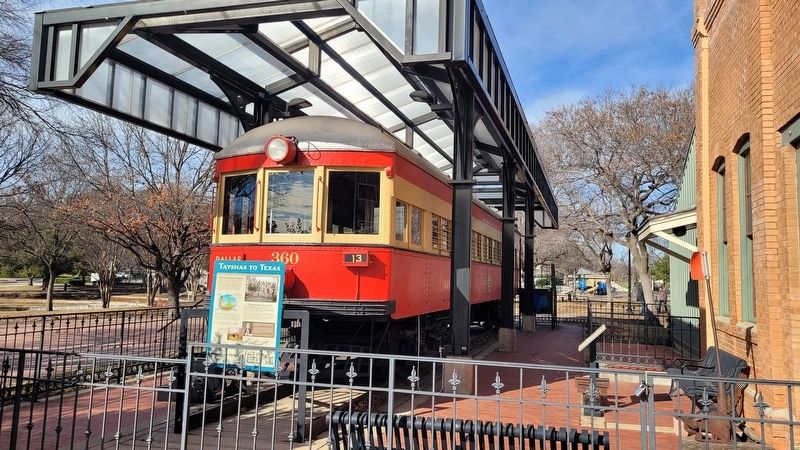
2. Tayshas to Texas Marker
The front view of Texas Electric Railway Car 360
Also see . . . Interurban Railway Museum - Discover Texas History. (Submitted on January 18, 2025, by James Hulse of Medina, Texas.)
Public Domain - United States Library of Congres - Edward S. Curtis, circa 1900
3. Six Tribal Leaders
(l to r) Little Plume (Piegan), Buckskin Charley (Ute), Geronimo (Chiricahua Apache), Quanah Parker (Comanche), Hollow Horn Bear (Brulé Sioux), and American Horse (Oglala Sioux) on horseback in ceremonial attire
Credits. This page was last revised on January 18, 2025. It was originally submitted on January 18, 2025, by James Hulse of Medina, Texas. This page has been viewed 237 times since then and 37 times this year. Photos: 1, 2, 3. submitted on January 18, 2025, by James Hulse of Medina, Texas.
