Westbrook in Lower Connecticut River Valley Region, Connecticut — The American Northeast (New England)
Lape-Read House
Photographed by Conrad Ward, August 4, 2024
1. Lape-Read House Marker
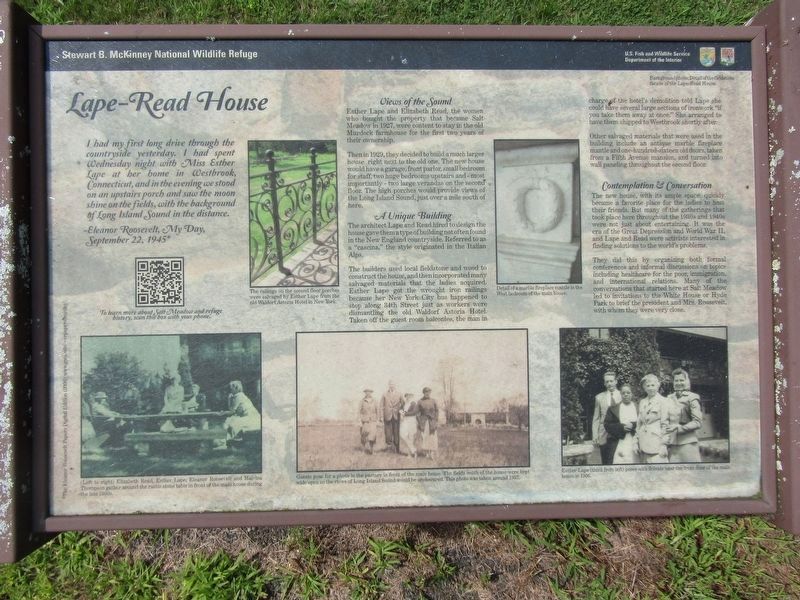
I had my first long drive through the countryside yesterday. I had spent Wednesday night with Miss Esther Lape at her home in Westbrook, Connecticut, and in the evening we stood on an upstairs porch and saw the moon shine on the fields, with the background of Long Island Sound in the distance.
- Eleanor Roosevelt, My Day, September 22, 1945
Views of the Sound
Esther Lape and Elizabeth Read, the women who bought the property that became Salt Mead in 1927, were content to stay in the old Murdock farmhouse for the first two years their ownership.
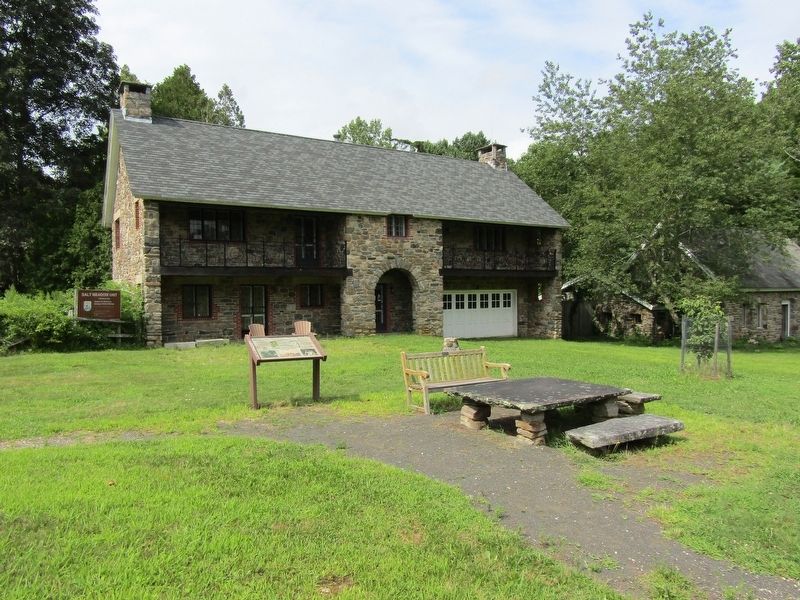
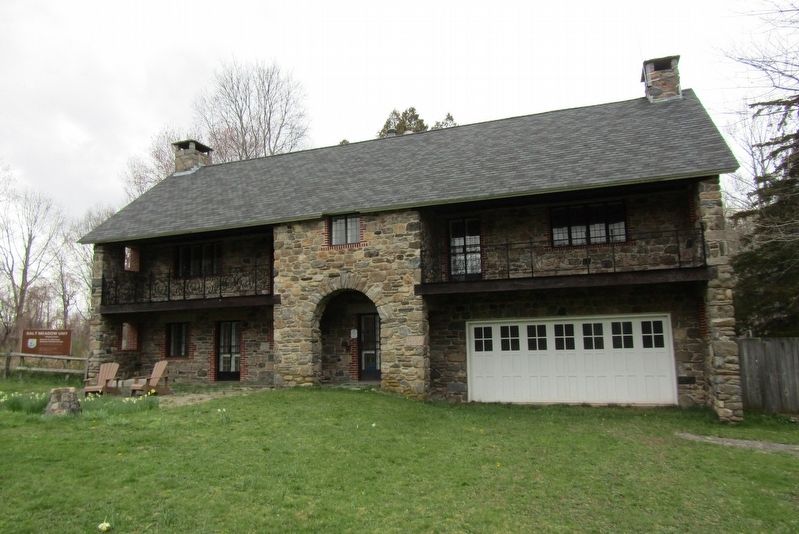
Then in 1909, they decided to build a much larger house right to the old one. The new house would have a garage, front parlor for staff, two huge bedrooms upstairs and -most importantly- two large verandas on the second floor. The high porches would provide views of the Long Island Sound, just over a mile south of here.
A Unique Building
The architect Lage and Read hired to design the house gave them the type of building not often found in the New England countryside. Referred to as a "cascina," the style originated in the Italian Alps.
The builders used local fieldstone
this page online
Other salvaged materials that were used in the building include an antique marble fireplace mantle and one-hundred-sixteen old doors, taken from a Fifth Avenue mansion, and turned into wall paneling throughout the second floor.
Contemplation & Conversation
The new house, with its ample space quicky, became a favorite place for the ladies to host their friends. But many gatherings that took place here throughout the 1930s and 1940s were not just about entertaining. It was the era of the Great Depression and World War II and Lape and Read were activists interested in finding solutions to the world's problems.
They did this
Photographed by Conrad Ward, August 4, 2024
2. Lape-Read House Marker
( photo captions )
(upper left)
The railings on the second floor porches were salvaged by Esther Lape from the old Waldorf Astoria Hotel in New York.
(upper right)
Detail of a marble fireplace mantle in the West bedroom of the main house.
(lower left)
(Left to right) Elizabeth Read, Esther Lape, Eleanor Roosevelt, and Malvina Thompson gather around the rustic stone table in front of the main house during the late 1930's.
(lower middle)
Guests pose for a photo in the pasture in front of the main house. The fields south of the house were kept wide open so the views of Long Island Sound would be unobscured. This photo was taken around 1937.
(lower right)
Esther Lape (third from left) poses with friends near the front door of the main house in 1956.
Erected by Stewart B. McKinney National Wildlife
Photographed by Conrad Ward, April 13, 2024
3. Lape-Read House
Topics. This historical marker is listed in these topic lists: Architecture • Women. A significant historical year for this entry is 1929.
Location. 41° 17.222′ N, 72° 28.347′ W. Marker is in Westbrook in Lower Connecticut River Valley Region, Connecticut. It can be reached from Old Clinton Road half a mile north of Hammock Road, on the left when traveling north. Located in the Stewart B. McKinney National Wildlife Refuge. Touch for map. Marker is in this post office area: Westbrook CT 06498, United States of America. Touch for directions.

Regionally, this marker is in the Connecticut River Valley and on the Connecticut Shoreline. It is also in the American Northeast, in New England, and on the Eastern Seaboard. Globally, it is in the North Atlantic Region, North America, the Western Hemisphere, the Western World, and the Anglosphere. Historically, it finds itself in what was once Middlesex County and also one of the original Thirteen Colonies.
Other nearby markers. At least 8 other markers are within 2 miles of this marker, measured as the crow flies: Salt Meadow Trail System (within shouting distance of this marker); Enoch Murdock House (within shouting distance of this marker); The Westbrook Barrier Islands (approx. one mile away); Welcome to Kirtland Landing (approx. one mile away); Rev. Worthington & Rev. Devotion (approx. 1.1 miles away); Jude (approx. 1.2 miles away); Toby Bardo (approx. 1.2 miles away); Westbrook (approx. 1.2 miles away). Touch for a list and map of all markers in Westbrook.
Also see . . .
1. Esther Lape. Wikipedia (Submitted on January 19, 2025.)
2. Elizabeth Fisher Read. Wikipedia (Submitted on January 19, 2025.)
3. Stewart B. McKinney National Wildlife Refuge. Official Website (Submitted on January 19, 2025.)
Credits. This page was last revised on May 19, 2026. It was originally submitted on January 18, 2025, by Conrad Ward of Guilford, Connecticut. This page has been viewed 253 times since then and 56 times this year. Photos: 1, 2, 3. submitted on January 18, 2025, by Conrad Ward of Guilford, Connecticut. • Michael Herrick was the editor who published this page.
