Bedford-Stuyvesant in Brooklyn in Kings County, New York — The American Northeast (Mid-Atlantic)
Eleanor Roosevelt Playground
1.211 acres
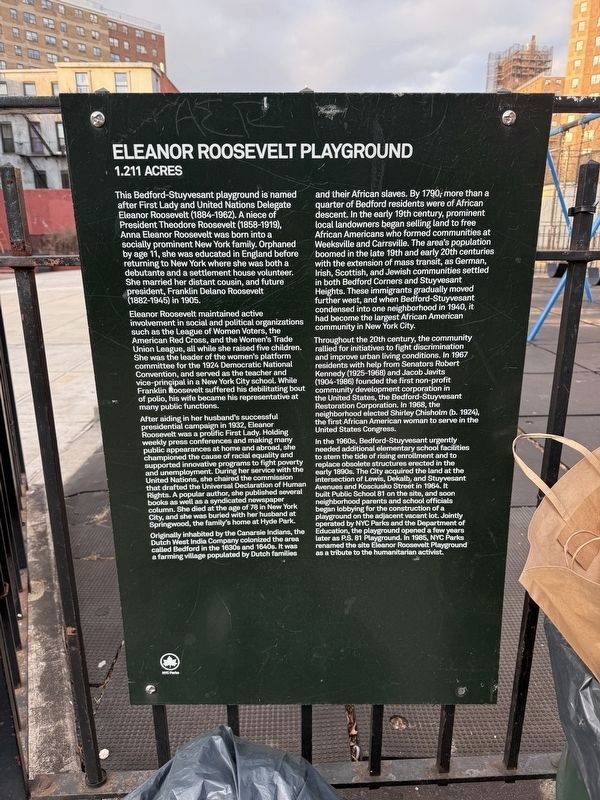
This Bedford-Stuyvesant playground is named after First Lady and United Nations Delegate Eleanor Roosevelt (1884-1962). A niece of President Theodore Roosevelt (1858-1919), Anna Eleanor Roosevelt was born into a socially prominent New York family. Orphaned by age 11, she was educated in England before returning to New York where she was both a debutante and a settlement house volunteer. She married her distant cousin, and future president, Franklin Delano Roosevelt (1882-1945) in 1905.
Eleanor Roosevelt maintained active involvement in social and political organizations such as the League of Women Voters, the American Red Cross, and the Women's Trade Union League, all white she raised five children. She was the leader of the women's platform committee for the 1924 Democratic National Convention, and served as the teacher and vice-principal in a New York City school. While Franklin Roosevelt suffered his debilitating bout of polio, his wife became his representative at many public functions.
After aiding in her husband's presidential campaign in 1932, Eleanor Roosevelt was a prolific First Lady. Holding weekly press
this page online
Originally inhabited by the Carnarsie Indians, the Dutch West India Company colonized the area called Bedford in the 1630s and 1640s. It was a farming village populated by Dutch families and their African slaves. By 1790, more than a quarter of Bedford residents were of African descent. In the early 19th century, prominent local landowners began selling land to free African Americans who formed communities at Weeksville and Carrsville. The area's population boomed in the late 19th and early 20th centuries with the extension of mass transit, as German, Irish, Scottish, and Jewish communities settled in both Bedford Corners

Throughout the 20th century, the community rallied for initiatives to fight discrimination and improve urban living conditions. In 1967 residents with help from Senators Robert Kennedy (1925-1968) and Jacob Javits (1904-1986) founded the first non-profit community development corporation in the United States, the Bedford-Stuyvesant Restoration Corporation. In 1968, the neighborhood elected Shirley Chisholm (b. 1924), the first African American woman to serve in the United States Congress.
In the 1960s, Bedford-Stuyvesant urgently needed additional elementary school facilities to stem the tide of rising enrollment and to replace obsolete structures erected in the early 1890s. The City acquired the land at the intersection of Lewis, Dekalb, and Stuyvesant Avenues and Kosciusko Street in 1964. It built Public School 81 on the site, and soon neighborhood parents and school officials began lobbying for the construction of a playground on the adjacent vacant lot. Jointly operated by NYC Parks and the Department of Education, the playground opened a few years later as P.S. 81 Playground. In 1985, NYC Parks renamed the site Eleanor Roosevelt Playground as a tribute to the humanitarian activist.
Erected by NYC Parks.
Topics and series. This historical marker is listed in these topic lists: African Americans • Government & Politics • Settlements & Settlers • Women. In addition, it is included in the Eleanor Roosevelt, the Former U.S. Presidents: #26 Theodore Roosevelt, the Former U.S. Presidents: #32 Franklin D. Roosevelt, and the NYC Parks series lists. A significant historical year for this entry is 1905.
Location. 40° 41.551′ N, 73° 56.148′ W. Marker is in Brooklyn, New York, in Kings County. It is in Bedford-Stuyvesant. It is on Kosciuszko Street east of Lewis Avenue, on the left when traveling east. Touch for map. Marker is at or near this postal address: 479 Kosciuszko St, Brooklyn NY 11221, United States of America. Touch for directions.

Regionally, this marker is in New York City and on Long Island. It is also in the American Northeast, in the Mid-Atlantic, and on the Eastern Seaboard. Globally, it is in the North Atlantic Region, North America, the Western Hemisphere, the Western World, and the Anglosphere. Historically, it finds itself in what was once New Netherland and also one of the original Thirteen Colonies.
Other nearby markers. At least 8 other markers are within walking distance of this marker: John the Baptist Community Garden (approx. ¼ mile away); Beattie Square (approx. 0.3 miles away); World War I Memorial (approx. 0.4 miles away); GreenThumb (approx. 0.6 miles away); Banneker Playground (approx. 0.7 miles away); Herbert Von King Park (approx. 0.7 miles away); Hattie Carthan Playground (approx. 0.7 miles away); a different marker also named Charles C. Pinn Triangle (approx. 0.9 miles away). Touch for a list and map of all markers in Brooklyn.
Another marker is no longer nearby. Charles C. Pinn Triangle (was approx. 0.9 miles away but has been replaced with another marker now near it).
Credits. This page was last revised on January 20, 2025. It was originally submitted on January 20, 2025, by Devry Becker Jones of Washington, District of Columbia. This page has been viewed 220 times since then and 28 times this year. Photos: 1, 2. submitted on January 20, 2025, by Devry Becker Jones of Washington, District of Columbia.
