Vatican City, — Southern Europe (Enclave within Rome in Italy)
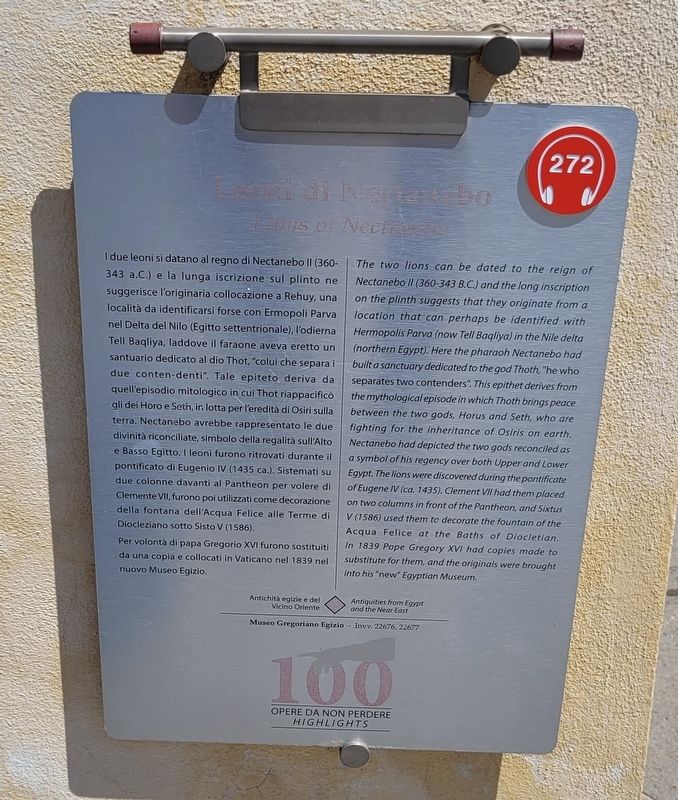
Leoni di Nectanebo
⎯⎯⎯
Lions of Nectanebo
Photographed by James Hulse, June 26, 2023
1. Leoni di Nectanebo / Lions of Nectanebo Marker

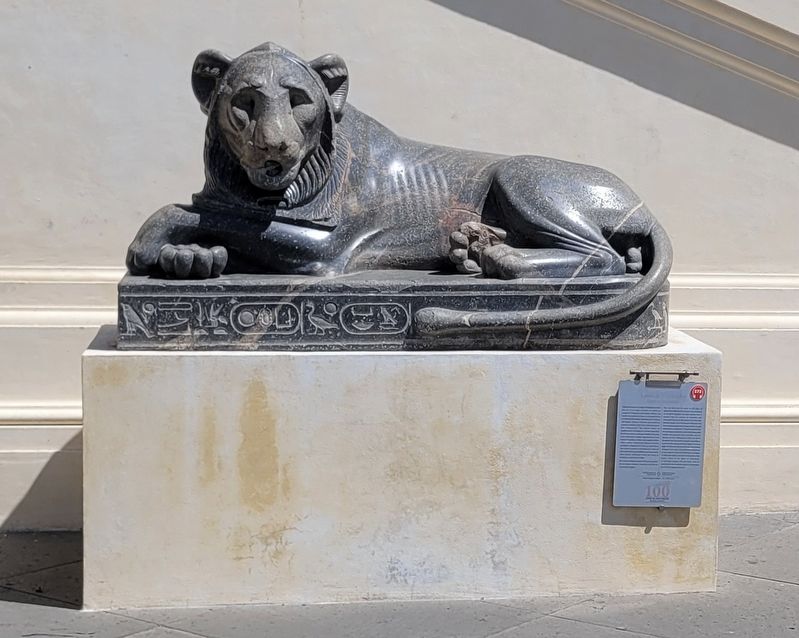
I due leoni si datano al regno di Nectanebo II (360-343 a.C.) e la lunga iscrizione sul plinto ne suggerisce l'originaria collocazione a Rehuy, una località da identificarsi forse con Ermopoli Parva nel Delta del Nilo (Egitto settentrionale), l'odierna Tell Baqliya, laddove il faraone aveva eretto un santuario dedicato al dio Thot, colui che separa i due conten-denti". Tale epiteto deriva da quell'episodio mitologico in cui Thot riappacificò gli dei Horo e Seth, in lotta per l'eredità di Osiri sulla terra. Nectanebo avrebbe rappresentato le due divinità riconciliate, simbolo della regalità sull'Alto e Basso Egitto. I leoni furono ritrovati durante il pontificato di Eugenio IV (1435 ca.). Sistemati su due colonne davanti al Pantheon per volere di Clemente VII, furono poi utilizzati come decorazione della fontana dell'Acqua Felice alle Terme di Diocleziano sotto Sisto V (1586).
Per volontà di papa Gregorio XVI furono sostituiti da una copia e collocati in Vaticano nel 1839 nel nuovo Museo Egizio.
The two lions can be dated to the reign of Nectanebo II (360-343 B.C.) and the long inscription
this page online
Erected by Museo Gregoriano Egizio - Antiquities from Egypt and the Near East. (Marker Number 272.)
Topics. This historical marker is listed in these topic lists: Anthropology & Archaeology • Religion & Religious Structures. A significant historical year for this entry is 1839.
Location. 41° 54.372′ N,
Photographed by James Hulse, June 26, 2023
2. The Lions of Nectanebo and Marker

Regionally, it is in Europe and the Western World.
Other nearby markers. At least 8 other markers are within walking distance of this marker: Restoration of Full Communion Between the Catholic and Orthodox Churches (approx. 0.4 kilometers away); Ponte Vittorio Emanuele II / Victor Emmanuel II Bridge (approx. one kilometer away in Italy); Monumento a Camillo Benso Conte di Cavour / Monument to Camillo Benso Count of Cavour (approx. 1.3 kilometers away in Italy); Corte Suprema di Cassazione (approx. 1.3 kilometers away in Italy); Ponte Umberto I / Umberto I Bridge (approx. 1.4 kilometers away in Italy); Convento ed Oratorio dei Filippini alla Vallicella / Convent and Oratory of Saint Philip Neri (approx. 1.4 kilometers away in Italy); Parione (approx. 1.5 kilometers away in Italy); Spirito Santo dei Napoletani / Holy Spirit of the Neapolitans (approx. 1.6 kilometers
Photographed by James Hulse, June 26, 2023
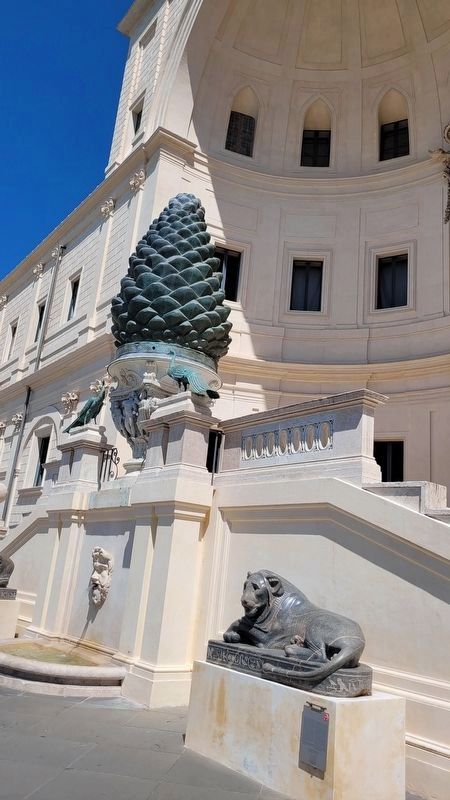
3. The view of the marker with the Pine Cone of St. Peter
Also see . . . Nectanebo II. Wikipedia
During the reign of Nectanebo II, Egyptian artists developed a specific style that left a distinctive mark on the reliefs of the Ptolemaic Kingdom. Like his indirect predecessor Nectanebo I, Nectanebo II showed enthusiasm for many of the cults of the gods within ancient Egyptian religion, and more than a hundred Egyptian sites bear evidence of his attention.(Submitted on January 23, 2025, by James Hulse of Medina, Texas.)
Photographed by James Hulse, June 26, 2023
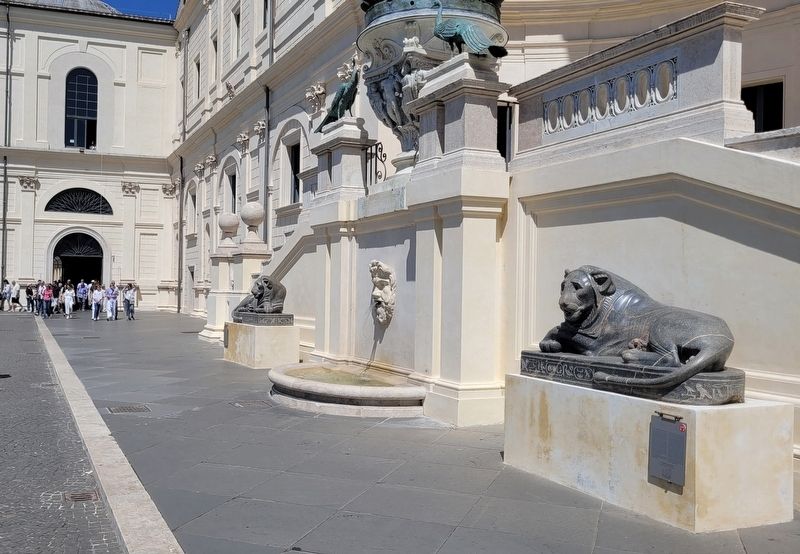
4. The view of the two lions at the Pine Cone of St. Peter courtyard
Credits. This page was last revised on October 27, 2025. It was originally submitted on January 23, 2025, by James Hulse of Medina, Texas. This page has been viewed 333 times since then and 38 times this year. Photos: 1, 2, 3, 4. submitted on January 23, 2025, by James Hulse of Medina, Texas.
