Rione X Campitelli in Roma in Città metropolitana di Roma Capitale, Latium, Rome, Italy — Central Italy (Tyrrhenian Coast)
Introduzione Al Percorso
⎯⎯⎯
Introduction to the Itinerary

Photographed by James Hulse, March 4, 2024
1. Introduzione Al Percorso / Introduction to the Itinerary Marker

Introduzione al percorso: valori culturali, paesaggistici e ambientali del nuovo itinerario
Un viaggio nello spazio e nel tempo. È questo lo spirito con cui il visitatore moderno può intraprendere il percorso che si snoda lungo le pendici meridionali e occidentali del Palatino (Palatium). Muovendo dalle possenti arcate severiane a est (III secolo d.C.), ultimo ampliamento del sontuoso palazzo imperiale, passeggiando sotto il fronte della reggia (I-II secolo d.C.) e sopra il Circo Massimo, insomma traversando la Storia a ritroso (dal I all'VIII secolo a.C.), si giunge alle pendici sud-ovest del colle (Cermalus), lì dove Romolo fondò la Città Eterna e dove Augusto, primo imperatore di Roma, abitò e visse gli anni fulgidi dell'esistenza. E di qui ancora, proseguendo lungo il fianco occidentale del monte, si ridiscende il tempo sovrastati dal santuario di Cibele e Victoria (acropoli palatina), dall'incombere della domus Tiberiana e degli Orti Farnesiani, fino ad arrivare alla chiesa medievale di San Teodoro. Passando infine negli horrea Agrippiana ("magazzini"), il tragitto si conclude con l'ingresso nel Foro
this page online
Ma il viaggio, oltre che nella materia archeologica, è anche l'affascinante itinerario in uno dei luoghi più suggestivi e inediti di Roma, così vicino alla città presente e viva, eppur distante dal chiassoso traffico urbano. Un cammino immerso a tratti nel più completo silenzio, in un'atmosfera quasi onirica, dove inflorescenze ed erbe, folti cespugli e macchie arboree, una vegetazione spontanea e rigogliosa, formano una cornice ricca di suggestioni visive e olfattive che esalta le possenti testimonianze di un'area archeologica unica al mondo.
Introduction to the itinerary: cultural, landscape and environmental values of the new itinerary
A journey in space and time. This is the spirit with which the modern visitor can take the path that winds along the southern and western slopes of the Palatine (Palatium). Starting from the massive Severan arcades to the east (3rd century AD), the last extension of the sumptuous imperial palace, walking under the front of the palace (1st-2nd century AD) and above the Circus Maximus,
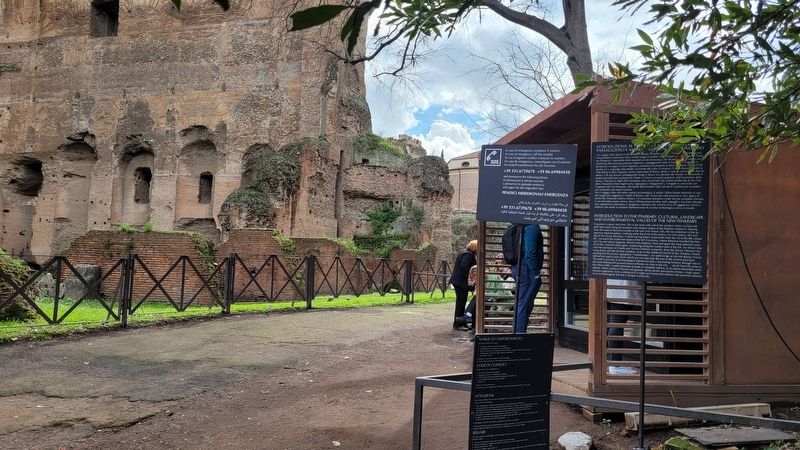
Photographed by James Hulse, March 4, 2024
2. The view of the Introduction to the Itinerary Marker along the pathway
Topics. This historical marker is listed in this topic list: Anthropology & Archaeology.
Location. 41° 53.484′ N, 12° 29.108′ E. Marker is in Roma, Lazio (Latium, Rome), in Città metropolitana di Roma Capitale. It is in Rione X Campitelli. It is on Via dei Fori Imperiali. The marker is located in the Roman Forum. Touch for map. Marker is in this post office area: Roma, Lazio 00186, Italy. Touch for directions.

Regionally, it is in Europe, the European Union, the Schengen Area, a coastal Mediterranean country, and the Western World. Historically, it finds itself in what was once the Roman Empire.
Other nearby markers. At least 8 other markers are within walking distance of this marker: Vicus Tuscus / Tuscan Street (here, next to this marker); Tempio dei Dioscuri / The Temple of the Dioscuri (within shouting distance of this marker); S. Maria Antiqua / Ancient Church of Saint Mary (within shouting distance of this marker); Il Complesso Domizianeo / The Domitianic Complex (within shouting distance of this marker); Le Costruzioni di Caligola / Caligula's Constructions (within shouting distance of this marker); L'atrio Nel Medioevo / The Atrium in the Middle Ages (within shouting distance of this marker); La vista del Foro Romano / The view of the Roman Forum (within shouting distance of this marker); Basilica Giulia / Basilica Iulia (within shouting distance of this marker). Touch for a list and map of all markers in Roma.
More about this marker. The marker is located in the Parco Archeologico del Colosseo (Roman Forum Archaeological Park) and it does require an entry fee to visit.
Also see . . . Parco Archeologico del Colosseo. Roma Turismo (Submitted on January 23, 2025, by James Hulse of Medina, Texas.)
Credits. This page was last revised on January 24, 2025. It was originally submitted on January 23, 2025, by James Hulse of Medina, Texas. This page has been viewed 85 times since then and 10 times this year. Photos: 1, 2. submitted on January 24, 2025, by James Hulse of Medina, Texas.
