Rione X Campitelli in Roma in Città metropolitana di Roma Capitale, Latium, Rome, Italy — Central Italy (Tyrrhenian Coast)
L'atrio Nel Medioevo
⎯⎯⎯
The Atrium in the Middle Ages

Photographed by James Hulse, March 4, 2024
1. L'atrio Nel Medioevo / The Atrium in the Middle Ages Marker

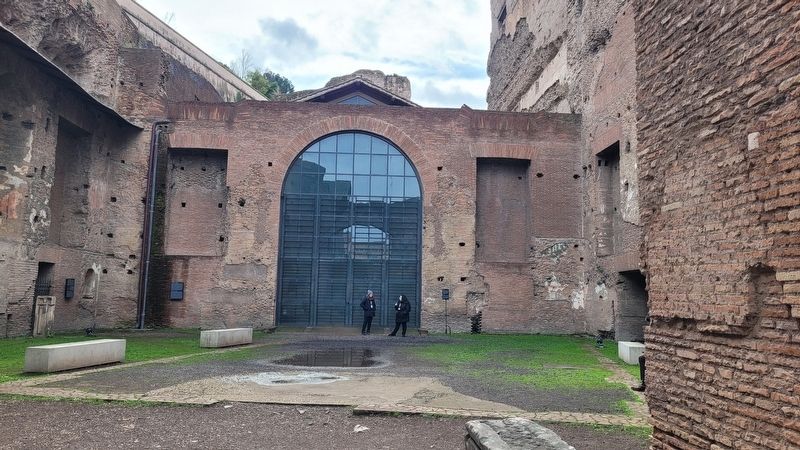
L'aula orientale del complesso domizianeo dal VI al IX secolo svolse la funzione di atrio di Santa Maria Antiqua e continuò ad essere utilizzata per altri due secoli anche dopo l'abbandono della chiesa a causa del terremoto dell'847. Le pitture conservate sulle pareti, in prevalenza a carattere votivo, attestano la lunga frequentazione dell'aula. Tra X e XI secolo vi si insediò una comunità di monaci latini che la trasformò, probabilmente, nella chiesa di Sant'Antonio de Inferno, come ricorda il testo dei Mirabilia Urbis Romae (metà del XII secolo). Alla vita di sant'Antonio è dedicato un ciclo di pitture nella nicchia centrale della parete orientale (X secolo). Sulla parete nord, a destra e a sinistra dell'ingresso, sono dipinti all'interno di due nicchie: tre santi in abito militare (prima metà del IX secolo), le sante Agnese e Cecilia (prima metà del IX secolo).
A La Vergine in piedi con il Bambino in braccio tra un donatore e una donatrice (VIII secolo)
B Figura a mezzo busto di vescovo entro un clipeo (fine X-inizi XI secolo)
C Storie di sant'Antonio nel deserto della Tebaide (X secolo)
D Iscrizione in cui è ricordato un monaco Leone, donatore di un ciclo pittorico oggi perduto (fine X-inizi XI secolo)
E Tre figure di santi (IX secolo)
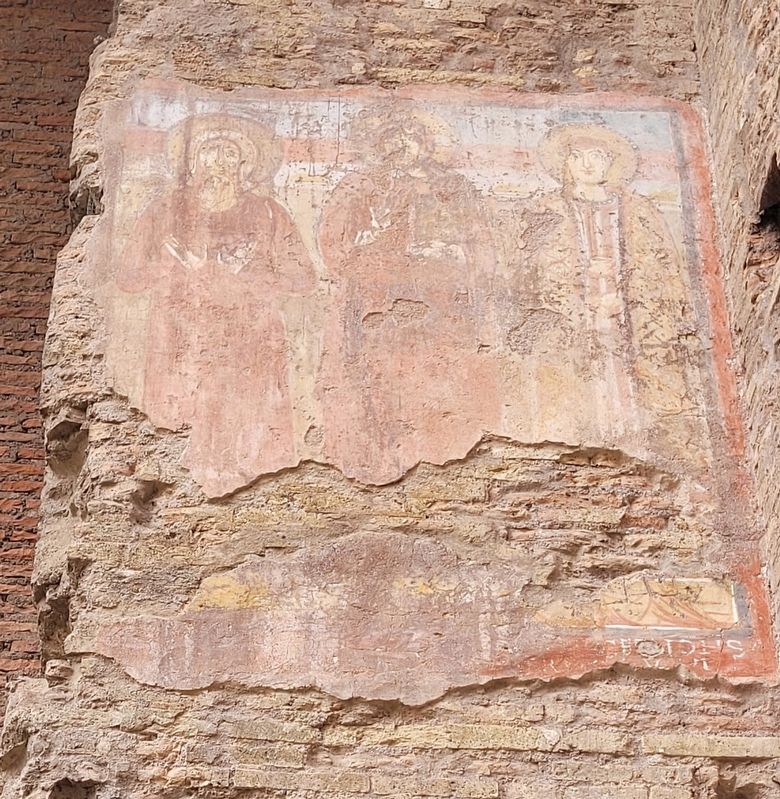
F Cristo fra i santi medici Abbaciro e Giovanni (X secolo)
G Sant'Abbaciro con in mano gli strumenti da chirurgo (età di Paolo I, 757-767)
Frammenti di arredo liturgico e architettonico della chiesa di Santa Maria Antiqua
H Arco di ciborio (metà VIII secolo)
I Pluteo con maglie annodate e motivi zoomorfi (IX secolo)
J Stipite con tralcio abitato (seconda metà VIII secolo)
K Cornice con matassa di nastri viminei (VIII-IX secolo)
Between
this page online
A The Virgin standing and holding the Child in her arms between a male and a female donor (8th century)
B Half-length figure of a bishop in a clipeus (late 10th-early 11th century)
C Stories of Saint Anthony in the desert of Thebes (10th century)
D Inscription mentioning a monk named Leo, donor of a painting cycle that is now lost (late 10th-early 11th century)
E Three figures of saints (9th century)
F Christ between the medical saints Abbacyrus and John (10th century)
G Saint Abbacyrus holding a surgeon's instruments in his hands (period of Paul I, 757-767)
Fragments of liturgical and architectural decorations from the church of Santa Maria Antiqua:
H Ciborium arch (mid-8th century)
I Pluteus with interlaced links and animal motifs (9th century)
J Jamb with inhabited vine (second half of 8th century)
K Cornice with a bundle of interlaced ribbons (8th-9th century)
Topics.

Photographed by James Hulse, March 4, 2024
2. The view of the marker and the Saint Abbacyrus portrait
Location. 41° 53.465′ N, 12° 29.144′ E. Marker is in Roma, Lazio (Latium, Rome), in Città metropolitana di Roma Capitale. It is in Rione X Campitelli. It is on Via dei Fori Imperiali. The marker is located at the left side of the entrance to the Santa Maria Church. Touch for map. Marker is in this post office area: Roma, Lazio 00186, Italy. Touch for directions.

Regionally, it is in Europe, the European Union, the Schengen Area, a coastal Mediterranean country, and the Western World. Historically, it finds itself in what was once the Roman Empire.
Other nearby markers. At least 8 other markers are within walking distance of this marker: Il Complesso Domizianeo / The Domitianic Complex (here, next to this marker); S. Maria Antiqua / Ancient Church of Saint Mary (a few steps from this marker); Le Costruzioni di Caligola / Caligula's Constructions (a few steps from this marker); La vista del Foro Romano / The view of the Roman Forum (a

Photographed by James Hulse, March 4, 2024
3. Saint Abbacyrus holding a surgeon's instruments in his hands (period of Paul I, 757-767)
More about this marker. The marker is located in the Parco Archeologico del Colosseo (Roman Forum Archaeological Park) and it does require an entry fee to visit.
Regarding L'atrio Nel Medioevo / The Atrium in the Middle Ages. Saint Abbacyrus (also known as Abacuc or Abachius) is a relatively obscure figure from early Christian history, and there is limited information about him. His name appears primarily in Eastern Christian traditions, where he is venerated as a saint, though not much is known about his life or deeds. In some sources, he is referred to as a 7th-century martyr or a monk, though specific details regarding his martyrdom or the circumstances of his life are unclear. It's possible that he lived during a time of significant
Photographed by James Hulse, March 4, 2024
4. L'atrio Nel Medioevo / The Atrium in the Middle Ages Marker
The marker is located at the far left of the church
Also see . . . Parco Archeologico del Colosseo. Roma Turismo (Submitted on January 23, 2025, by James Hulse of Medina, Texas.)
Photographed by James Hulse, March 4, 2024
5. Christ between the medical saints Abbacyrus and John (10th century)
Credits. This page was last revised on February 26, 2025. It was originally submitted on January 23, 2025, by James Hulse of Medina, Texas. This page has been viewed 115 times since then and 14 times this year. Photos: 1, 2, 3, 4, 5. submitted on January 24, 2025, by James Hulse of Medina, Texas.
