Rione X Campitelli in Roma in Città metropolitana di Roma Capitale, Latium, Rome, Italy — Central Italy (Tyrrhenian Coast)
Le Costruzioni di Caligola
⎯⎯⎯
Caligula's Constructions

Photographed by James Hulse, March 4, 2024
1. Le Costruzioni di Caligola / Caligula's Constructions Marker

La chiesa di Santa Maria Antiqua si installò negli ambienti che costituiscono l'ampliamento della domus tiberiana verso il Foro, ambienti realizzati da Caligola (37-41 d.C.) e, successivamente, rifatti da Domiziano (81-96 d.C.). Per la loro posizione strategica, essi rivestirono sempre un ruolo importante di collegamento tra il Foro e il soprastante Palazzo imperiale. Nella zona Caligola dedicò il tempio in onore del divo Augusto, aperto sul vicus Tuscus, e costruì al di sopra un ponte che collegava arditamente il Palatino con il Campidoglio. I testi precisano che dietro al tempio di Augusto, di solito identificato nella grande Aula occidentale, c'era la biblioteca, da situare verosimilmente negli spazi dell'attuale atrio e della chiesa. Delle costruzioni di Caligola, distrutte dagli incendi del 64 e dell'80 d.C., non resta quasi nulla, tranne una grande vasca rettangolare rivestita di marmo nell'ambiente dell'Atrio. Qui se ne può oggi leggere il perimetro, ridisegnato sul piano del pavimento domizianeo da Giacomo Boni, che nello scavo rinvenne anche numerose sepolture.
The church of Santa
this page online
Topics. This historical marker is listed in these topic lists: Anthropology & Archaeology • Religion & Religious Structures. A significant historical year for this entry is 37 CE.
Location. 41° 53.474′ N,

Photographed by James Hulse, March 4, 2024
2. Le Costruzioni di Caligola / Caligula's Constructions Marker

Regionally, it is in Europe, the European Union, the Schengen Area, a coastal Mediterranean country, and the Western World. Historically, it finds itself in what was once the Roman Empire.
Other nearby markers. At least 8 other markers are within walking distance of this marker: La vista del Foro Romano / The view of the Roman Forum (here, next to this marker); L'atrio Nel Medioevo / The Atrium in the Middle Ages (a few steps from this marker); Il Complesso Domizianeo / The Domitianic Complex (a few steps from this marker); S. Maria Antiqua / Ancient Church of Saint Mary (a few steps from this marker); Tempio dei Dioscuri / The Temple of the Dioscuri (within shouting distance of this marker); Atrium Vestae / Hall of Vesta (within shouting distance of this marker); Ponte di Caligola / Bridge of Caligula
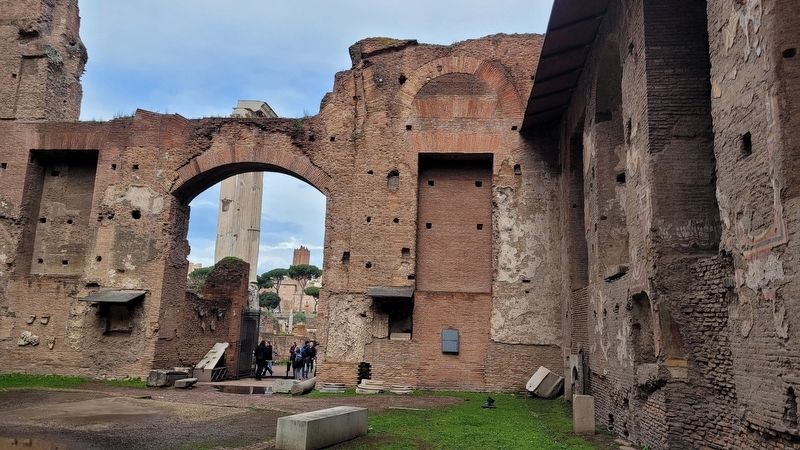
Photographed by James Hulse, March 4, 2024
3. The view of the marker in the Santa Maria Church courtyard
More about this marker. The marker is located in the Parco Archeologico del Colosseo (Roman Forum Archaeological Park) and it does require an entry fee to visit.
Also see . . . Parco Archeologico del Colosseo. Roma Turismo (Submitted on January 23, 2025, by James Hulse of Medina, Texas.)
Credits. This page was last revised on January 24, 2025. It was originally submitted on January 23, 2025, by James Hulse of Medina, Texas. This page has been viewed 147 times since then and 27 times this year. Photos: 1, 2, 3. submitted on January 24, 2025, by James Hulse of Medina, Texas.
