Rione X Campitelli in Roma in Città metropolitana di Roma Capitale, Latium, Rome, Italy — Central Italy (Tyrrhenian Coast)
Pitture
⎯⎯⎯
Paintings
Photographed by James Hulse, March 4, 2024
1. Pitture / Paintings Marker

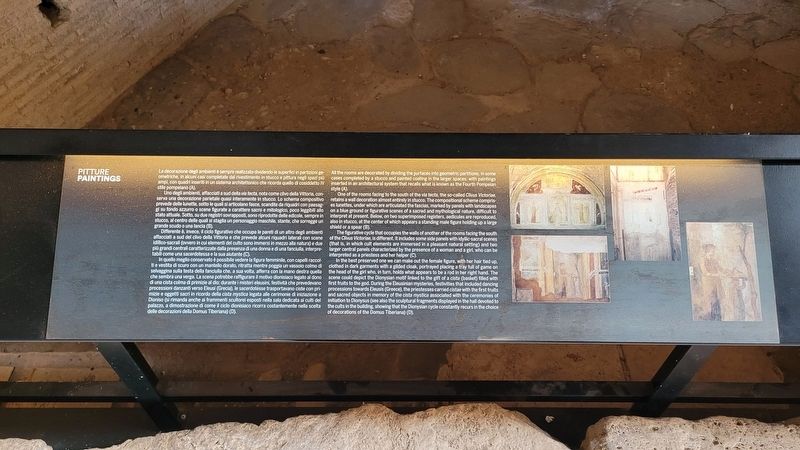
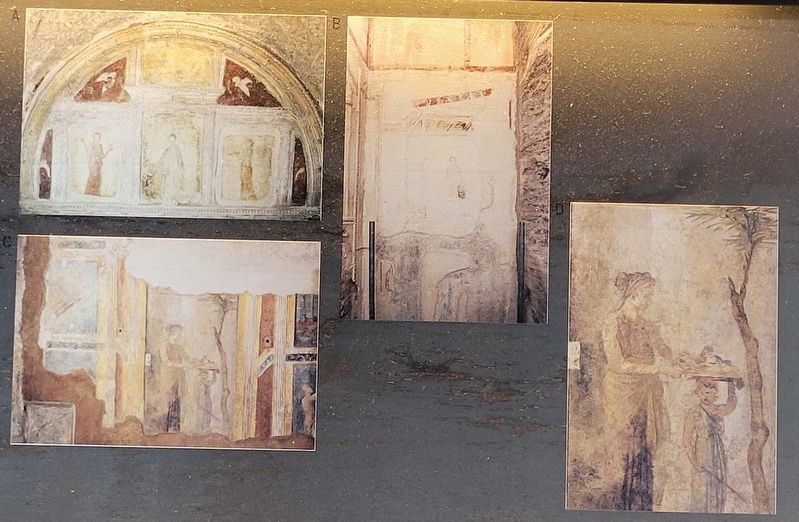
La decorazione degli ambienti è sempre realizzata dividendo le superfici in partizioni geometriche, in alcuni casi completate dal rivestimento in stucco e pittura negli spazi più ampi, con quadri inseriti in un sistema architettonico che ricorda quello di cosiddetto IV stile pompeiano (A).
Uno degli ambienti, affacciati a sud della via tecta, nota come clivo della Vittoria, conserva una decorazione parietale quasi interamente in stucco. Lo schema compositivo prevede delle lunette, sotto le quali si articolano fasce, scandite da riquadri con paesaggi su fondo azzurro o scene figurate a carattere sacro e mitologico, poco leggibili allo stato attuale. Sotto, su due registri sovrapposti, sono riprodotte delle edicole, sempre in stucco, al centro delle quali si staglia un personaggio maschile, stante, che sorregge un grande scudo o una lancia (B).
Differente è, invece, il ciclo figurativo che occupa le pareti di un altro degli ambienti affacciati a sud del clivo della Vittoria e che prevede alcuni riquadri laterali con scene idillico-sacrali (ovvero in cui elementi del culto sono immersi in mezzo alla
this page online
In quello meglio conservato è possibile vedere la figura femminile, con capelli raccolti e vestita di scuro con un mantello dorato, ritratta mentre poggia un vassoio colmo di selvaggina sulla testa della fanciulla che, a sua volta, afferra con la mano destra quella che sembra una verga. La scena potrebbe raffigurare il motivo dionisiaco legato al dono di una cista colma di primizie al dio: durante i misteri eleusini, festività che prevedevano processioni danzanti verso Eleusi (Grecia), le sacerdotesse trasportavano ciste con primizie e oggetti sacri in ricordo della cista mystica legata alle cerimonie di iniziazione a Dioniso (si rimanda anche ai frammenti scultorei esposti nella sala dedicata ai culti del palazzo, a dimostrazione di come il ciclo dionisiaco ricorra costantemente nella scelta delle decorazioni della Domus Tiberiana) (D).
All the rooms are decorated by dividing the surfaces into geometric partitions, in some cases completed by a stucco and painted
Photographed by James Hulse, March 4, 2024
2. Pitture / Paintings Marker
One of the rooms facing to the south of the via tecta, the so-called Clivus Victoriae, retains a wall decoration almost entirely in stucco. The compositional scheme comprises lunettes, under which are articulated the fascias, marked by panels with landscapes on a blue ground or figurative scenes of a sacred and mythological nature, difficult to interpret at present. Below, on two superimposed registers, aedicules are reproduced, also in stucco, at the center of which appears a standing male figure holding up a large shield or a spear (B).
The figurative cycle that occupies the walls of another of the rooms facing the south of the Clivus Victoriae, is different. It includes some side panels with idyllic-sacral scenes (that is, in which cult elements are immersed in a pleasant natural setting) and two larger central panels characterized by the presence of a woman and a girl, who can be interpreted as a priestess and her helper (C).
In the best preserved one we can make out the female figure,
Photographed by James Hulse, March 4, 2024
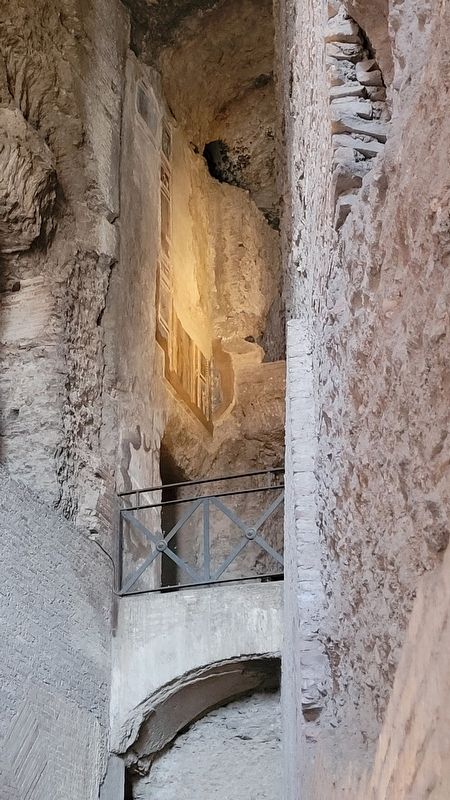
3. Closeup of the Paintings in the upper section
Topics. This historical marker is listed in these topic lists: Anthropology & Archaeology • Arts, Letters, Music.
Location. 41° 53.461′ N, 12° 29.182′ E. Marker is in Roma, Lazio (Latium, Rome), in Città metropolitana di Roma Capitale. It is in Rione X Campitelli. It is on Via dei Fori Imperiali. The marker is
Photographed by James Hulse, March 4, 2024
4. Closeup of the Paintings from the Marker

Regionally, it is in Europe, the European Union, the Schengen Area, a coastal Mediterranean country, and the Western World. Historically, it finds itself in what was once the Roman Empire.
Other nearby markers. At least 8 other markers are within walking distance of this marker: Decorazioni in Stucco / Stucco Decorations (here, next to this marker); Ponte di Caligola / Bridge of Caligula (a few steps from this marker); North Facade of the Domus Tiberiana (a few steps from this marker); Casa delle Vestali - Settore Sud-Est / House of the Vestals - Southeast Area (within shouting distance of this marker); La vista del Foro Romano / The view of the Roman Forum (within shouting distance of this marker); Atrium Vestae / Hall of Vesta (within shouting distance of this marker); Le Costruzioni di Caligola / Caligula's Constructions (within shouting distance of this marker); L'atrio Nel Medioevo / The Atrium in the Middle Ages (within shouting distance of this marker). Touch for a list and map of all markers in Roma.
More about this marker. The marker is located in the Parco Archeologico del Colosseo (Roman Forum Archaeological Park) and it does require an entry fee to visit.
Also see . . . Parco Archeologico del Colosseo. Roma Turismo (Submitted on January 25, 2025, by James Hulse of Medina, Texas.)
Credits. This page was last revised on January 25, 2025. It was originally submitted on January 25, 2025, by James Hulse of Medina, Texas. This page has been viewed 108 times since then and 12 times this year. Photos: 1, 2, 3, 4. submitted on January 25, 2025, by James Hulse of Medina, Texas.
