Rione X Campitelli in Roma in Città metropolitana di Roma Capitale, Latium, Rome, Italy — Central Italy (Tyrrhenian Coast)
Sostruzioni del Palazzo e Clivo della Vittoria
⎯⎯⎯
Palace Substructures and the Clivus Victoriae
Photographed by James Hulse, March 4, 2024
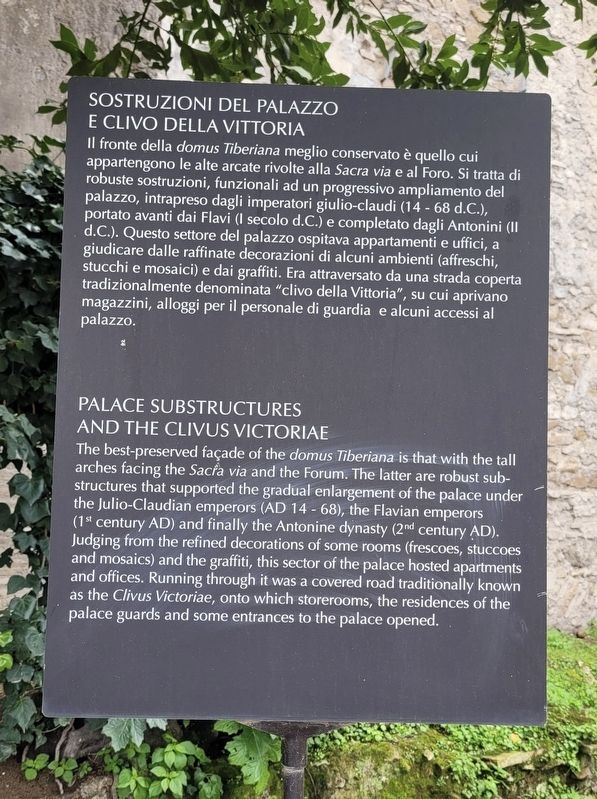
1. Sostruzioni del Palazzo e Clivo della Vittoria / Palace Substructures and the Clivus Victoriae Marke

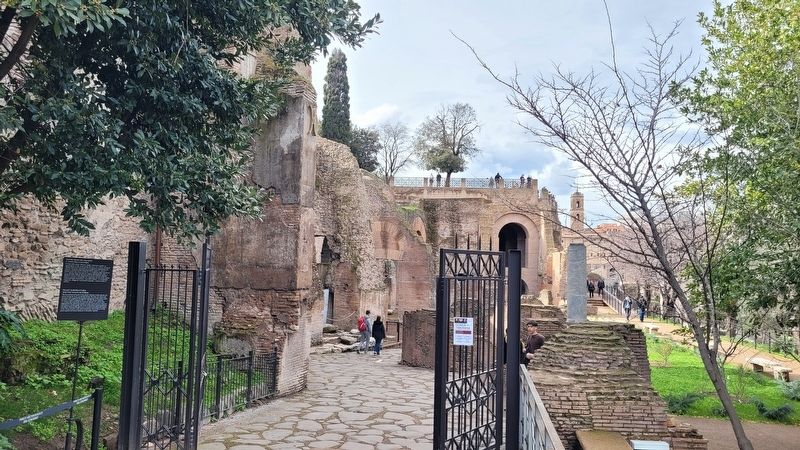
Il fronte della domus Tiberiana meglio conservato è quello cui appartengono le alte arcate rivolte alla Sacra via e al Foro. Si tratta di robuste sostruzioni, funzionali ad un progressivo ampliamento del palazzo, intrapreso dagli imperatori giulio-claudi (14 - 68 d.C.), portato avanti dai Flavi (I secolo d.C.) e completato dagli Antonini (II d.C.). Questo settore del palazzo ospitava appartamenti e uffici, a giudicare dalle raffinate decorazioni di alcuni ambienti (affreschi, stucchi e mosaici) e dai graffiti. Era attraversato da una strada coperta tradizionalmente denominata "clivo della Vittoria", su cui aprivano magazzini, alloggi per il personale di guardia e alcuni accessi al palazzo.
The best-preserved façade of the domus Tiberiana is that with the tall arches facing the Sacra via and the Forum. The latter are robust substructures that supported the gradual enlargement of the palace under the Julio-Claudian emperors (AD 14 - 68), the Flavian emperors (1st century AD) and finally the Antonine dynasty (2nd century AD). Judging from the refined decorations of some rooms (frescoes, stuccoes
this page online
Topics. This historical marker is listed in this topic list: Anthropology & Archaeology. A significant historical year for this entry is 14 CE.
Location. 41° 53.437′ N, 12° 29.228′ E. Marker is in Roma, Lazio (Latium, Rome), in Città metropolitana di Roma Capitale. It is in Rione X Campitelli. It is on Via dei Fori Imperiali. The marker is located in the Roman Forum at the Domus Tiberiana. Touch for map. Marker is in this post office area: Roma, Lazio 00186, Italy. Touch for directions.

Regionally, it is in Europe, the European Union, the Schengen Area, a coastal Mediterranean country, and the Western World. Historically, it finds itself in what was once the Roman Empire.
Other nearby markers. At least 8 other markers are within walking distance of this marker: Lontano da Roma: il declino degli Orti / Far from Rome: the decline of the Gardens (a few steps from this
Photographed by James Hulse, March 4, 2024
2. The Palace Substructures and Marker
More about this marker. The marker is located in the Parco Archeologico del Colosseo (Roman Forum Archaeological Park) and it does require an entry fee to visit.
Also see . . .
1. Roma Turismo. Parco Archeologico del Colosseo (Submitted on January 25, 2025, by James Hulse of Medina, Texas.)
2. Domus Tiberiana. Wikipedia
The Domus Tiberiana was an Imperial Roman palace in ancient Rome, located on the northwest corner of the Palatine Hill. It probably takes its name from a house built by the Emperor Tiberius, who is known to have lived on the Palatine, though no sources mention his having built a residence. It was enlarged by the successors to Tiberius, and would have been the principal Roman residence of Tiberius, Caligula, Claudius, and Nero during the early part of his reign. Relatively little is known of the structure archaeologically, since the Farnese Gardens have occupied the site of the main level since the 16th century, making excavation difficult.(Submitted on January 25, 2025, by James Hulse of Medina, Texas.)
Credits. This page was last revised on January 26, 2025. It was originally submitted on January 25, 2025, by James Hulse of Medina, Texas. This page has been viewed 122 times since then and 33 times this year. Photos: 1, 2. submitted on January 25, 2025, by James Hulse of Medina, Texas.
