Rione X Campitelli in Roma in Città metropolitana di Roma Capitale, Latium, Rome, Italy — Central Italy (Tyrrhenian Coast)
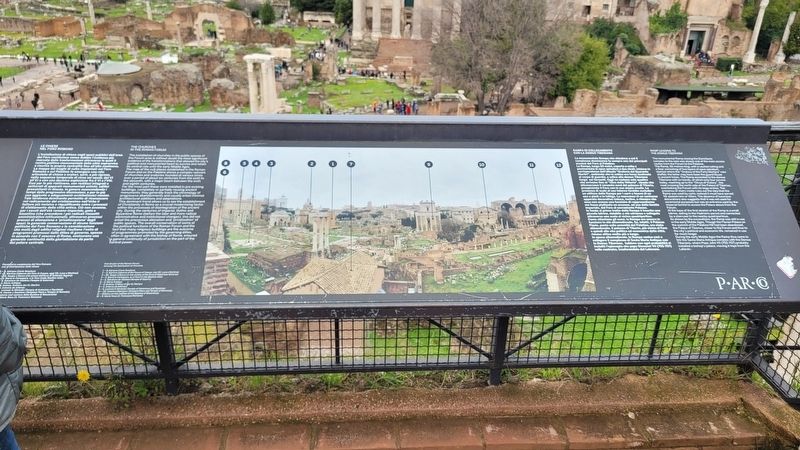
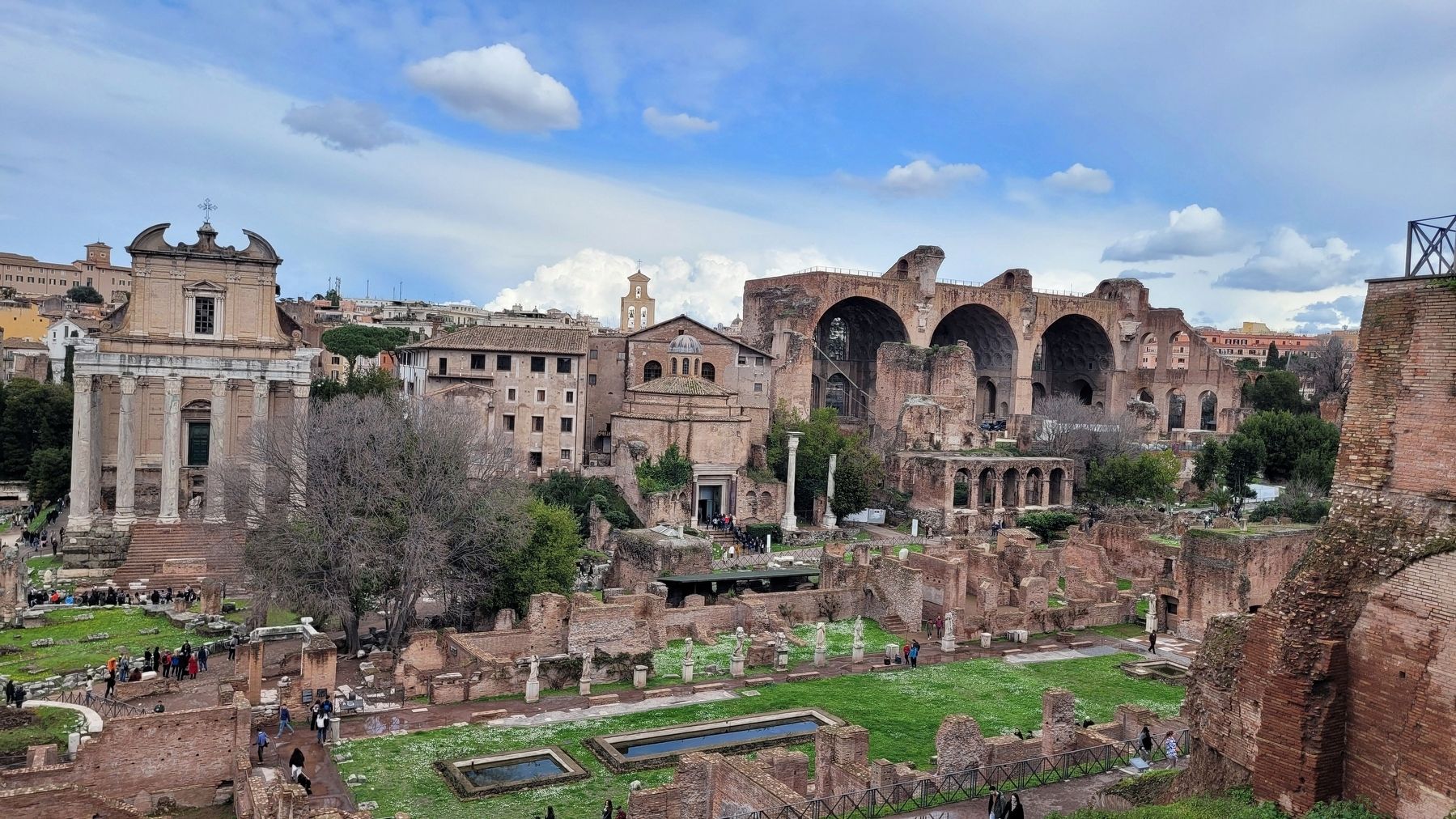
La vista del Foro Romano
⎯⎯⎯
The view of the Roman Forum
Photographed by James Hulse, March 4, 2024
1. La vista del Foro Romano / The view of the Roman Forum Marker

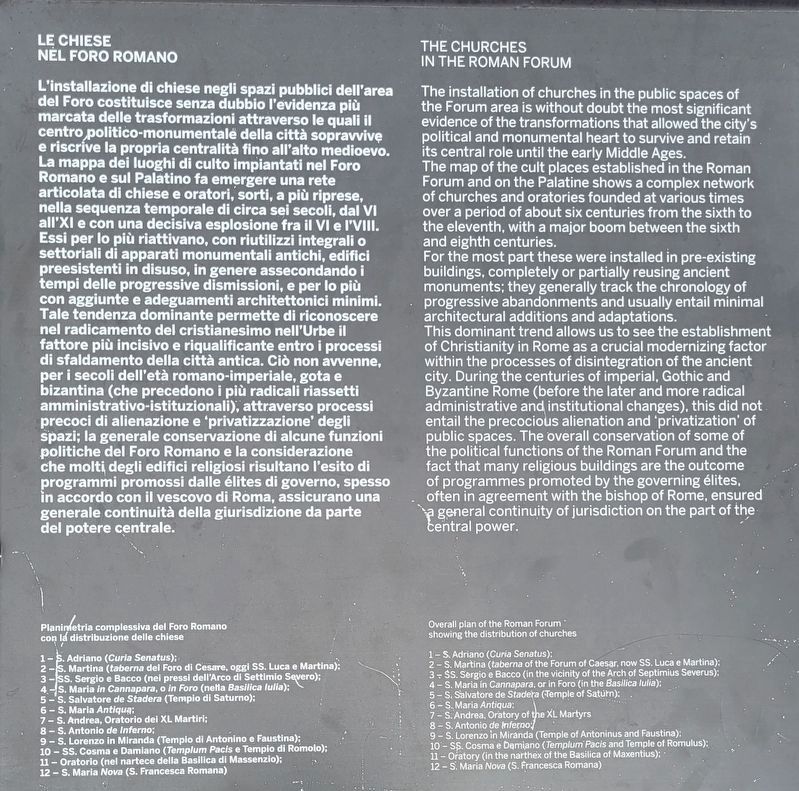
Le Chiese Nel Foro Romano
L'installazione di chiese negli spazi pubblici dell'area del Foro costituisce senza dubbio l'evidenza più marcata delle trasformazioni attraverso le quali il centro politico-monumentale della città sopravvive e riscrive la propria centralità fino all'alto medioevo. La mappa dei luoghi di culto impiantati nel Foro Romano e sul Palatino fa emergere una rete articolata di chiese e oratori, sorti, a più riprese, nella sequenza temporale di circa sei secoli, dal VI all'XI e con una decisiva esplosione fra il VI e I'VIII. Essi per lo più riattivano, con riutilizzi integrali o settoriali di apparati monumentali antichi, edifici preesistenti in disuso, in genere assecondando i tempi delle progressive dismissioni, e per lo più con aggiunte e adeguamenti architettonici minimi. Tale tendenza dominante permette di riconoscere nel radicamento del cristianesimo nell'Urbe il fattore più incisivo e riqualificante entro i processi di sfaldamento della città antica. Ciò non avvenne, per i secoli dell'età romano-imperiale, gota e bizantina (che precedono i più radicali riassetti amministrativo-istituzionali),
this page online
Planimetria complessiva del Foro Romano con la distribuzione delle chiese
1 - S. Adriano (Curia Senatus);
2 - S. Martina (taberna del Foro di Cesare, oggi SS. Luca e Martina);
3 - SS. Sergio e Bacco (nei pressi dell'Arco di Settimio Severo);
4 - S. Maria in Cannapara, o in Foro (nella Basilica lulia);
5 - S. Salvatore de Stadera (Tempio di Saturno);
6 - S. Maria Antiqua;
7 - S. Andrea, Oratorio dei XL Martiri;
8 - S. Antonio de Inferno;
9 - S. Lorenzo in Miranda (Tempio di Antonino e Faustina);
10 - SS. Cosma e Damiano (Templum Pacis e Tempio di Romolo);
11 - Oratorio (nel nartece della Basilica di Massenzio);
12 - S. Maria Nova (S. Francesca Romana)
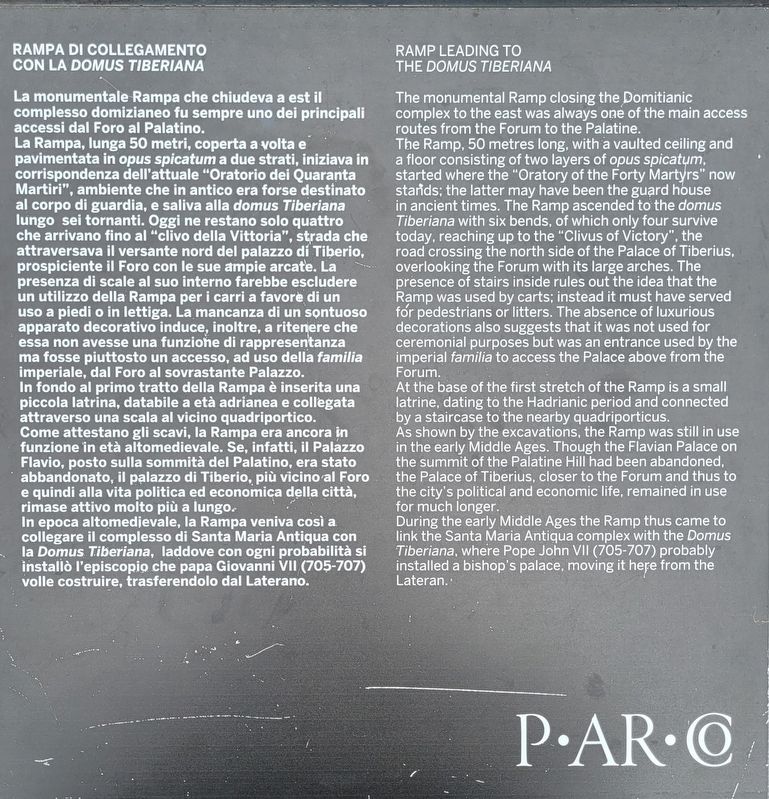
Rampa di Collegamento Con La Domus Tiberiana
La monumentale Rampa che chiudeva
Photographed by James Hulse, March 4, 2024
2. Closeup of the left side of the marker text
La Rampa, lunga 50 metri, coperta a volta e pavimentata in opus spicatum a due strati, iniziava in corrispondenza dell'attuale "Oratorio dei Quaranta Martiri", ambiente che in antico era forse destinato al corpo di guardia, e saliva alla domus Tiberiana lungo sei tornanti. Oggi ne restano solo quattro che arrivano fino al "clivo della Vittoria", strada che attraversava il versante nord del palazzo di Tiberio, prospiciente il Foro con le sue ampie arcate. La presenza di scale al suo interno farebbe escludere un utilizzo della Rampa per i carri a favore di un uso a piedi o in lettiga. La mancanza di un sontuoso apparato decorativo induce, inoltre, a ritenere che essa non avesse una funzione di rappresentanza ma fosse piuttosto un accesso, ad uso della familia imperiale, dal Foro al sovrastante Palazzo.
In fondo al primo tratto della Rampa è inserita una piccola latrina, databile a età adrianea e collegata attraverso una scala al vicino quadriportico. Come attestano gli scavi, la Rampa era ancora in funzione in età altomedievale. Se, infatti,
Photographed by James Hulse, March 4, 2024
3. Closeup of the right side of the marker text
In epoca altomedievale, la Rampa veniva così a collegare il complesso di Santa Maria Antiqua con la Domus Tiberiana, laddove con ogni probabilità si installò l'episcopio che papa Giovanni VII (705-707) volle costruire, trasferendolo dal Laterano.
The Churches in the Roman Forum
The installation of churches in the public spaces of the Forum area is without doubt the most significant evidence of the transformations that allowed the city's political and monumental heart to survive and retain its central role until the early Middle Ages.
The map of the cult places established in the Roman Forum and on the Palatine shows a complex network of churches and oratories founded at various times over a period of about six centuries from the sixth to the eleventh, with a major boom between the sixth and eighth centuries.
For the most part these were installed in pre-existing buildings, completely or partially reusing ancient
Photographed by James Hulse, March 4, 2024
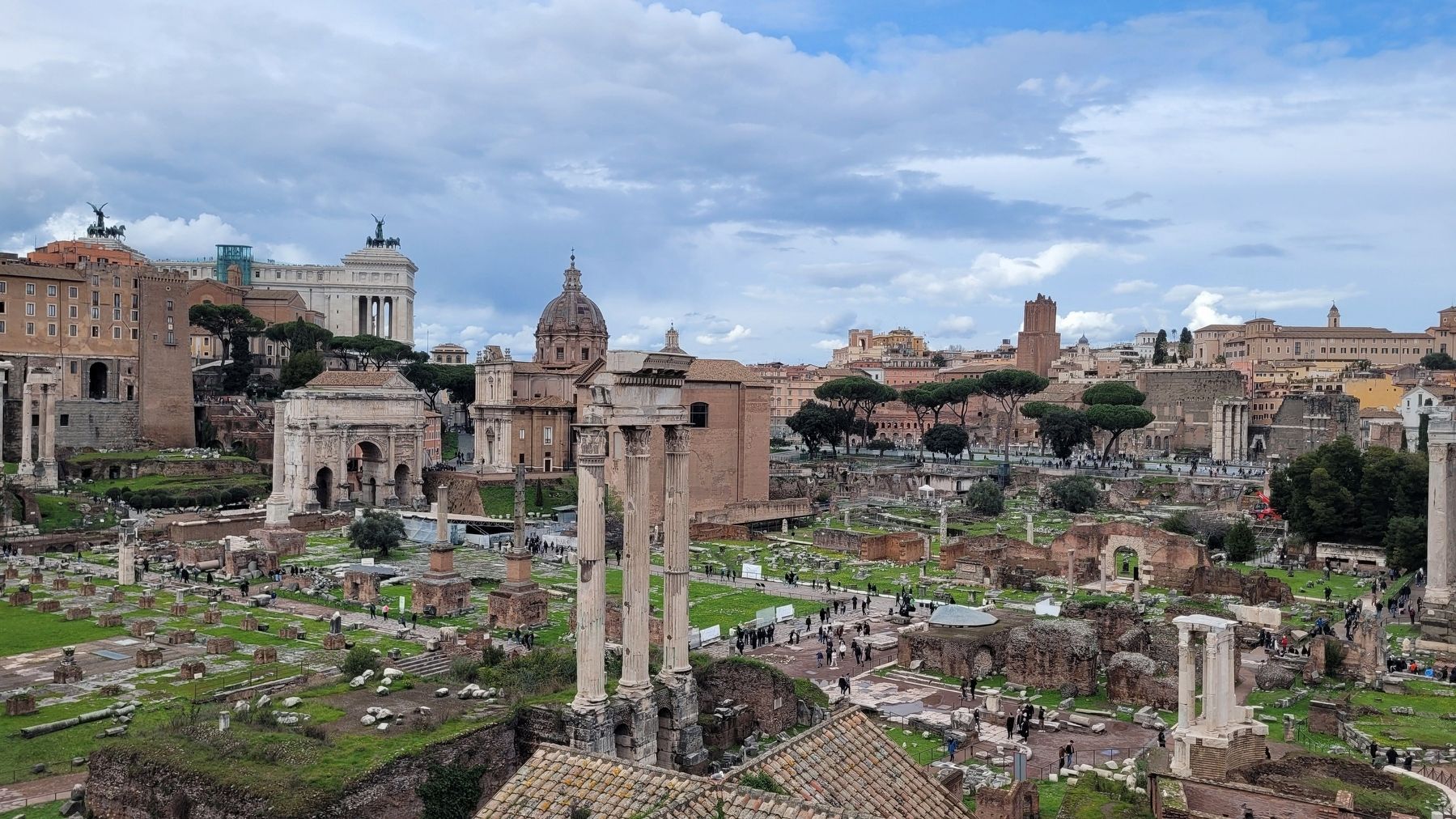
4. The view of the Roman Forum looking northwest at the marker
This dominant trend allows us to see the establishment of Christianity in Rome as a crucial modernizing factor within the processes of disintegration of the ancient city. During the centuries of imperial, Gothic and Byzantine Rome (before the later and more radical administrative and institutional changes), this did not entail the precocious alienation and 'privatization' of public spaces. The overall conservation of some of the political functions of the Roman Forum and the fact that many religious buildings are the outcome of programmes promoted by the governing élites, often in agreement with the bishop of Rome, ensured a general continuity of jurisdiction on the part of the central power.
Overall plan of the Roman Forum showing the distribution of churches
1 - S. Adriano (Curia Senatus);
2 - S. Martina (taberna of the Forum of Caesar, now SS. Luca e Martina);
3 - SS. Sergio e Bacco (in the vicinity of the Arch of Septimius Severus);
4 - S. Maria in Cannapara, or in Foro (in the Basilica lulia);
5 - S. Salvatore de Stadera (Temple of Saturn);
6 - S. Maria Antiqua;
7 - S. Andrea, Oratory of the XL Martyrs;
8 - S. Antonio de Inferno;
9 - S. Lorenzo in Miranda (Temple of Arntoninus and Faustina);
10 - SS. Cosma e Damiano (Templum Pacis and Temple of Romulus);
11 - Oratory (in the narthex of the Basilica of Maxentius);
12 - S. Maria Nova (S. Francesca Romana
Ramp Leading to the Domus Tiberiana
The
Photographed by James Hulse, March 4, 2024
5. The view of the Roman Forum looking northeast at the marker
The Ramp, 50 metres long, with a vaulted ceiling and a floor consisting of two layers of started where the "Oratory of the Forty Martyrs" now stands; the latter may have been the guard house in ancient times. The Ramp ascended to the domus Tiberiana with six bends, of which only four survive today, reaching up to the "Clivus of Victory", the road crossing the north side of the Palace of Tiberius, overlooking the Forum with its large arches. The presence of stairs inside rules out the idea that the Ramp was used by carts; instead it must have served for pedestrians or litters. The absence of luxurious decorations also suggests that it was not used for ceremonial purposes but was an entrance used by the imperial familia to access the Palace above from the Forum.
At the base of the first stretch of the Ramp is a small latrine, dating to the Hadrianic period and connected by a staircase to the nearby quadriporticus.
As shown by the excavations, the Ramp was still in use in the early Middle Ages. Though the Flavian Palace on the summit of the Palatine Hill had been abandoned, the Palace of Tiberius, closer to the Forum and thus to the city's political and economic life, remained in use for much longer.
During the early Middle Ages the Ramp thus came to link the Santa Maria Antiqua complex with the Domus Tiberiana, where Pope John VII (705-707) probably installed a bishop's palace, moving it here from the Lateran.
Erected by Parco.
Topics. This historical marker is listed in these topic lists: Anthropology & Archaeology • Religion & Religious Structures.
Location. 41° 53.476′ N, 12° 29.154′ E. Marker is in Roma, Lazio (Latium, Rome), in Città metropolitana di Roma Capitale. It is in Rione X Campitelli. It is on Via dei Fori Imperiali. The marker is located in the Roman Forum at an overlook. Touch for map. Marker is in this post office area: Roma, Lazio 00186, Italy. Touch for directions.

Regionally, it is in Europe, the European Union, the Schengen Area, a coastal Mediterranean country, and the Western World. Historically, it finds itself in what was once the Roman Empire.
Other nearby markers. At least 8 other markers are within walking distance of this marker: Le Costruzioni di Caligola / Caligula's Constructions (here, next to this marker); L'atrio Nel Medioevo / The Atrium in the Middle Ages (a few steps from this marker); Il Complesso Domizianeo / The Domitianic Complex (within shouting distance of this marker); Tempio dei Dioscuri / The Temple of the Dioscuri (within shouting distance of this marker); S. Maria Antiqua / Ancient Church of Saint Mary (within shouting distance of this marker); Atrium Vestae / Hall of Vesta (within shouting distance of this marker); Ponte di Caligola / Bridge of Caligula (within shouting distance of this marker); Decorazioni in Stucco / Stucco Decorations (within shouting distance of this marker). Touch for a list and map of all markers in Roma.
More about this marker. The marker is located in the Parco Archeologico del Colosseo (Roman Forum Archaeological Park) and it does require an entry fee to visit.
Also see . . . Roma Turismo. Parco Archeologico del Colosseo (Submitted on January 25, 2025, by James Hulse of Medina, Texas.)
Credits. This page was last revised on January 26, 2025. It was originally submitted on January 25, 2025, by James Hulse of Medina, Texas. This page has been viewed 142 times since then and 22 times this year. Photos: 1, 2, 3, 4, 5. submitted on January 26, 2025, by James Hulse of Medina, Texas.
