Rione X Campitelli in Roma in Città metropolitana di Roma Capitale, Latium, Rome, Italy — Central Italy (Tyrrhenian Coast)
Terme di Elagabalo
le trasformazioni tardoantiche
⎯⎯⎯
Baths of Elagabalus
late-antique changes

Photographed by James Hulse, March 4, 2024
1. Terme di Elagabalo / Baths of Elagabalus Marker

Nel IV secolo d.C. una parte dell'edificio severiano fu profondamente modificato. I vani più vicini all'Arco di Tito vengono occupati da un piccolo complesso termale. Alla zona riservata agli ambienti termali (caldarium, tepidarium, frigidarium) si affiancano tre ambienti disposti a croce intorno a una vasca quadrangolare, ricavati in parte nelle murature preesistenti. Il vano di fondo è costituito da una grande esedra semicircolare costruita ex novo in opera mista di laterizi e tufelli e dotata di un letto/divano in muratura a forma di C (stibadium), con una piccola vasca centrale. Si tratta di un tipo di struttura che caratterizza molti ambienti conviviali di età tardoantica. L'insieme architettonico è da interpretare come una sala per banchetti (cenatio) aperta sul cortile con una trifora scandita da due colonne in cipollino. La decorazione parietale e pavimentale era in marmo bianco. Al momento della cena, l'acqua doveva riempire la vasca e il semicerchio intorno allo stibadium, dando agli ospiti l'impressione di trovarsi al centro di un lago.
Il cortile, pavimentato da un mosaico a grosse tessere bianche, viene trasformato in zona di passeggio, con un portico e con vasche, fontane e aiuole. Un altro piccolo ninfeo semicircolare chiude scenograficamente questo spazio aperto.
La funzione di questo straordinario insieme architettonico, che vive con qualche modifica fino al VI secolo d.C., non è chiara. Certamente si tratta di un complesso importante da interpretare, piuttosto che come una domus, come sede di un'associazione di natura civile o militare in continuità con l'edificio precedente o come luogo di prima accoglienza per personaggi di grande rilievo, forse in attesa di essere ricevuti a Palazzo (deversorium, hospitium). Un collegamento con il Palazzo si desumerebbe dalla sua
this page online
Il restauro ha inteso restituire proprio la fase edilizia di età tardoantica, in quanto ben conservata e fruibile.
Didascalie
(Foto #1) Ortofoto dell'area con sovrapposizione in degli interventi del IV secolo d.C. realizzati all'interno dell'edificio severiano (in grigio), che continua ad essere in uso
(Foto #2) Le strutture del IV secolo nell'ala occidentale delle "Terme di Elagabalo: cenatio, stibadium e boineum. La calcara (fornace per calce) è di età medievale
In the 4th century AD a part of the Severan building was profoundly modified. The rooms closest to the Arch of Titus were occupied by a small thermal bath. In the area assigned to its various chambers (caldarium, tepidarium, frigidarium) there are three rooms arranged in a cross-shaped pattern around a quadrangular basin, partly set in the pre-existing walls. The end chamber consists of a large semicircular exedra built from the ground up in opus mixtum of brick and stonework and endowed with a C-shaped masonry bed (stibadium). On the whole this was a banquet
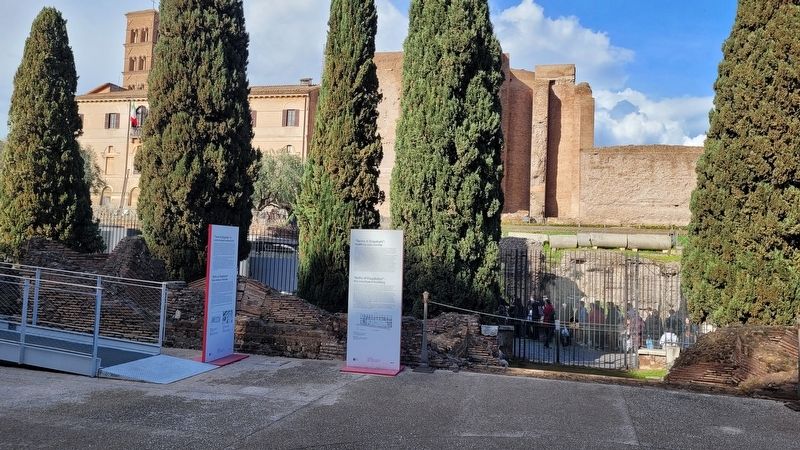
Photographed by James Hulse, March 4, 2024
2. Terme di Elagabalo / Baths of Elagabalus Marker
The marker is left marker of the two markers.
The courtyard, paved with mosaic, laid with large white tesserae, was transformed into a area for walking, with a portico and pools, fountains and flowerbeds. Another small semi-circular nymphaeum screened this open space scenically.
The function of this extraordinary architectural ensemble, which was used with some changes until the 6th century AD, is unclear. Certainly it is an important complex to be interpreted not so much as a domus, as the meeting hall of a collegium of civil or military nature (schola), or as a place for the first reception of those who visited the Palace (deversorium, hospitium). A connection with the Palace can be suggested from its position, from the luxury and the scenographic framework in which the convivial rites were to take place.
The present restoration intends to exploit the phase of the late Antiquity, as it

Photographed by James Hulse, March 4, 2024
3. Two white marble columns supported a large banquet room
Captions
(Photo #1) Orthophoto of the area with superimposed in red the additions dating from the 6th century AD inside the Severan building (in grey), which continued in use
(Photo #2) Structures from the 4th century in the west wing of the "Baths of Elagabalus": cenotio, stibadium and balneum. The limekiln dates from the Middle Ages
Erected by Parco Archeologico del Colosseo.
Topics. This historical marker is listed in this topic list: Anthropology & Archaeology.
Location. 41° 53.419′ N, 12° 29.364′ E. Marker is in Roma, Lazio (Latium, Rome), in Città metropolitana di Roma Capitale. It is in Rione X Campitelli. It is on Via dei Fori Imperiali. The marker is located in the Roman Forum. Touch for map. Marker is in this post office area: Roma, Lazio 00186, Italy. Touch for directions.

Regionally, it is in Europe, the European Union, the Schengen Area, a coastal Mediterranean country, and the Western World. Historically, it finds itself in what was once the Roman Empire.
Other nearby markers. At least 8 other markers are within walking distance of this marker: A different marker also named Terme di Elagabalo / Baths of Elagabalus (here, next to this marker); a different marker also named Terme di Elagabalo / Baths of Elagabalus (a few steps from this marker); a different marker also named Terme di Elagabalo / Baths of Elagabalus (a few steps from this marker); Sostruzioni della Terrazza di Vigna Barberini / Substructures of the Barberini Vineyard Terrace (a few steps from this marker); Arco di Tito / Arch of Titus (within shouting distance of this marker); Veduta Dell'arco di Tito / View of the Arch of Titus (within shouting distance of this marker); Podio di un Tempio / Podium of a Temple (within shouting distance of this marker); Arch of Titus / Arco di Tito (within shouting distance of this marker). Touch for a list and map of all markers in Roma.
More about this marker. The marker is located in the Parco Archeologico del Colosseo (Roman Forum Archaeological Park) and it does require an entry fee to visit.
Also see . . . Roma Turismo. Parco Archeologico del Colosseo (Submitted on January 26, 2025, by James Hulse of Medina, Texas.)
Credits. This page was last revised on January 27, 2025. It was originally submitted on January 26, 2025, by James Hulse of Medina, Texas. This page has been viewed 114 times since then and 21 times this year. Photos: 1, 2, 3. submitted on January 27, 2025, by James Hulse of Medina, Texas.
