Rione X Campitelli in Roma in Città metropolitana di Roma Capitale, Latium, Rome, Italy — Central Italy (Tyrrhenian Coast)
Terme di Elagabalo
le preesistenze
⎯⎯⎯
Baths of Elagabalus
the pre-existent structures

Photographed by James Hulse, March 4, 2024
1. Terme di Elagabalo / Baths of Elagabalus Marker

Il nome "Terme di Elagabalo" attribuito all'edificio deriva dalla confusione tra una notizia delle fonti scritte, che attribuivano a questo imperatore (218-222 d.C.) un "lavacrum publicum [...] in aedibus aulicis", e il ritrovamento negli sterri dell'Ottocento, nella zona più vicina all'Arco di Tito, di un piccolo impianto termale. In realtà il balneum appartiene a un intervento del IV secolo d.C., mentre la costruzione in laterizio che lo accoglie è attribuibile all'attività edilizia di Settimio Severo (193-211 d.C.) e Caracalla (211-217 d.C.).
Le indagini, iniziate nel 2007, hanno consentito di ricostruire sia le diverse fasi dell'edificio dall'età imperiale fino al periodo tardoantico, sia la complessa maglia insediativa dell'area nelle epoche precedenti. Per quanto riguarda queste ultime sono emersi: 1) un abitato capannicolo dell'età del ferro (IX-VIII secolo a.C.); 2) pozzi per acqua di età arcaica e repubblicana (VI-IV secolo a.C.), che indicano un tipo d'insediamento più strutturato; 3) tre isolati abitativi che occupano, dal IV-II secolo a.C. all'età giulio-claudia, tutta la pendice della collina sino all'Arco di Tito, all'interno dei quali spicca una casa (domus) riccamente decorata; 4) le tracce della distruzione totale di questi edifici causata dall'incendio del 64 d.C.; 5) i resti della via porticata della reggia neroniana (Domus Aurea), successiva all'incendio; 6) un grande edificio di età adrianea (123-138 d.C.), che occupa tutto l'isolato, identificato come magazzino (horreum).
Didascalie
(Foto #1) Ortofoto dell'area con sovrapposizione in giallo delle strutture di età tardo repubblicana e giulio-claudia; in azzurro le fogne
(Foto #2) Ortofoto dell'area con sovrapposizione in giallo dell'edificio adrianeo (horreum) e degli ambienti di sostruzione della terrazza della Vigna Barberini; in azzurro la rete fognaria
The
this page online
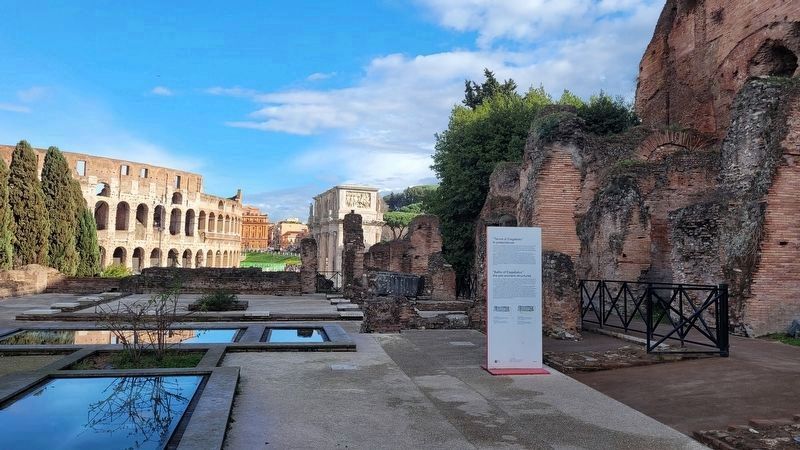
Photographed by James Hulse, March 4, 2024
2. Terme di Elagabalo / Baths of Elagabalus Marker
The view of the Colosseum and Arch of Constantine in the background
Captions
(Photo #1) Orthophoto of the area, with superimposed in yellow the structures dating from the late Republican and Julio-Claudian period; in blue the drains
(Photo #2) Orthophoto of the area with superimposed in yellow Hadrian's building (horreum) and the substructure of the terrace of the Vigna Barberini; in blue the drains
Erected by Parco Archeologico del Colosseo.
Topics. This historical marker is listed in this topic list: Anthropology & Archaeology. A significant historical year for this entry is 2007.
Location. 41° 53.412′ N, 12° 29.368′ E. Marker is in Roma, Lazio (Latium, Rome), in Città metropolitana di Roma Capitale. It is in Rione X Campitelli. It is on Via dei Fori Imperiali. The marker is located in the Roman Forum. Touch for map. Marker is in this post office area: Roma, Lazio 00186, Italy. Touch for directions.

Regionally, it is in Europe, the European Union, the Schengen Area, a coastal Mediterranean country, and the Western World. Historically, it finds itself in what was once the Roman Empire.
Other nearby markers. At least 8 other markers are within walking distance of this marker: A different marker also named Terme di Elagabalo / Baths of Elagabalus (a few steps from this marker); Sostruzioni della Terrazza di Vigna Barberini / Substructures of the Barberini Vineyard Terrace (a few steps from this marker); a different marker also named Terme di Elagabalo / Baths of Elagabalus (a few steps from this marker); a different marker also named Terme di Elagabalo / Baths of Elagabalus (a few steps from this marker); Dell'Arco di Costantino e dell'Anfiteatro Flavio / The Arch of Constantine and Flavian Amphitheater (within shouting distance of this marker); Arco di Tito / Arch of Titus (within shouting distance of this marker); Veduta Dell'arco di Tito / View of the Arch of Titus (within shouting distance of this marker); Podio di un Tempio / Podium of a Temple (within shouting distance of this marker). Touch for a list and map of all markers in Roma.
More about this marker. The marker is located in the Parco Archeologico del Colosseo (Roman Forum Archaeological Park) and it does require an entry fee to visit.
Also see . . . Roma Turismo. Parco Archeologico del Colosseo (Submitted on January 26, 2025, by James Hulse of Medina, Texas.)
Credits. This page was last revised on January 27, 2025. It was originally submitted on January 26, 2025, by James Hulse of Medina, Texas. This page has been viewed 158 times since then and 37 times this year. Photos: 1, 2. submitted on January 27, 2025, by James Hulse of Medina, Texas.
