Rione X Campitelli in Roma in Città metropolitana di Roma Capitale, Latium, Rome, Italy — Central Italy (Tyrrhenian Coast)
La Casa delle Vestali
⎯⎯⎯
The House of the Vestals
Photographed by James Hulse, March 4, 2024
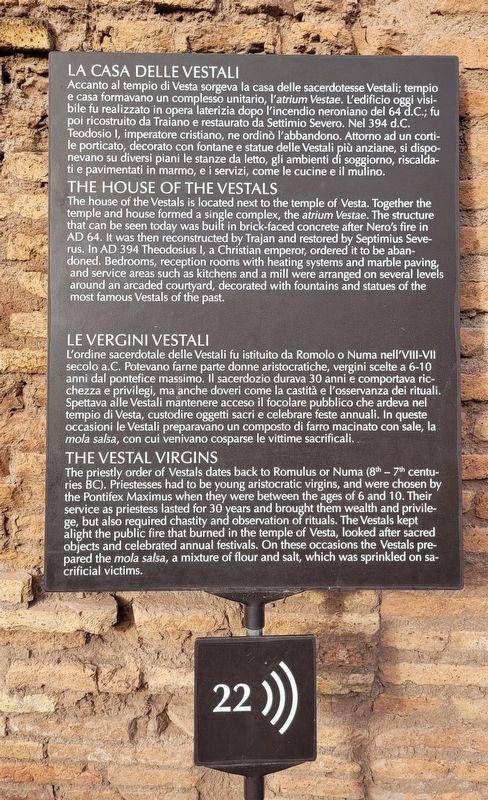
1. La Casa delle Vestali / The House of the Vestals Marker

La Casa delle Vestali
Accanto al tempio di Vesta sorgeva la casa delle sacerdotesse Vestali; tempio e casa formavano un complesso unitario, l'atrium Vestae. L'edificio oggi visibile fu realizzato in opera laterizia dopo l'incendio neroniano del 64 d.C.; fu poi ricostruito da Traiano e restaurato da Settimio Severo. Nel 394 d.C. Teodosio I, imperatore cristiano, ne ordinò l'abbandono. Attorno ad un cortile porticato, decorato con fontane e statue delle Vestali più anziane, si disponevano su diversi piani le stanze da letto, gli ambienti di soggiorno, riscaldati e pavimentati in marmo, e i servizi, come le cucine e il mulino.
Le Vergini Vestali
L'ordine sacerdotale delle Vestali fu istituito da Romolo o Numa nell'VIII-VII secolo a.C. Potevano farne parte donne aristocratiche, vergini scelte a 6-10 anni dal pontefice massimo. Il sacerdozio durava 30 anni e comportava ricchezza e privilegi, ma anche doveri come la castità e l'osservanza dei rituali. Spettava alle Vestali mantenere acceso il focolare pubblico che ardeva nel tempio di Vesta, custodire oggetti sacri e celebrare feste annuali. In queste occasioni le Vestali preparavano un composto di farro macinato con sale, la mola salsa, con cui venivano cosparse le vittime sacrificali.
The House of the Vestals
The house of the Vestals is located next to the temple of Vesta. Together the temple and house formed a single complex, the atrium Vestae. The structure that can be seen today was built in brick-faced concrete after Nero's fire in AD 64. It was then reconstructed by Trajan and restored by Septimius Severus. In AD 394 Theodosius I, a Christian emperor, ordered it to be abandoned. Bedrooms, reception rooms with heating systems and marble paving, and service areas such as kitchens and a mill were arranged on several levels
this page online
The Vestal Virgins
The priestly order of Vestals dates back to Romulus or Numa (8th - 7th centuries BC). Priestesses had to be young aristocratic virgins, and were chosen by the Pontifex Maximus when they were between the ages of 6 and 10. Their service as priestess lasted for 30 years and brought them wealth and privilege, but also required chastity and observation of rituals. The Vestals kept alight the public fire that burned in the temple of Vesta, looked after sacred objects and celebrated annual festivals. On these occasions the Vestals prepared the mola salsa, a mixture of flour and salt, which was sprinkled on sacrificial victims.
Erected by Parco. (Marker Number 22.)
Topics. This historical marker is listed in this topic list: Anthropology & Archaeology.
Location. 41° 53.497′ N, 12° 29.182′ E. Marker is in Roma, Lazio (Latium, Rome), in Città metropolitana di Roma Capitale. It is in Rione X Campitelli. It is on Via dei Fori Imperiali. The marker is located in
Photographed by James Hulse, March 4, 2024
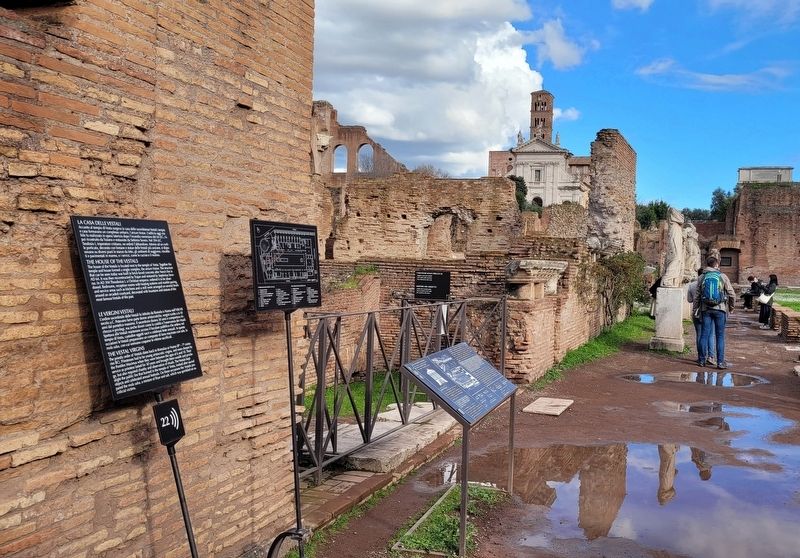
2. La Casa delle Vestali / The House of the Vestals Marker
The marker is located at the far left of the group of markers.

Regionally, it is in Europe, the European Union, the Schengen Area, a coastal Mediterranean country, and the Western World. Historically, it finds itself in what was once the Roman Empire.
Other nearby markers. At least 8 other markers are within walking distance of this marker: Via Sacra: Il Fuoco di Vesta / Via Sacra: the Fire of Vesta (here, next to this marker); La Casa delle Vestali prima del 64 d.C. / The House of the Vestals before 64 A.D. (a few steps from this marker); Tempio di Vesta / Temple of Vesta (a few steps from this marker); Aedes Vestae / Temple of Vesta (a few steps from this marker); Atrium Vestae / Hall of Vesta (a few steps from this marker); Regia (within shouting distance of this marker); Via Sacra: Il Tempo Che Scorre / Via Sacra: the Passage of Time (within shouting distance of this marker); Archaic Burial Ground / Sepolcreto Arcaico (within shouting distance of this marker). Touch for a list and map of all markers in Roma.
More about this marker. The marker is located in the Parco

Photographed by James Hulse, March 4, 2024
3. The location of the House of the Vestals and courtyard
Also see . . .
1. Roma Turismo. Parco Archeologico del Colosseo (Submitted on January 27, 2025, by James Hulse of Medina, Texas.)
2. Vestal Virgin. Wikipedia
The Vestals were unlike any other public priesthood. They were chosen before puberty from several suitable candidates, freed from any legal ties and obligations to their birth family, and enrolled in Vesta's priestly college of six priestesses. They were supervised by a senior vestal but chosen and governed by Rome's leading male priest, the pontifex maximus; in the Imperial era, this meant the emperor.(Submitted on January 27, 2025, by James Hulse of Medina, Texas.)
Credits. This page was last revised on January 27, 2025. It was originally submitted on January 27, 2025, by James Hulse of Medina, Texas. This page has been viewed 173 times since then and 40 times this year. Photos: 1, 2, 3. submitted on January 27, 2025, by James Hulse of Medina, Texas.
