Rione X Campitelli in Roma in Città metropolitana di Roma Capitale, Latium, Rome, Italy — Central Italy (Tyrrhenian Coast)
Casa delle Vestali - Settore Sud-Est
⎯⎯⎯
House of the Vestals - Southeast Area

Photographed by James Hulse, March 4, 2024
1. Casa delle Vestali - Settore Sud-Est / House of the Vestals - Southeast Area Marker

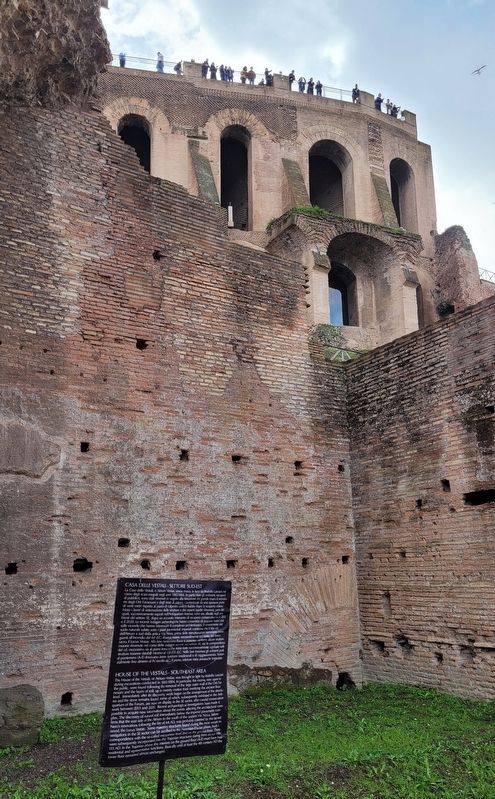
La Casa delle Vestali, o Atrium Vestae, venne messa in luce da Rodolfo Lanciani nel corso degli scavi eseguiti negli anni 1882-1884. In particolare gli ambienti, ora aperti al pubblico, sono stati rinvenuti in seguito alla rimozione del grande muro di recinzione degli Orti Farnesiani e degli strati di interro, caratterizzati da uno spessore anche di venti metri rispetto al piano di calpestio antico. Subito dopo la scoperta ebbero inizio i lavori di sistemazione delle strutture e dei reperti lapidei rinvenuti, parte dei quali, successivamente esposti nell'Antiquarium forense, sono ora allestiti negli ambienti del settore SE, dopo un accurato intervento di recupero conservativo tra il 2013 e il 2020. Le recenti indagini archeologiche hanno consentito di acquisire nuovi dati sulle vicende che hanno interessato il complesso architettonico. Il rinvenimento del suolo naturale subito sotto i piani pavimentali imperiali conferma che il lato est dell'Atrium a sud della antica Via Nova, prima delle ristrutturazioni neroniane conseguenti all'incendio del 64 d.C, doveva essere verosimilmente occupato dal bosco sacro,
this page online
The House of the Vestals, or Atrium Vestae, was brought to light by Rodolfo Lanciani during excavations conducted in 1882-1884. In particular, the rooms, now open to the public, were found following the removal of the large outer wall of the Orti Farnesiani and the layers of soil, up to twenty meters thick overlying the ancient floor level. Immediately after its discovery, work began on the arrangement of the structures and the stone remains found, some of which, subsequently exhibited in the Antiquarium of the Forum, are now on display in the SE sector, after careful conservation work between 2013 and 2020. Recent
Photographed by James Hulse, March 4, 2024
2. Casa delle Vestali - Settore Sud-Est / House of the Vestals - Southeast Area Marker
The Palatine Belvedere Terrace lookout is located in the background
Topics. This historical marker is listed in this topic list: Anthropology & Archaeology. A significant historical year for this entry is 1882.
Location. 41° 53.473′ N, 12° 29.204′ E. Marker is in Roma, Lazio (Latium, Rome), in Città metropolitana

Photographed by James Hulse, March 4, 2024
3. Casa delle Vestali - Settore Sud-Est / House of the Vestals - Southeast Area Marker

Regionally, it is in Europe, the European Union, the Schengen Area, a coastal Mediterranean country, and the Western World. Historically, it finds itself in what was once the Roman Empire.
Other nearby markers. At least 8 other markers are within walking distance of this marker: North Facade of the Domus Tiberiana (a few steps from this marker); Pitture / Paintings (within shouting distance of this marker); Decorazioni in Stucco / Stucco Decorations (within shouting distance of this marker); Ponte di Caligola / Bridge of Caligula (within shouting distance of this marker); Atrium Vestae / Hall of Vesta (within shouting distance of this marker); La Casa delle Vestali prima del 64 d.C. / The House of the Vestals before 64 A.D. (within shouting distance of this marker); Via Sacra: Il Fuoco di Vesta / Via Sacra: the Fire of Vesta (within shouting distance of this marker); La Casa delle Vestali / The House of the Vestals
Photographed by James Hulse, March 4, 2024
4. House of the Vestals - Southeast Area
More about this marker. The marker is located in the Parco Archeologico del Colosseo (Roman Forum Archaeological Park) and it does require an entry fee to visit.
Also see . . .
1. Roma Turismo. Parco Archeologico del Colosseo (Submitted on January 27, 2025, by James Hulse of Medina, Texas.)
2. House of the Vestals. Wikipedia
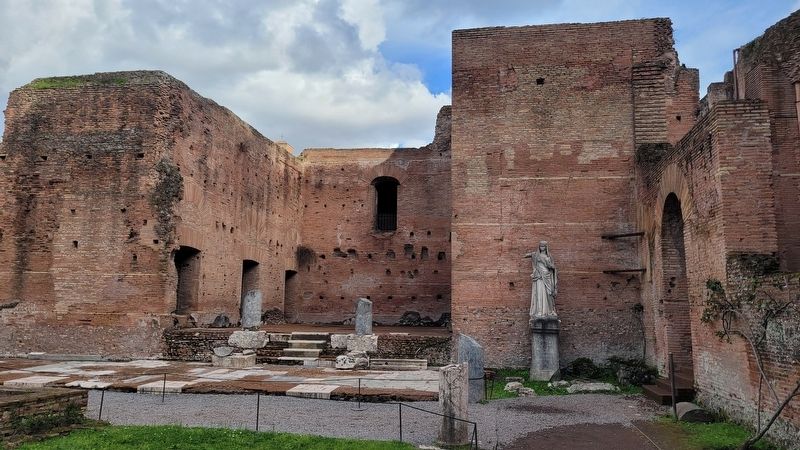
The House of the Vestal Virgins (Latin: Atrium Vestae; Italian: Casa delle Vestali) was the residence of Vestal Virgins, located behind the circular Temple of Vesta at the eastern edge of the Roman Forum, between the Regia and the Palatine Hill. The domus publica, where the Pontifex Maximus dwelled, was located near the Atrium until that role was assumed by the emperors.(Submitted on January 28, 2025, by James Hulse of Medina, Texas.)
Credits. This page was last revised on January 28, 2025. It was originally submitted on January 27, 2025, by James Hulse of Medina, Texas. This page has been viewed 119 times since then and 30 times this year. Photos: 1, 2, 3, 4. submitted on January 28, 2025, by James Hulse of Medina, Texas.
