San Saba in Roma in Città metropolitana di Roma Capitale, Latium, Rome, Italy — Central Italy (Tyrrhenian Coast)
La Storia e il Contesto Urbano
⎯⎯⎯
The History of the Site and the Urban Context
Photographed by James Hulse, February 27, 2024
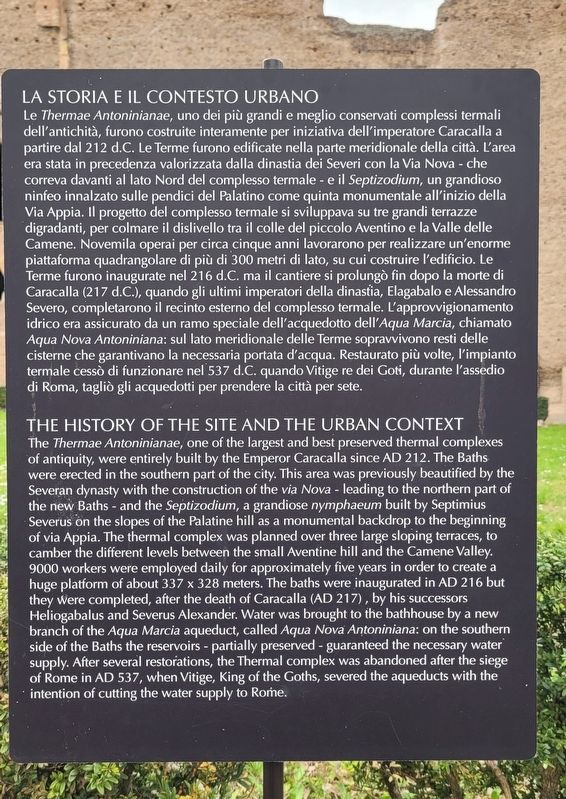
1. La Storia e il Contesto Urbano / The History of the Site and the Urban Context Marker

Le Thermae Antoninianae, uno dei più grandi e meglio conservati complessi termali dell'antichità, furono costruite interamente per iniziativa dell'imperatore Caracalla a partire dal 212 d.C. Le Terme furono edificate nella parte meridionale della città. L'area era stata in precedenza valorizzata dalla dinastia dei Severi con la Via Nova - che correva davanti al lato Nord del complesso termale - e il Septizodium, un grandioso ninfeo innalzato sulle pendici del Palatino come quinta monumentale all'inizio della Via Appia. Il progetto del complesso termale si sviluppava su tre grandi terrazze digradanti, per colmare il dislivello tra il colle del piccolo Aventino e la Valle delle Camene. Novemila operai per circa cinque anni lavorarono per realizzare un'enorme piattaforma quadrangolare di più di 300 metri di lato, su cui costruire l'edificio. Le Terme furono inaugurate nel 216 d.C. ma il cantiere si prolungò fin dopo la morte di Caracalla (217 d.C.), quando gli ultimi imperatori della dinastia, Elagabalo e Alessandro Severo, completarono il recinto esterno del complesso termale. L'approvvigionamento idrico
this page online
The Thermae Antoninianae, one of the largest and best preserved thermal complexes of antiquity, were entirely built by the Emperor Caracalla since AD 212. The Baths were erected in the southern part of the city. This area was previously beautified by the Severan dynasty with the construction of the via Nova - leading to the northern part of the new Baths - and the Septizodium, a grandiose nymphaeum built by Septimius Severus on the slopes of the Palatine hill as a monumental backdrop to the beginning of via Appia. The thermal complex was planned over three large sloping terraces, to camber the different levels between the small Aventine hill and the Camene Valley. 9000 workers were employed daily for approximately five years in order
Photographed by James Hulse, February 27, 2024
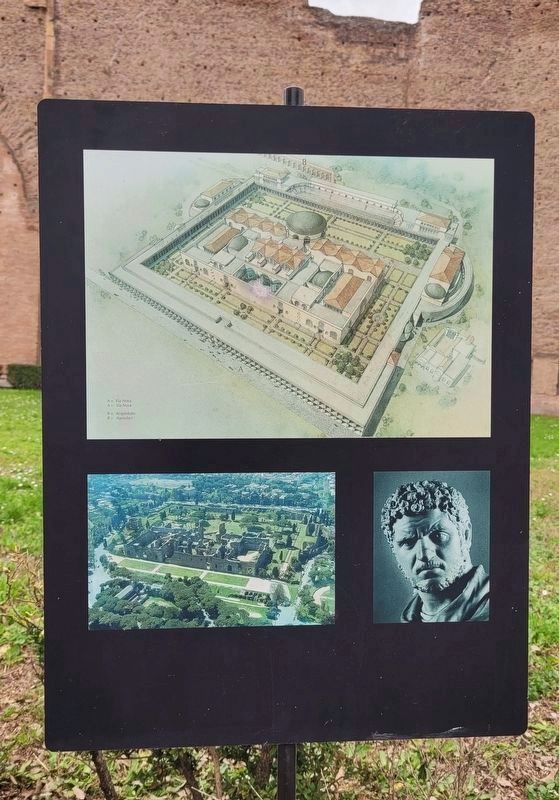
2. La Storia e il Contesto Urbano / The History of the Site and the Urban Context Marker
The diagrams on the plaque next to the marker include a drawing of original view of the Baths and a portrait of Caracalla.
Topics. This historical marker is listed in this topic list: Anthropology & Archaeology. A significant historical year for this entry is 212 CE.
Location. 41° 52.824′ N, 12° 29.524′ E. Marker is in Roma, Lazio (Latium, Rome), in Città metropolitana di Roma Capitale. It is in San Saba. It is at the intersection of Viale delle Terme di Caracalla and Via Antonina on Viale delle Terme di Caracalla. The marker is located on the grounds to the Baths of Caracalla. Touch for map. Marker is in this post office area: Roma,
Photographed by James Hulse, February 27, 2024
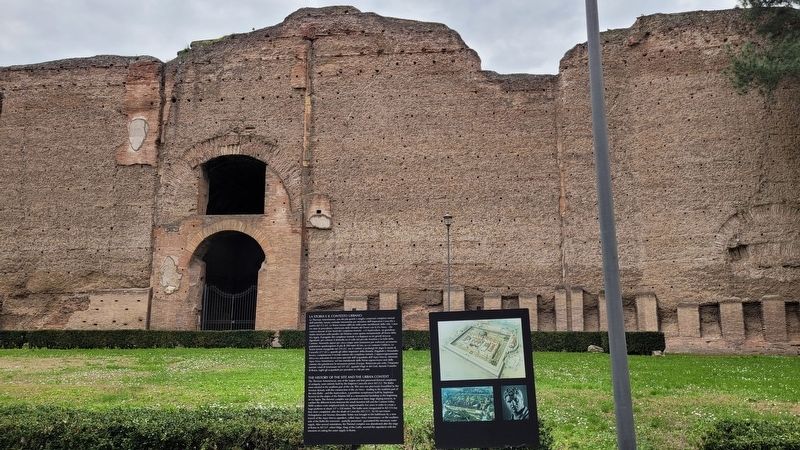
3. The view of the markers in front of the Baths of Caracalla from the outer courtyard

Regionally, it is in Europe, the European Union, the Schengen Area, a coastal Mediterranean country, and the Western World. Historically, it finds itself in what was once the Roman Empire.
Other nearby markers. At least 8 other markers are within walking distance of this marker: I Percorsi, I Sotterranei, Gli Impianti Idraulici (here, next to this marker); Le Decorazioni e le Opere D'arte / The Decorations and Works of Art (a few steps from this marker); Terme di Caracalla - Rovine Attuali / Caracalla`s Baths - Actual Ruins (within shouting distance of this marker); Terme di Caracalla - Ricostruzione / Caracalla`s Baths - Reconstruction (within shouting distance of this marker); Palestra Occidentale / Western Gym (within shouting distance of this marker); Le Murature Romane / Roman Walls (about 90 meters away, measured in a direct line); Tabula Lusoria / Game Board (about 120 meters away); La Natatio E I Giochi / Swimming Pools and Games (about 120 meters away). Touch for a list and map of all markers in Roma.
More about this marker. There is a small entry fee to visit the Baths
Photographed by James Hulse, February 27, 2024
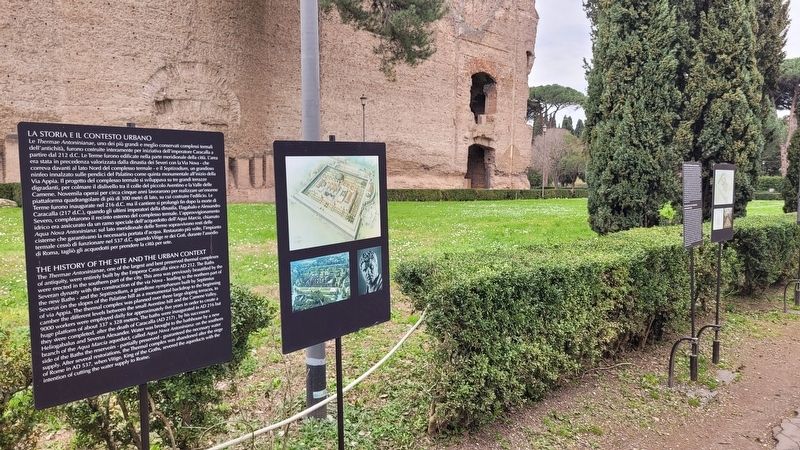
4. The view of the markers along the pathway
Also see . . . Baths of Caracalla. Wikipedia
The Baths of Caracalla (Italian: Terme di Caracalla) in Rome, Italy, were the city's second largest Roman public baths, or thermae, after the Baths of Diocletian. The baths were likely built between AD 212 (or 211) and 216/217, during the reigns of emperors Septimius Severus and Caracalla. They were in operation until the 530s and then fell into disuse and ruin.(Submitted on January 28, 2025, by James Hulse of Medina, Texas.)
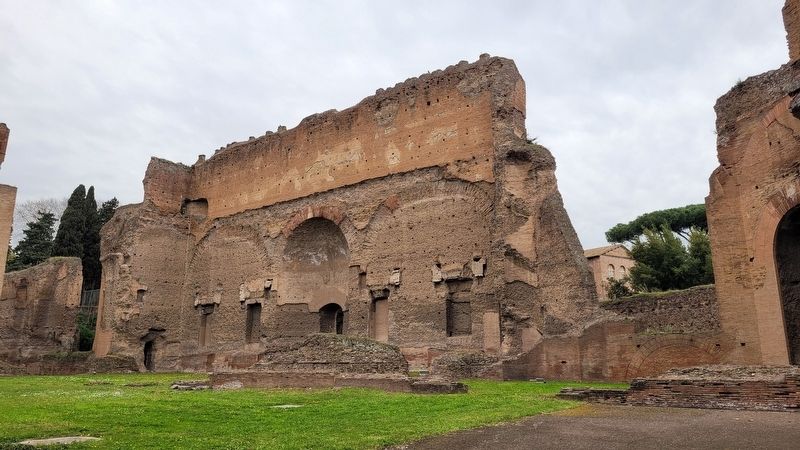
Photographed by James Hulse, February 27, 2024
5. A view of one of the large walls surrounding the Baths of Caracalla
Credits. This page was last revised on January 29, 2025. It was originally submitted on January 28, 2025, by James Hulse of Medina, Texas. This page has been viewed 100 times since then and 12 times this year. Photos: 1, 2, 3, 4, 5. submitted on January 29, 2025, by James Hulse of Medina, Texas.
